

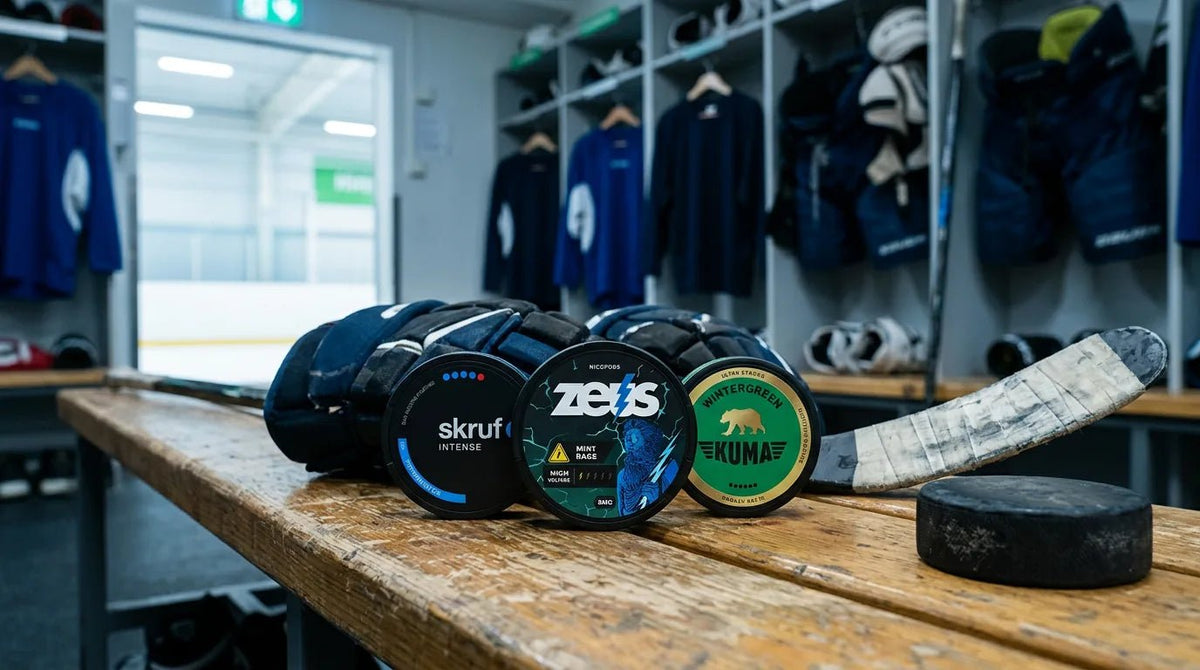
The new hockey season is in full swing, and if you have ever watched a broadcast closely, you have probably spotted it: the bump under a player's top lip. So why do hockey players use snus so much more than other athletes? It is one of the strongest pouch cultures in world sport, from junior rinks in Sweden to the top professional leagues.
In this guide we look at where hockey's snus habit came from, what anti-doping tests show, what the science says about performance, and which tobacco-free pouches fans and rec-league players reach for today. Want an icy Swedish favourite? Skruf Intense Peppermint Ice 11 mg is a locker-room classic at €5.99.
Key Takeaways
- Snus is deeply rooted in ice hockey culture, especially in Sweden, Finland, Switzerland and North America.
- Anti-doping tests show high use: about 53% of urine samples at one Ice Hockey World Championship contained nicotine metabolites.
- It is mostly social, not physical. Research links hockey snus use to team norms, bonding and long road trips.
- Nicotine is not banned in sport. WADA monitors it but does not list it as a prohibited substance.
- No proven performance boost: a controlled trial found snus did not improve endurance.
How Common Is Snus in Ice Hockey?
Very common. Ice hockey shows up again and again as the sport with the highest snus use. Some of the clearest numbers come from anti-doping tests and large surveys:
- World Championship: Swiss anti-doping urine tests at an Ice Hockey World Championship found cotinine, a breakdown product of nicotine, in about 53% of samples.
- Italy: a study of 60,802 anti-doping urine samples found nicotine in 22.7% of all athletes. For ice hockey, yearly positivity ranged from 18.1% to 61.3% between 2012 and 2020.
- Elite sport overall: a review in Sports Medicine reported cumulative nicotine exposure of 32% in ice hockey, one of the highest rates of any sport.
- Finland: among Finnish teenagers, ice hockey was more strongly linked to snus use than any other sport.
- Women's hockey: in the Swedish Women's Hockey League (SDHL), 19% of players used snus daily or occasionally, and none smoked.
That last finding sums up hockey's relationship with nicotine. Players almost never smoke, but oral nicotine is everywhere.
Why Do Hockey Players Use Snus? 5 Reasons
1. Locker-Room Culture
The biggest reason is social. A Swedish interview study of young hockey players found that "socialization in and through psychosocial norms of the ice-hockey environment" was the core reason players started using snus. In simple terms: everyone around them did it.
A study of 249 Swedish boys aged 12 to 19 found that 13% of young hockey players used snuff and 34% had tried it. Boys who also played other sports were less likely to use it, suggesting the hockey environment itself was the driver.
2. Team Bonding and Road Trips
Hockey involves long bus rides, hotel stays and hours of waiting between games. Sharing a can of pouches became a ritual, like a coffee break or a card game. Research from Switzerland shows team-sport athletes use snus more than individual-sport athletes, which fits the idea that it spreads through groups.
3. Scandinavian Influence
Sweden is the home of snus and one of hockey's great nations. As Swedish and Finnish players moved to leagues across Europe and North America, the habit came with them. Swiss researchers suggest that snus's link with winter sports may have been imported from Sweden.
4. Discreet and Smoke-Free
Smoking is out of the question for athletes who need their lungs. A pouch can be used on the bench, in the locker room or on a flight without smoke, vapour or smell. Modern white pouches also remove the need to spit.
5. Perceived Focus and Calm
Many players say a pouch helps them relax before a game or switch off after one. Nicotine does act on the brain's reward system, which is why the FDA describes it as the substance that makes tobacco products addictive. But feeling sharper is not the same as playing better, as the next section shows.
Does Snus Improve Hockey Performance?
The evidence says no. In a double-blind trial published in the Journal of Sport and Health Science, 12 healthy men took either 8 mg Swedish snus or a placebo before cycling to exhaustion. Time to exhaustion was 54 minutes with snus and 50 minutes with placebo, a difference that was not statistically significant.
The authors concluded that "snus could not be considered an ergogenic substance at submaximal exercise level." Sports scientists writing in the European Journal of Sport Science went further, warning of "no proven benefit to physical or mental performance" and noting worrying use among younger athletes.
For a deeper look at the research, read our guide to nicotine pouches and athletic performance.
Is Snus Banned in Hockey?
No. Nicotine is not a prohibited substance. The World Anti-Doping Agency includes nicotine in its 2026 Monitoring Program, alongside caffeine and bupropion. These substances are tracked "to detect potential patterns of misuse" but "are not considered Prohibited Substances."
The Italian anti-doping researchers argue WADA should keep monitoring nicotine because of how widespread it is. Leagues, teams, arenas and youth programmes can also set their own rules, so check before you use pouches at a rink.
| Question | Answer |
|---|---|
| On WADA's Prohibited List? | No |
| On WADA's Monitoring Program? | Yes, in competition |
| Proven performance benefit? | No |
| Addictive? | Yes |
| Allowed in youth hockey? | No. Nicotine products are for adults only |
From Snus to White Pouches
Traditional Swedish snus contains ground tobacco. Today, many hockey fans and rec-league players use tobacco-free nicotine pouches instead. Brands like ZYN, VELO, Skruf, ZEUS, KUMA, LOOP, XQS and C.R.E.A.M offer the same under-lip format with no tobacco leaf, no brown drip and a huge range of flavours.
Not sure how the two compare? Our guide to what snus is explains the differences.
Best Nicotine Pouches for Hockey Fans
Whether you are watching from the stands, playing beer league on a Tuesday night or following the game from your sofa, these are the cans we see most often in hockey bags:
| Pouch | Strength | Why hockey fans like it | Price |
|---|---|---|---|
| Skruf Intense Peppermint Ice | 11 mg | Swedish brand with an icy rink-cold mint | €5.99 |
| Skruf Superwhite Nordic Liquorice | 11 mg | Classic Nordic flavour for ex-snus users | €5.99 |
| ZEUS Mint Rage | 4 to 20 mg | Intense mint with a strength for every level | €4.99 |
| KUMA Wintergreen | 11 mg | Bold wintergreen, a North American favourite | €4.49 |
| CREAM Cold As Ice Light | 4 mg | Light option for game nights | €3.99 |
Browse more in our Skruf, ZEUS and KUMA collections, or go big with our strong nicotine pouches.
Smart Pouch Habits for Players and Fans
- Do not use pouches during intense play if you are not used to them. Nicotine raises heart rate, and the CDC says there are no safe tobacco products, including nicotine pouches.
- Pick a sensible strength. Extra-strong pouches can cause dizziness or nausea, especially when you are dehydrated after a game.
- Bin your pouches. Do not leave them on the bench, in the stands or on the ice.
- Keep them away from young players. Nicotine is for adults only, and youth hockey is where habits start.
- Look after your gums. Move the pouch around and take breaks. Our guide to pouches for sensitive gums has more tips.
FAQ: Snus and Ice Hockey
Why do hockey players use snus?
Mostly because of culture. Swedish research describes snus use as part of the social norms of the ice hockey environment, passed on in locker rooms and on team trips. Players also report using it to relax, to focus and to pass time on long bus journeys, although studies have not shown that it improves performance.
Is snus banned in ice hockey?
No. Nicotine is not on the World Anti-Doping Agency's Prohibited List. WADA includes it in its 2026 Monitoring Program, which tracks substances for patterns of misuse without banning them. Individual leagues, teams and arenas can still set their own rules.
How common is snus in ice hockey?
Very common. Anti-doping urine tests at an Ice Hockey World Championship found nicotine metabolites in about 53% of samples. In Italy, 18% to 61% of ice hockey samples tested positive for nicotine each year between 2012 and 2020.
Does snus improve hockey performance?
There is no good evidence that it does. In a controlled trial, 8 mg of snus did not improve endurance or reduce perceived effort. Nicotine also raises heart rate and is highly addictive.
Do hockey players use snus or nicotine pouches?
Both. Traditional Swedish snus contains tobacco, while modern white nicotine pouches like ZYN, VELO, Skruf, ZEUS and KUMA are tobacco-free. Many players have moved to pouches, which are discreet and do not need spitting.
Final Thoughts
So, why do hockey players use snus? Mostly because it is part of the culture: shared in locker rooms, passed on from Swedish legends and kept alive on long road trips. The science does not back up any performance boost, and nicotine is addictive, but for adult fans who already use pouches, hockey season is the perfect time to stock up.
Grab a can of Skruf Intense Peppermint Ice or explore our full range at outlet prices. Orders over €99 ship free across the EU, and new subscribers get 10% off with a code sent when they sign up. For adults only.
Share:
Death Row Nicotine Pouches: The Launch, the Four Inmates and How to Get the Casket
EU Nicotine Pouch Tax Vote on 9 November 2026: What Could Change