

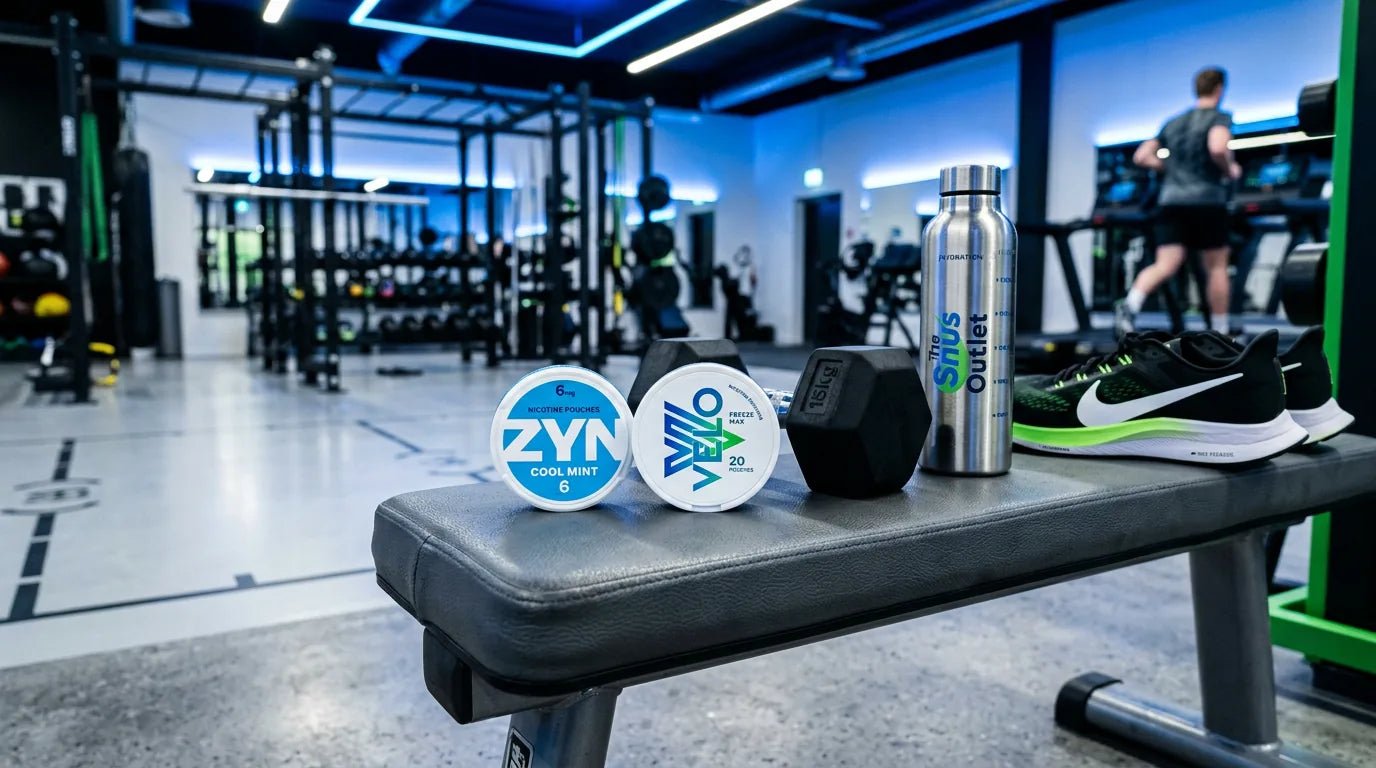
When French international Michael Olise's World Cup 2026 locker-room photo went viral in June, the nicotine pouch tin visible beside him sparked a global debate. But here's the thing: professional athletes have been using snus and nicotine pouches in changing rooms across Europe for years. WADA doesn't ban nicotine. A PFA study found over 20% of female professional footballers currently use them. And now the questions are getting louder: do nicotine pouches actually help athletic performance — or hurt it? We went through the science to give you a clear-eyed answer.
Key Takeaways
- Nicotine is not banned in sport. WADA places nicotine on its monitoring program — the same list as caffeine was on before it was removed — but it is not a prohibited substance.
- Short-term cognitive benefits are real but modest: improved focus, reaction time and attention are documented, especially in precision sports.
- Cardiovascular costs during high-intensity exercise (elevated heart rate, vasoconstriction, increased oxygen demand) can offset any performance gains in endurance sports.
- Nicotine pouches are dramatically better than cigarettes for athletes — no combustion, no CO, no VO2 max reduction from smoke.
- For casual active users, moderate strength pouches (6mg or below) used outside training windows carry lower risk than nicotine used during high-intensity exercise.
Are Nicotine Pouches Banned in Sport?
This is the first question most athletes ask — and the answer is a clear no. WADA's Prohibited List does not include nicotine as a banned substance. Nicotine sits on WADA's Monitoring Program — a watchlist of substances that agencies track for prevalence and emerging evidence but have not found sufficient grounds to prohibit. Crucially, the three-criteria test for WADA prohibition requires at least two of the following: the substance must enhance performance, pose a health risk to athletes, or violate the spirit of sport. Nicotine has not met this dual threshold.
Sports scientists familiar with the WADA process have noted that the monitoring placement is effectively a data-gathering exercise: "If there were clear performance enhancement, WADA would have acted already." Neither FIFA nor any major European sports federation currently prohibits nicotine pouch use. Athletes can legally use ZYN, VELO, LOOP, XQS and other nicotine pouches in training, competition and post-match contexts without violating anti-doping rules.
What Nicotine Does to the Exercising Body
Nicotine is a sympathomimetic stimulant — it activates the sympathetic nervous system, which triggers a cascade of physiological changes relevant to anyone exercising. Understanding these effects is key to evaluating whether pouches help or hinder performance.
Cardiovascular effects: Nicotine increases resting heart rate by approximately 5–10 BPM and raises blood pressure through peripheral vasoconstriction. During exercise, this means your heart is already running "hotter" before you start, your oxygen demand at rest is elevated, and peripheral blood flow to muscles may be reduced due to narrowed blood vessels. For endurance athletes — runners, cyclists, swimmers — these cardiovascular costs are significant. The NIH Office of Dietary Supplements emphasises that cardiovascular efficiency (including oxygen delivery to muscle) is central to aerobic performance — and nicotine-induced vasoconstriction works against this.
Key distinction from cigarettes: Traditional cigarette smoking reduces VO2 max directly through carbon monoxide (CO) binding to haemoglobin, reducing oxygen-carrying capacity. Nicotine pouches produce no CO. For athletes who use nicotine, switching from cigarettes or vaping to pouches removes the combustion-related cardiovascular penalty entirely — leaving only the direct nicotine effects, which are considerably more manageable.
The Cognitive Case: Focus, Reaction Time and Precision Sports
The strongest scientific argument for nicotine in sport is on the cognitive side, not the physical side. Research consistently shows that nicotine binds to alpha-7 nicotinic acetylcholine receptors in the brain, supporting attention, working memory and fine motor response. A meta-analysis on acute nicotine effects found reliable cognitive enhancement on tasks involving attention, working memory and fine motor skills — though effect sizes are modest and individual variation is high.
This is why prevalence of nicotine use is notably higher in precision sports (shooting, darts, snooker, archery) than in endurance sports — the cognitive focus benefit matters more when cardiovascular output is less relevant. In football, the most commonly cited reasons for use among players are pre-match mental preparation, reduced anxiety and improved concentration — not any expectation of physical enhancement. The reaction-time benefit, while real, is typically described as meaningful only in users who are nicotine-naive or in tolerance reset. Regular daily users often report the effect normalises as they become habituated.
One further nuance: delivery speed affects the anxiety response. Low-strength dry pouches (3–6mg from brands like ZYN or The Snus Outlet's sports range) deliver nicotine gradually over 30–60 minutes — a very different pharmacokinetic profile to cigarettes or vaping, which spike nicotine rapidly. The slow-release dry format reduces the anxiety-inducing adrenal response while retaining the attention benefit.
How Widespread Is Nicotine Pouch Use in Professional Sport?
More widespread than most fans realise. A joint study by the Professional Footballers' Association (PFA) and Loughborough University found that 18% of male and 22% of female professional footballers in the UK currently use snus or nicotine pouches. Lifetime use was reported at 42% of male players and 39% of female players — figures that suggest nicotine pouch use has become deeply embedded in professional football culture, particularly in clubs with strong Northern European influence.
Broader data from WADA's monitoring programme found nicotine metabolites in approximately 19% of tested professional footballers. Prevalence estimates across sports vary considerably: football sits around 19–25%; ice hockey and rugby show comparable rates; endurance sports (cycling, marathon) show much lower prevalence, for obvious cardiovascular reasons. Precision sports (shooting, darts, snooker) have anecdotally higher rates. The June 2026 World Cup spotlight — triggered by the Olise photo going viral — has pushed many football clubs to formalize policies around pouch use as a player welfare and performance management issue.
Nicotine Pouches vs Other Nicotine Sources for Athletes
If an athlete is going to use nicotine, the format matters enormously from a performance standpoint.
| Nicotine Source | CO / Lung Impact | VO2 Max Effect | Cardiovascular Cost | For Active Users |
|---|---|---|---|---|
| Cigarettes | High | Significant reduction | High (CO + nicotine) | Strongly inadvisable |
| Vaping | Low (but present) | Minor reduction | Moderate | Not recommended |
| Nicotine patches | None | No direct impact | Moderate (systemic) | Low-risk delivery |
| Nicotine pouches | None | No direct impact | Moderate (HR, vasoconstriction) | Best option among NRT for athletes |
| Snus (tobacco) | None | No direct impact | Moderate | Oral cancer risk; banned in most EU markets |
The clear conclusion: if an athlete uses nicotine, tobacco-free nicotine pouches like ZYN, VELO, LOOP or XQS represent the lowest-risk delivery format available. No combustion, no CO, no lung tissue damage, no VO2 max reduction from smoke. The pharmacological nicotine effects remain — but the catastrophic respiratory costs of smoking are entirely absent. Browse VELO and ZYN at The Snus Outlet with free EU shipping on orders over €99.
The Recovery Question: Sleep, Blood Flow and Adaptation
Athletic performance isn't just what happens during training — it's what happens after. Here, nicotine has a documented negative effect that many pouch users underestimate: sleep disruption. Nicotine is a stimulant that increases cortisol and suppresses melatonin release, both of which interfere with sleep onset and REM quality. For athletes who rely on sleep as their primary recovery tool, evening pouch use is the most potentially performance-damaging habit pattern — more so than anything that happens during training itself.
The practical recommendation from sports medicine professionals is straightforward: if you use nicotine pouches as an athlete, use them in the morning or pre-training window, not post-training or in the hours before sleep. Additionally, nicotine-induced vasoconstriction may mildly impair the post-exercise nutrient delivery window — the 30–60 minute period after training when protein and carbohydrate uptake in muscle is elevated. This is unlikely to be decisive at moderate strengths, but it's worth being aware of if you're optimising recovery with precision nutrition.
What Does This Mean for Active Users?
The honest summary for the regular gym-goer, recreational athlete or weekend footballer:
- Using nicotine pouches is not going to make you a better athlete in any meaningful physical sense. The science does not support that claim — and WADA's own reasoning confirms it.
- Short-term focus benefits are real — a 3–6mg pouch 20–30 minutes before a technically demanding training session (not an endurance session) may sharpen reaction time and concentration for some users.
- If you're a current smoker who trains, switching to nicotine pouches is a significant harm-reduction step. Your aerobic capacity, recovery and cardiovascular health will all benefit from removing combustion from the equation.
- Don't use pouches during high-intensity cardio. The elevated heart rate and vasoconstriction add cardiovascular load at exactly the wrong time.
- Keep evening use minimal if sleep quality matters to your performance — which for most athletes, it does.
Frequently Asked Questions
Are nicotine pouches banned in professional sport?
No. WADA places nicotine on its monitoring program but does not prohibit it. FIFA, UEFA and other major sports governing bodies have no prohibition on nicotine pouch use. Athletes can legally use brands like ZYN, VELO, LOOP and XQS in training and competition without violating anti-doping rules. This may be reviewed as evidence accumulates, but as of 2026, there is no ban.
Do nicotine pouches improve athletic performance?
Not in any clear or consistent way. Short-term cognitive effects — improved attention, focus and reaction time — are documented in research but are modest in magnitude and highly variable between individuals. Physical performance (strength, endurance, VO2 max) is not improved by nicotine and may be slightly impaired through cardiovascular effects. WADA's assessment is effectively that the performance enhancement case is unproven — which is why nicotine is monitored, not banned.
What strength of nicotine pouch is best for athletes?
If you use nicotine pouches as an active person, lower strengths (3–6mg) are appropriate. Higher strengths (11mg+) significantly elevate heart rate and blood pressure, which creates unnecessary cardiovascular load around exercise. Brands like light nicotine pouches in the 3–6mg range — ZYN 3mg, XQS Spearmint 6mg — deliver the cognitive focus effect with a more manageable physiological footprint. Avoid using pouches at any strength during high-intensity cardio sessions.
How many professional athletes use nicotine pouches?
More than most people realise. A joint PFA/Loughborough University study found 18–22% of professional UK footballers currently use snus or nicotine pouches, with lifetime use at approximately 40%. WADA data has detected nicotine in around 19% of tested professional footballers. Use is particularly concentrated in football, ice hockey and rugby — all team sports with high-pressure, intermittent-effort profiles where the cognitive focus argument has most traction.
Final Thoughts
Nicotine pouches won't make you a faster runner or a stronger lifter. But they're not the performance time bomb that some headlines suggest either. For athletes who use nicotine — and a significant minority of professional athletes do — tobacco-free pouches like ZYN, VELO, LOOP and XQS represent the lowest-risk delivery format available, and the science is clear that they're dramatically better than cigarettes in a sporting context.
Use them sensibly — moderate strength, outside training windows, away from bedtime — and the risk profile is manageable for most active adults. Browse the full range at The Snus Outlet's sports nicotine pouch collection with free EU shipping on orders over €99.