

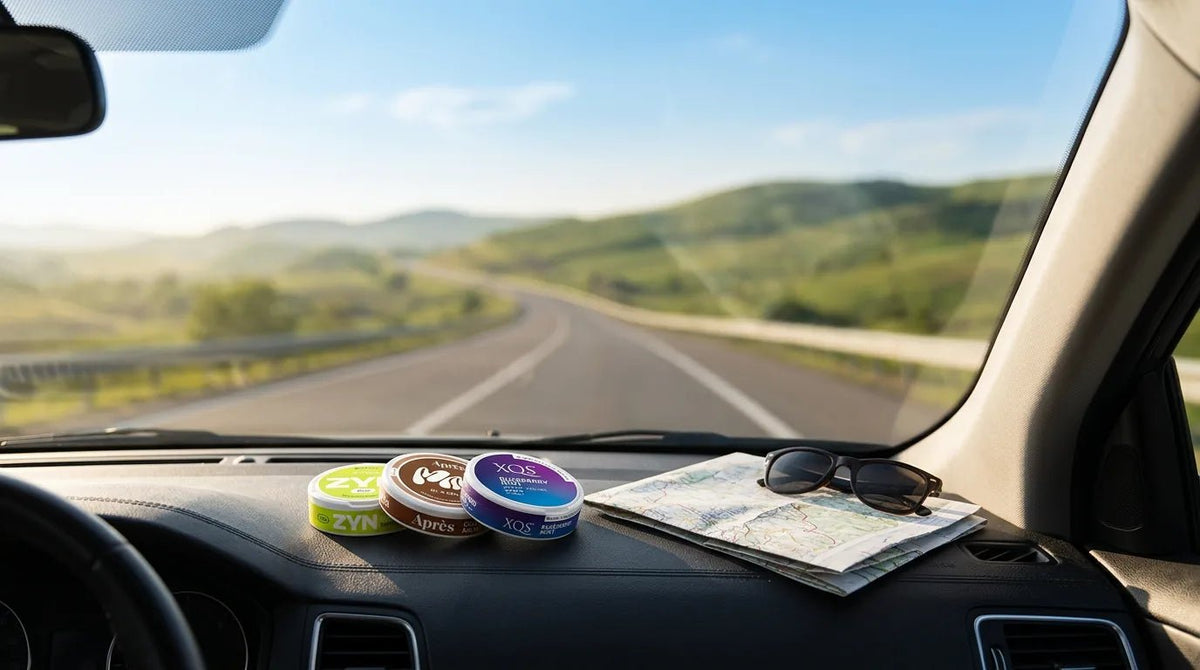
Long drives and nicotine pouches go together for plenty of people. There is no smoke, no lighter and no need to take your hands off the wheel, which is a big reason pouches have caught on with commuters, holiday drivers and delivery crews. But a pouch is not a cure for tiredness, and it is smart to know what the research does and does not say. This guide covers nicotine pouches while driving long distance: the evidence, the safety rules, how much to pack and the best formats for the road. Browse our nicotine pouches for travel collection if you are planning a trip.
- Research shows nicotine can modestly improve attention in lab tests, but it is not a substitute for sleep or rest breaks
- Researchers have no data on nicotine involvement in traffic accidents, so the picture is incomplete
- Fatigue contributes to 15 to 20% of serious crashes, according to the EU road safety observatory
- Place a pouch before you set off or at a stop, not mid-traffic, and avoid strengths you have not tried
- Mini and slim formats in moderate strengths suit the road best
Can You Use Nicotine Pouches While Driving?
We could not find a verified rule that specifically bans using a nicotine pouch while driving in the EU, and a pouch does not need your hands once it is in place. That said, road laws, employer policies and rental car agreements differ by country, so always check your own situation. Professional drivers in particular should look at company policy before using any nicotine product on shift. This article is general information and not legal advice.
The bigger question is safety. Nicotine is a stimulant, and it can cause dizziness, nausea or a racing heart in some people, especially at higher strengths or when you are new to pouches. Anything that makes you feel unwell behind the wheel is a reason to stop.
What the Research Says About Nicotine and Driving
The honest summary is that the evidence is limited and mostly from laboratories. A 2010 review in Current Drug Abuse Reviews by Penning and colleagues states that no studies have looked at the prevalence of driving under the influence of nicotine and that there is no data on nicotine involvement in traffic accidents. It adds that nicotine is known for cognitive-enhancing effects, reducing reaction time and increasing alertness.
| Study | What it found | Limits |
|---|---|---|
| Heishman et al., 2010 meta-analysis | Across 41 double-blind lab studies, nicotine significantly improved alerting attention (accuracy and response time), orienting attention, fine motor skills and some memory measures | Lab tasks, not real driving; effect sizes were small to moderate |
| Simulated driving studies | Smokers who had to abstain performed significantly worse, and craving smokers improved to normal levels after a cigarette | Older simulator studies using cigarettes, not pouches |
| Mumenthaler et al., 2010 pilot study | After 12 hours of smoking abstinence, pilots on placebo gum did worse in a simulator than pilots on 4 mg nicotine gum hourly | Only 29 pilots, described as underpowered |
The Heishman meta-analysis only included smokers deprived for no more than two hours, and the authors concluded the effects likely reflected genuine performance enhancement rather than relief of withdrawal. The pilot study points the other way: going without nicotine for a long time can hurt performance in someone who is dependent.
What this means in practice: if you use pouches regularly, a long drive without nicotine could leave you craving and distracted. If you do not use them, there is no reason to start for a trip.
Why Fatigue Is the Real Enemy
Alertness on a long drive is mostly about rest, not nicotine. The European Road Safety Observatory's fatigue report estimates that driver fatigue contributes to 15 to 20% of serious crashes, with higher shares for crashes involving trucks, fatal crashes and motorway crashes. For professional drivers, it lists a required break of at least 45 minutes after no more than four and a half hours of driving.
The same report describes napping and handing the wheel to a passenger as effective countermeasures, while opening a window or turning up the music are less effective. It does not suggest stimulants as a fix.
- Stop every two hours or so and walk around
- Take a short nap if you feel drowsy
- Share the driving when you can
- Never use a pouch to push through exhaustion
Road Trip Rules for Using Pouches
| Situation | What to do |
|---|---|
| Before you leave | Place your first pouch while parked, and use a strength you know well |
| During the drive | Swap pouches at a service stop or red light rather than fumbling in motion |
| Feeling dizzy or nauseous | Remove the pouch and pull over safely if needed |
| Used pouches | Keep a small sealable bag or lidded tin for them |
| Crossing borders | Check each country's rules for carrying and using pouches |
Our guide to disposing of used nicotine pouches explains how to bin them safely, and our piece on why nicotine pouches make you dizzy covers what to do if you feel off.
Best Formats for the Car
For driving, the best pouch is the one you barely notice. Look for a pouch that stays put, does not drip and delivers a strength you are used to.
- Mini pouches: small, discreet and easy to place. Our best mini nicotine pouches guide ranks them by price
- Dry slim pouches: less moisture means less chance of a drip while you drive
- Moderate strengths: save the extra strong cans for when you are not behind the wheel
| Pick | Why it works on the road | Our price per can |
|---|---|---|
| Après Mini 3 mg | Very light and the cheapest mini we stock | €4.49 |
| ZYN Mini 3 mg | Dry, steady and easy to place | €4.99 |
| XQS slim (about 8 mg) | A step up for regular users, with fresh flavours | €5.90 |
If you like variety, brands such as VELO, LOOP, ZEUS, C.R.E.A.M and KUMA all have options, but test a new strength at home first rather than on the motorway.
How Many Pouches to Pack
Run out halfway through a long trip and you will spend the next three hours thinking about it. The maths is simple: multiply your normal daily pouches by the number of days, add a buffer and divide by 20, which is the usual pouch count per can.
| Pouches per day | Trip length | Pouches needed | Cans to pack (with buffer) |
|---|---|---|---|
| 6 | 3 days | 18 | 2 |
| 8 | 5 days | 40 | 3 |
| 10 | 7 days | 70 | 5 |
Cans can melt into a mess in a hot car, so keep them out of direct sun. Our storage guide explains how to keep them fresh, and our best nicotine pouches for travel post has more packing ideas.
Common Mistakes on Long Drives
- Trying a new, stronger pouch on the road. Test unfamiliar strengths at home, where a dizzy spell costs you nothing
- Using several pouches back to back to stay awake. That raises the chance of nausea, headaches and a racing heart without fixing tiredness
- Leaving cans in direct sun for hours. Heat makes pouches soft and flavours fade fast
- Skipping water. A dry mouth is common with pouches, and a bottle within reach helps
- Forgetting the used pouches. Throwing them out of the window is littering, and it is bad for the environment
Night driving deserves extra caution. Your body clock is already working against you after dark, and no pouch changes that. If your eyes feel heavy, find a safe place to stop and rest before you continue.
Crossing Borders by Car
A road trip across Europe can pass through several legal systems in one day. Some countries restrict strengths or sales, and carrying rules vary. Read our travelling with nicotine pouches guide before you cross a border, and stick to a reasonable personal amount.
FAQ: Nicotine Pouches and Driving
Is it safe to use nicotine pouches while driving?
For regular users, a familiar pouch is unlikely to be more distracting than a drink, but nicotine can cause dizziness or nausea in some people. If you feel unwell, stop and remove it.
Will a nicotine pouch keep me awake?
Lab research shows nicotine can modestly improve attention, but it is not a replacement for rest. The EU road safety observatory points to naps and sharing the driving as the effective fixes for fatigue.
Can nicotine pouches affect a driving test or a police check?
We have no verified information on this, and rules differ by country. Professional drivers should check employer policy and local law.
What is the best nicotine pouch for long drives?
A small, dry pouch at a strength you already know, such as a mini or slim in the low to moderate range.
How many pouches should I pack?
Multiply your usual daily use by the days you are away, add a buffer and divide by 20 to get the number of cans.
Final Thoughts
Pouches can make a long drive more comfortable if you are already a nicotine user, but the safest plan is still rest, breaks and common sense. Stick to strengths you know, pack enough and keep your attention on the road. Stock up on road-trip favourites in our travel pouch collection, with free EU shipping on orders over €99. Nicotine is addictive and for adult users only.
Share:
Are Nicotine Pouches Legal in New Zealand? 2026 Rules Explained