
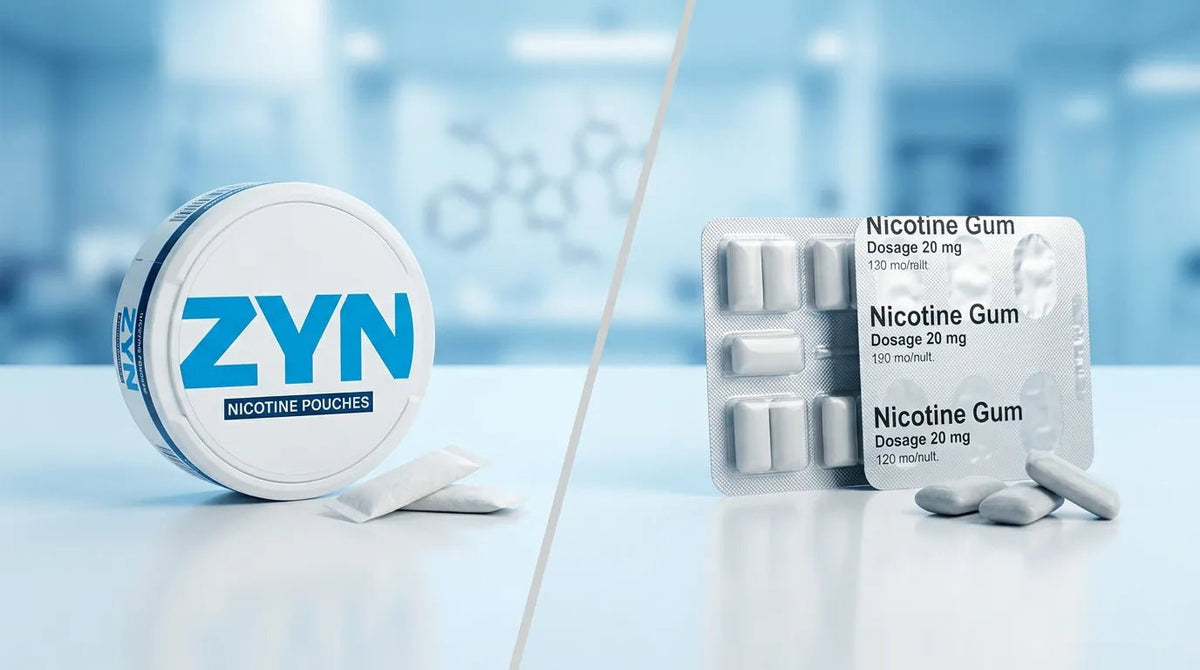
Nicotine pouches and nicotine gum are both oral nicotine products — but the science increasingly favours one over the other. Nicotine gum has been the default oral nicotine replacement therapy for decades — available in pharmacies, NHS-recommended, clinically established. Nicotine pouches are newer, faster-growing, and increasingly positioned alongside NRT products in regulatory conversations. If you're choosing between the two — whether you're quitting smoking, managing nicotine use, or just looking for the most effective oral format — the science now offers some clear answers. Here's what the research actually says.
- A 2022 randomised study found 4mg nicotine pouches reduced cravings by 23 points at 60 minutes vs 15 points for nicotine gum — a significant efficacy difference
- The same study found the 4mg nicotine pouch was bioequivalent to nicotine lozenges and more efficacious than gum at delivering nicotine
- Nicotine pouches are more discreet — no chewing required, no visible jaw movement, no chewing sounds
- Nicotine gum is NHS-approved NRT; pouches are not formally classified as NRT in most EU markets, though regulatory classification is evolving
- Cost per mg of nicotine typically favours online nicotine pouches over pharmacy-bought gum by a meaningful margin
How Each Product Delivers Nicotine
Both nicotine pouches and nicotine gum deliver nicotine through the oral mucosa — the soft tissue lining of the mouth and gum. Nicotine passes through this tissue directly into the bloodstream, bypassing the lungs and the digestive system (which would metabolise it before it became active). This transmucosal absorption pathway is the same mechanism used by nicotine lozenges and oral nicotine strips.
The difference lies in how each product presents nicotine to the mucosa. Nicotine gum requires chewing to release nicotine, followed by the "chew and park" technique: chew until you taste the nicotine tingle, then park the gum between your cheek and gum to allow absorption. This technique requires active attention — chewing too much or swallowing the saliva reduces effectiveness. Nicotine pouches sit passively between the gum and upper lip, releasing nicotine steadily as they moisten — no technique required beyond placement.
A key factor in nicotine delivery is the pH of the product matrix. Nicotine absorption through oral tissue is significantly more efficient at higher pH (alkaline) conditions. Most modern nicotine pouches use alkaline agents (sodium carbonate, bicarbonate) to raise the pouch pH and accelerate nicotine absorption. Nicotine gum also contains buffering agents, but the release mechanism is technique-dependent and more variable.
What the Research Shows on Craving Reduction
A 2022 randomised crossover study published in the journal Nicotine & Tobacco Research directly compared nicotine pouches, nicotine gum, and placebo on craving suppression. The results were clear: the nicotine pouch group showed a 23-point reduction in craving scores at 60 minutes post-administration, compared to a 15-point reduction for nicotine gum and an 8-point reduction for placebo. The nicotine pouch outperformed gum on the primary efficacy measure by a statistically meaningful margin.
A separate pharmacokinetic study found that a 4mg tobacco-free nicotine pouch was bioequivalent to a 4mg nicotine lozenge — another FDA-approved NRT product — in terms of nicotine delivery. The study also confirmed the pouch was "significantly more efficacious than the nicotine gum" at equivalent doses. This positions tobacco-free nicotine pouches at the top tier of oral NRT delivery mechanisms from a pharmacokinetic standpoint, despite not carrying formal NRT regulatory status in most European markets.
A broader 2025 review published in PMC (NCBI) confirmed that "nicotine pouches deliver amounts of nicotine similar to other tobacco products and do so at a rate similar to other oral nicotine products, including some FDA-approved nicotine replacement therapies." This is the current scientific consensus: tobacco-free nicotine pouches are comparable to established NRT formats in nicotine delivery efficacy.
Head-to-Head Comparison
| Factor | Nicotine Pouches | Nicotine Gum |
|---|---|---|
| Craving reduction (60 min) | 23-point reduction (2022 study) | 15-point reduction (same study) |
| Absorption mechanism | Passive oral mucosa — no technique needed | Chew-and-park — technique-dependent |
| Session length | 20–60 min depending on brand | 20–30 min with proper technique |
| Discretion | Completely invisible, no jaw movement | Visible chewing, jaw movement, sounds |
| Flavour variety | Wide — mint, berry, coffee, citrus, tropical | Limited — mostly mint, fruit mint, original |
| Strength range | 2–20+ mg | 2mg and 4mg standard |
| Regulatory status | Consumer product; not classified as NRT in most EU markets | NHS-approved NRT; available on prescription in UK |
| Typical EU cost | ~€4.50–€5.20/can (20 pouches) | ~€7–€12 for 30 pieces pharmacy retail |
| Eating/drinking | Can eat/drink (remove pouch first) | Cannot eat/drink while chewing |
Nicotine Pouches vs Gum: Discretion and Social Context
Nicotine gum carries a social visibility problem that pouches solve completely. Chewing is audible and visible — in a meeting, during a presentation, at a dinner table, or in a quiet office, gum chewing is noticed. Most users are conscious of this, which leads to under-using their NRT product in social situations: exactly the moments when cravings are highest. Nicotine pouches are completely invisible. No jaw movement, no sound, no smell. They can be used in any social context without detection.
There's also the eating and drinking constraint. You cannot eat or drink while chewing nicotine gum — and you should avoid coffee and acidic drinks for 15 minutes before using gum, as they reduce absorption. Nicotine pouches have no such constraint. You remove the pouch before eating or drinking, and you can resume immediately after. For work environments and meal contexts, the practical difference is significant.
Flavour, Strength, and Personalisation
Nicotine gum is available in two strengths (2mg and 4mg) and a limited flavour range — mostly variations on mint, with some fruit mint options. The flavour fades significantly after the first few minutes of the chew-and-park cycle. Nicotine pouches offer a fundamentally different experience: ZYN, VELO, LOOP, XQS, ZEUS and KUMA collectively cover strengths from 2mg to 20mg+ and flavour profiles from icy menthol to coffee, berry, tropical, and coffee-caramel. The flavour sustain is much longer, particularly with LOOP's coated format that maintains flavour intensity for 45–60 minutes.
For heavy users (20+ cigarettes per day equivalent), nicotine gum's ceiling of 4mg is often inadequate. Most heavy users need 9–14mg to effectively suppress cravings. Nicotine pouches fill this gap — LOOP at 9mg, ZEUS and KUMA at 11–14mg — in formats that are pleasant to use rather than clinical obligations.
Regulatory Status and NHS Recognition
This is where nicotine gum currently has a formal advantage. NHS guidance on NRT specifically covers patches, gum, lozenges, inhalers, and sprays — nicotine pouches are not formally listed. In the UK, nicotine gum can be prescribed by GPs and dispensed at no cost to those on low incomes. Nicotine pouches are not eligible for prescription under current NHS frameworks.
However, the regulatory environment is evolving rapidly. The FDA granted ZYN a Modified Risk Tobacco Product authorisation in June 2026, explicitly stating ZYN is lower-risk than cigarettes. Several European regulatory bodies have begun reclassifying tobacco-free nicotine pouches in ways that may eventually bring them closer to NRT status. The Finnish regulatory agency (Fimea) already treats them as NRT-adjacent, requiring pharmacy sale. The science clearly supports equivalent or superior nicotine delivery — the regulatory labelling is catching up.
Cost Comparison
Pharmacy-bought nicotine gum in the EU typically costs €7–€12 for a 30-piece pack. At 2mg, that's €3.50–€6.00 per 30mg of nicotine. At 4mg, the same calculation gives a better ratio but still positions gum as expensive per session. Nicotine pouches from The Snus Outlet start from €4.50/can for 20 pouches at 11mg — delivering substantially more nicotine per euro than pharmacy gum, with free EU shipping on orders over €99. For daily users who rely on their NRT product consistently, the cost difference over a month is meaningful.
FAQ: Nicotine Pouches vs Nicotine Gum
Can I use nicotine pouches as a direct substitute for nicotine gum?
Yes — and the pharmacokinetic evidence suggests you'll get at least equivalent, and in some studies superior, nicotine delivery. Use the same mg-per-dose logic as your gum (a 4mg gum user should start with a 4–6mg pouch), adjust based on your craving response in the first week, and step down gradually if reduction is the goal.
Is nicotine gum safer than nicotine pouches?
Both are substantially safer than smoking. Nicotine gum is an approved NRT with decades of safety data. Tobacco-free nicotine pouches have a shorter history but share the core principle of nicotine delivery without combustion, tar, or carbon monoxide. The 2025 PMC review confirmed comparable nicotine delivery to FDA-approved NRT. No definitive safety disadvantage for pouches has been established — the regulatory labelling difference reflects process rather than established harm differential.
Can I use nicotine pouches and nicotine gum together?
Combination NRT is a recognised approach — using a long-acting product (patches) alongside a short-acting oral product (gum) to cover background nicotine needs and acute cravings. Using two short-acting oral products (both pouches and gum) simultaneously would likely overshoot your nicotine needs and increase side-effect risk. Stick to one oral format at a time and supplement with patches if background coverage is needed.
Why is nicotine gum less effective if I drink coffee before using it?
Acidic beverages (coffee, fruit juice) temporarily lower the pH of your oral mucosa, reducing nicotine absorption from the gum. This is why NRT guidance recommends not eating or drinking acidic liquids for 15 minutes before using gum. Nicotine pouches have a built-in pH buffer in the pouch matrix, so they are significantly less sensitive to the pre-use dietary environment — another practical advantage in daily use.
Final Thoughts
The research now clearly positions tobacco-free nicotine pouches as at least equivalent to nicotine gum — and in direct head-to-head craving reduction studies, more effective. Pouches are more discreet, more flavourful, stronger (for heavy users), and increasingly cost-effective through online retailers. Nicotine gum retains the advantages of NHS-approved NRT status and pharmacy accessibility. For users who need NHS funding or prefer a clinically categorised product, gum remains relevant. For everyone else — especially those who've tried gum and found it insufficient — nicotine pouches are the stronger choice. Free EU shipping on orders over €99.
Share:
Travelling with Nicotine Pouches: The Complete Airport and Flight Guide
Strongest Nicotine Pouches in Europe 2026: Top 7 Ranked