

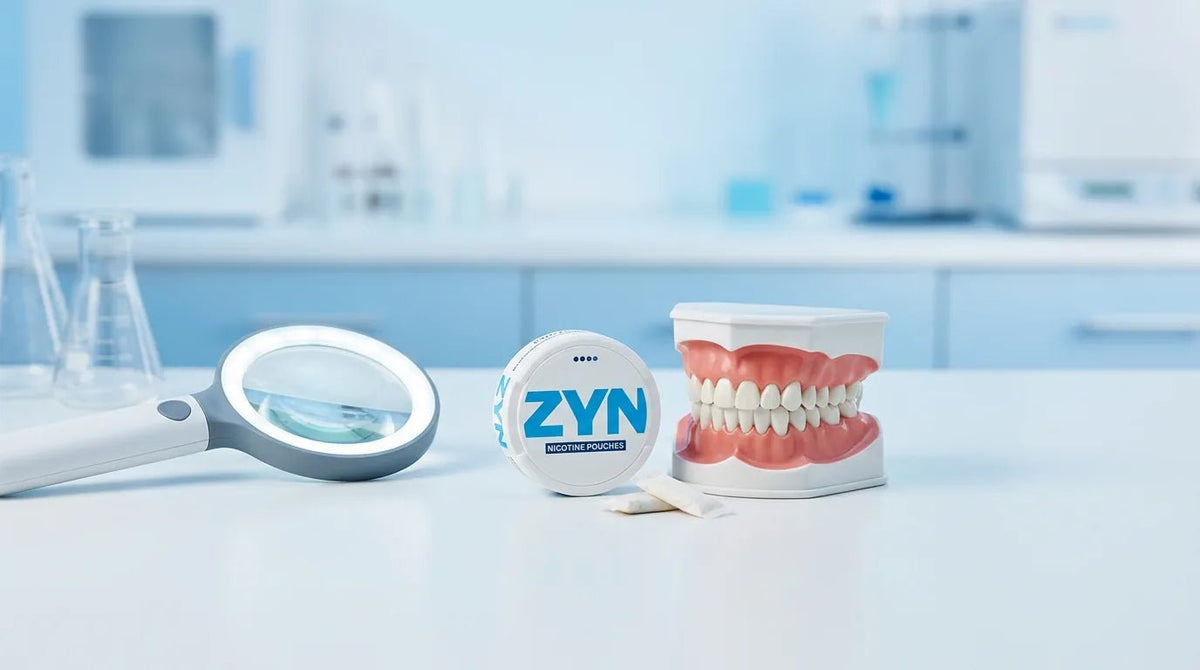
Gum disease — or periodontitis — is the chronic inflammation of the gum tissue surrounding and supporting the teeth. It's the leading cause of adult tooth loss in Europe and is strongly linked to smoking, which is why many people switching from cigarettes to nicotine pouches want to know: does switching help, hurt, or have no effect on gum health? The 2026 research provides a nuanced but broadly positive answer — with one important caveat about placement technique.
- Short-term clinical studies report that exclusive nicotine pouch users show reduced gingival (gum) inflammation compared to cigarette smokers — switching improves gum health
- Nicotine pouches produce no combustion byproducts (tar, carbon monoxide, benzene) — the primary mechanism by which smoking causes periodontal disease
- A real localised risk exists: gingival recession at the placement site can develop if pouches are consistently placed in the same spot or with excessive pressure
- Long-term studies (5+ years) on tobacco-free nicotine pouches specifically are not yet available — current evidence is limited to short-term trials
- Proper placement technique — varying position, not forcing the pouch against the gum, using slim formats — significantly reduces local tissue risk
What Causes Gum Disease: The Basics
Periodontal disease is primarily driven by bacterial plaque — the biofilm of bacteria that accumulates along and below the gumline. When plaque is not adequately removed by brushing and flossing, bacteria trigger a chronic inflammatory response in the gum tissue. This inflammation (gingivitis at the early stage, periodontitis when it advances) causes the gums to pull away from the teeth, forming periodontal pockets where further bacterial accumulation occurs. Over time, the supporting bone and connective tissue degrade, eventually causing tooth mobility and loss.
Nicotine itself affects this process primarily through two mechanisms: vasoconstriction (narrowing of blood vessels), which can mask the visible signs of gingivitis (bleeding gums) even as damage progresses; and effects on immune cell function, which may impair the body's normal inflammatory response to bacteria. However, nicotine's direct contribution to periodontal disease is considerably smaller than the combustion byproducts of tobacco — tar, carbon monoxide, and dozens of other chemicals that cause direct tissue damage, starve gum tissue of oxygen, and significantly impair periodontal healing.
This distinction is critical for evaluating nicotine pouches: they contain pharmaceutical-grade nicotine without any combustion products. The tissue damage pathway that makes cigarettes so destructive to gum health is entirely absent from tobacco-free nicotine pouches.
What the Research Shows: Pouches vs Smoking
A systematic narrative review published in 2026 synthesised available clinical and mechanistic evidence on the oral health effects of nicotine pouches across four domains: oral mucosal changes, periodontal status, dental caries, and oral cancer risk. The review's finding on periodontal status was clear: "short-term clinical studies report reductions in oral mucosal irritation and gingival inflammation among exclusive users" — meaning smokers who switched completely to tobacco-free nicotine pouches showed improved gum health outcomes compared to their baseline as smokers.
A separate 28-day open-label randomised study specifically evaluated ZYN Dry and ZYN Moist (tobacco-free nicotine pouches) on salivary cytokines, epithelial thickness, and inflammatory cell presence after 28 days of exclusive use. The markers of gingival inflammation measurably reduced compared to baseline cigarette smoking levels. This is consistent with the broader harm-reduction framework: removing combustion removes the primary mechanism of tissue damage.
A cross-sectional study published in 2026 comparing 126 nicotine pouch users, 63 oral tobacco pouch users (snus/chew), and 83 non-users found that tobacco-free pouch users had mucosal changes primarily limited to the direct placement site — erythema, localised tissue adaptation — with fewer systemic oral health indicators than tobacco-containing product users. The contrast between tobacco-containing snus and tobacco-free pouches on gum health outcomes is meaningful: snus users show more gum recession and periodontal effects than tobacco-free pouch users.
The One Genuine Risk: Localised Gum Recession
The evidence is not uniformly positive. Localised gingival recession at the placement site is a real and documented finding in nicotine pouch research. A 2023 review for dental professionals published in NHS-aligned dental journals noted: "Localised gingival recession might be seen" in nicotine pouch users, particularly at the site where pouches are consistently placed.
Gingival recession at the placement site is not caused by nicotine — it's caused by repeated mechanical pressure on the same gum tissue, combined with the slightly alkaline pH of the pouch matrix, which can mildly affect local mucosal cells over time. This is the same mechanism that caused recession in traditional Scandinavian snus users who consistently used the same corner of the upper lip for decades, though the effect appears less pronounced with the lighter, drier formats of modern tobacco-free pouches.
The risk is directly related to placement technique — not inherent to the product. Users who vary the placement position across the upper gum (left, centre, right), who don't pack the pouch tightly against the gum, and who use slimmer formats (like ZYN's ultra-thin pouch) show significantly less local tissue change than those who consistently use the same position with a full, moist pouch.
How Nicotine Pouches Compare to Alternatives on Gum Health
| Product | Periodontal Risk | Mechanism | Local Placement Risk |
|---|---|---|---|
| Cigarettes | Very high — primary risk factor for periodontitis | Combustion byproducts, vasoconstriction, immune impairment, hypoxia | N/A |
| Snus (tobacco-containing) | Moderate — associated with localised recession and mucosal changes | Direct tobacco leaf contact, nitrosamines, mechanical pressure | High — consistent placement causes recession |
| Tobacco-free nicotine pouches | Low — no combustion, no tobacco leaf contact | Mild nicotine vasoconstriction only; no combustion byproducts | Moderate if poor technique; low with proper rotation |
| Nicotine gum | Low — no sustained placement contact | Minimal gum contact, no combustion | Very low |
| Nicotine patches | Minimal — no oral contact | Systemic nicotine only; no oral tissue exposure | None |
Within the oral nicotine product category, tobacco-free pouches sit between nicotine gum (virtually no periodontal risk) and tobacco-containing snus (moderate risk). The gap between pouches and cigarettes is enormous — switching from cigarettes to pouches is a major improvement in gum health trajectory.
Placement Technique: How to Protect Your Gums
Since placement technique is the primary controllable variable for local gum tissue health, here are the evidence-aligned practices:
- Rotate position daily — alternate between upper left, upper centre-left, upper centre-right, and upper right. Giving each section 1–2 days of rest prevents cumulative pressure at any single point
- Don't force the pouch against the gum — place it loosely between the gum and upper lip. Constant firm pressure against the gum surface is the primary mechanism of localised recession
- Use slim-format pouches — products like ZYN's ultra-thin slim pouches and VELO's slim range exert less pressure than bulkier formats
- Observe the two-hour guideline — most brands recommend sessions of 20–60 minutes. Extended sessions (2+ hours continuously) increase cumulative local tissue exposure unnecessarily
- Inspect monthly — visually inspect your upper gum tissue monthly for any visible recession, redness, or tissue thinning at placement sites. Early signs are reversible; advanced recession is not
The Evidence Gap: What We Still Don't Know
The 2026 systematic review explicitly noted that "no long-term studies are available" on tobacco-free nicotine pouches' oral health effects. The longest published clinical trials run to 28–90 days. This is an evidence gap, not evidence of harm — but it means the confident long-term safety claim cannot yet be made from clinical evidence alone. The biological rationale for safety is strong (no combustion, no tobacco), and the short-term data is positive, but users should understand the distinction between "no evidence of harm so far" and "proven safe over decades."
The comparison to established NRT products (gum, patches, lozenges) is instructive: these have decades of evidence behind them, which is why NHS NRT guidance can make stronger safety claims. For tobacco-free nicotine pouches, the evidence is growing rapidly — the 2025–2026 period has produced more published research on the topic than the preceding five years combined.
FAQ: Nicotine Pouches and Gum Health
Can nicotine pouches cause gum disease?
The current evidence does not support a causal link between tobacco-free nicotine pouches and periodontitis (gum disease). Short-term studies show gingival inflammation actually decreases when smokers switch to pouches. The one documented risk is localised gum recession at the placement site from consistent mechanical pressure — which is technique-dependent and not inherent to the product.
Do pouches cause gum recession?
Localised gum recession at the placement site is a documented possibility, particularly with poor technique (always same position, forced against gum, extended sessions). With proper placement rotation and slim-format pouches, this risk appears manageable. It is significantly less than the recession associated with traditional tobacco-containing snus, and incomparably less than smoking-related periodontal destruction.
Should I tell my dentist I use nicotine pouches?
Yes — always disclose any nicotine product use to your dentist. Your dentist can monitor for any localised tissue changes at placement sites, assess your overall periodontal health, and provide personalised guidance based on examination. Nicotine pouches are not a secret or shameful product — dentists need complete information to give you accurate advice.
Which nicotine pouch format is gentlest on gum tissue?
Slim, dry-format pouches exert the least physical pressure. ZYN's slim dry format is the most studied and consistently referenced in dental literature as causing the least local tissue disruption. VELO's slim format and XQS's slim range are also lower-impact than bulkier, wetter pouch formats.
Final Thoughts
The evidence is clear on the relative picture: switching from cigarettes to tobacco-free nicotine pouches is a significant improvement for gum health. The absence of combustion byproducts removes the primary mechanism of smoking-related periodontal disease. The one genuine risk — localised recession from repeated mechanical pressure — is technique-dependent and largely preventable. Good placement rotation, slim formats, and regular dental monitoring are the three practical steps that keep gum health on a positive trajectory. Browse discreet slim nicotine pouches at The Snus Outlet — free EU shipping on orders over €99.
Share:
How to Choose Your Nicotine Pouch Strength: The Complete 2026 Guide
Best Value Nicotine Pouches in Europe 2026: Most mg Per Euro Ranked