
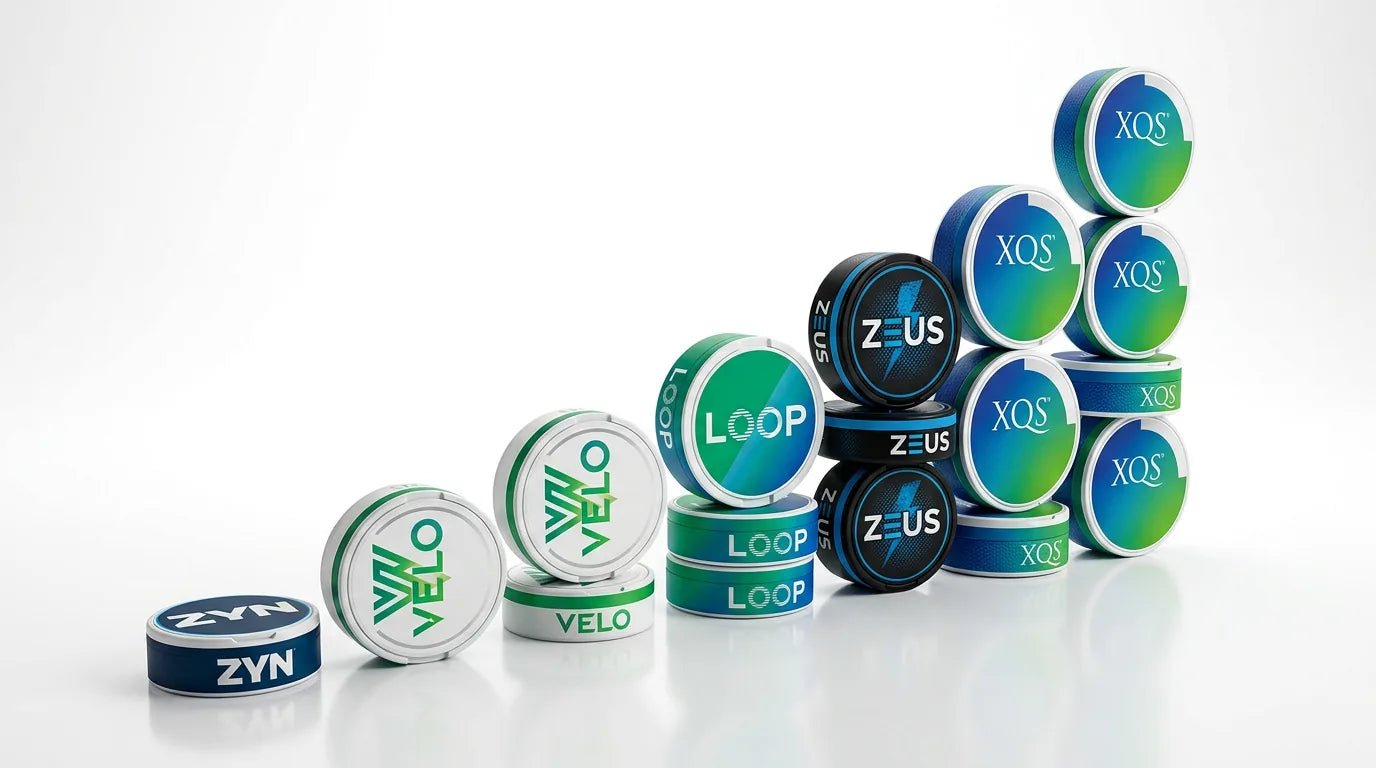
The global nicotine pouch market is one of the fastest-growing categories in consumer goods — and 2026 is a landmark year. According to data from Global Market Insights, the market reached $9.9 billion in 2026 and is now on a trajectory that analysts project will hit $56.7 billion by 2035. This is a market growing at a compound annual rate of 19.4% — outpacing almost every segment of traditional tobacco and most nicotine alternatives. Here is a full breakdown of who leads, which regions are driving volume, and what the industry's trajectory means for buyers shopping for nicotine pouches in Europe today.
Key Takeaways
- The global nicotine pouch market hits $9.9 billion in 2026, up from $8.6 billion in 2025 — a 15% year-on-year increase
- Philip Morris International (ZYN) holds approximately 26% of the global market; the top five players together control 64%
- North America is the largest region; Europe is the second-largest, driven by Scandinavia and accelerating growth in Germany
- Synthetic nicotine dominates product formulation, accounting for roughly $7.4 billion of the 2025 market
- Pouches above 10 mg nicotine content hold 50% of total market share — high-strength demand is not a niche trend
The Numbers: Market Size and Growth Rate in 2026
The headline figure from the Global Market Insights 2026–2035 report is unambiguous: $9.9 billion in global nicotine pouch revenue for 2026, growing at a CAGR of 19.4% through to 2035 when the market is forecast to reach $56.7 billion. That is a near six-fold increase over nine years from a market that barely existed a decade ago.
The 2025 baseline was $8.6 billion globally — driven almost entirely by smoke-free product adoption across North America and Europe. Synthetic nicotine formulations alone accounted for approximately $7.41 billion of that 2025 figure, reflecting how dramatically the industry has moved away from tobacco-derived nicotine in product formulation.
Strength is also shifting upward. Nicotine pouches with more than 10 mg of nicotine per pouch now account for 50% of total market share — a data point that reflects the maturation of the user base, with experienced consumers increasingly seeking higher satisfaction per pouch rather than entry-level formats.
| Year | Global Market Size | YoY Growth |
|---|---|---|
| 2025 | $8.6 billion | Baseline |
| 2026 | $9.9 billion | +15% |
| 2028 | ~$14 billion (Euromonitor est.) | ~+19% CAGR |
| 2030 | ~$19–23 billion | ~+19% CAGR |
| 2035 | $56.7 billion (GMI forecast) | 19.4% CAGR |
Brand Power: Who Leads the Global Nicotine Pouch Market
The market is heavily concentrated at the top. The five largest players — Philip Morris International, British American Tobacco, Imperial Brands, Turning Point Brands and Altria Group — collectively hold approximately 64% of global revenues. This is a market where brand recognition and distribution muscle matter enormously, and where smaller brands compete aggressively on price and flavour innovation to capture the remaining 36%.
Check out our full 2026 product lineup to compare the leading brands available across Europe right now.
| Parent Company | Key Brands | Market Position | Notable Strength |
|---|---|---|---|
| Philip Morris International | ZYN | ~26% global share — market leader | ZYN volumes grew 30%+ YoY; 100M+ cans in 2023 alone |
| British American Tobacco | VELO, Lyft | 2nd globally; strong in Europe | Multi-brand strategy across premium and mid-tier segments |
| Imperial Brands | Zone X, Skruf | 3rd — European and emerging market focus | Strong Scandinavian distribution heritage |
| Altria Group | On! (US) | US-centric; smaller global presence | Extensive US convenience store distribution network |
| Independent brands | LOOP, ZEUS, XQS, C.R.E.A.M, KUMA | 36% combined independent share | Flavour innovation, online-first pricing, higher strength focus |
The independent brand landscape is where the real energy sits in 2026. Brands like LOOP, ZEUS and XQS are winning on flavour range, value pricing and a willingness to push strength limits that the Big Tobacco players are more cautious about, particularly in regulated European markets. Browse our ZYN collection or explore LOOP, ZEUS and XQS — the competitive alternatives taking real market share.
Regional Breakdown — Where Growth Is Fastest
Growth is not evenly distributed. North America is both the largest and fastest-growing single region, with the US market alone valued at approximately $2.4 billion in 2025, growing at a CAGR of 20.3% through 2035. ZYN's retail dominance in American convenience stores is the main engine here — 30%+ annual volume growth driven by a market that is still converting smokers and vapers at scale.
In Europe, the Nordic countries remain the heartland — Sweden and Norway have the highest per-capita usage rates, partly due to the cultural familiarity with snus. But the most notable development in 2026 is Germany, which Global Market Insights flags as the region with the most significant expected growth trajectory in Europe over the next decade. Meanwhile, the UK continues to grow following the disposable vape restrictions introduced in 2025.
| Region | 2025 Market Value | Key Growth Driver | Lead Brand |
|---|---|---|---|
| North America | $2.4B (US alone) | Smoking cessation, convenience store rollout | ZYN (PMI) |
| Europe | ~$3.5B estimated | Nordic base + Germany expansion + UK vape ban | VELO (BAT), ZYN |
| Asia Pacific | Emerging (China ~28% of APAC) | Urban adult adoption, online retail | Local + imported brands |
| Middle East / Africa | Small but growing | Public smoking bans in Gulf states | Import-driven |
What Is Driving the Growth?
The market's 19.4% annual growth rate is not accidental. Several structural forces are pushing the category simultaneously, and they reinforce each other:
- Smoking bans and restrictions: tightening public smoking rules across Europe and North America push existing nicotine users toward discreet, smokeless formats. Nicotine pouches are the cleanest beneficiary of this regulatory pressure.
- Disposable vape crackdowns: the EU and UK crackdowns on single-use disposable e-cigarettes in 2025 created a gap that nicotine pouches have partially filled, particularly among younger adult users who valued the convenience of a small, low-maintenance product.
- Synthetic nicotine innovation: the shift to synthetic nicotine (86% of the market) allows manufacturers to offer cleaner-tasting products, navigate tobacco-specific regulations more easily, and innovate on flavour without tobacco-derived ingredient constraints.
- Flavour diversity: where cigarettes and traditional snus offer limited variety, the nicotine pouch category competes on an enormous flavour range — from classic mint to tropical fruit and coffee. This breadth attracts consumers who would never have engaged with traditional tobacco.
- E-commerce and direct-to-consumer growth: online retailers, including specialist stores like The Snus Outlet, have made it significantly easier for European consumers to access a wide range at competitive prices — something that traditional newsagent or pharmacy distribution could never match.
Product Trends Reshaping the Market in 2026
Beyond raw volume growth, several product-level shifts define where the industry is heading:
Higher strength is the default: the 10 mg+ segment holding 50% of market share is a signal that the "entry-level" phase of category growth is largely behind us in mature markets. Consumers know what they want — and they want satisfying nicotine delivery. This has pushed brands like ZEUS and C.R.E.A.M to build their entire identities around strong-to-extra-strong formats.
Extended-release technology is becoming a competitive differentiator. Manufacturers are investing in pouch formats that maintain consistent nicotine delivery over 60+ minutes rather than a fast spike-and-fade. LOOP's coil technology is an early example of the format innovation that analysts expect to accelerate through 2026 and beyond.
Sustainability is an emerging purchasing criterion, particularly among European consumers. Biodegradable pouch materials, recyclable aluminium cans and carbon-neutral shipping are transitioning from marketing differentiators to table-stakes expectations in premium market segments.
What This Means for Buyers Shopping in Europe in 2026
For consumers, the market dynamics of 2026 are broadly positive. Intense competition between major tobacco conglomerates and a growing independent brand ecosystem has driven down effective prices — particularly in the online direct-to-consumer segment — and dramatically widened the available flavour and strength range.
The practical upshot: more brands, more flavours, and better prices than at any point in the category's history. The competitive pressure that has led to PMI investing aggressively in ZYN distribution is the same pressure keeping independent brands like KUMA, XQS and LOOP competitively priced.
On the regulatory side, European buyers should be aware that the EU's ongoing TPD3 framework negotiations — and the EU Tobacco Excise Directive revision (COM(2025) 580) — may affect product availability and maximum nicotine content thresholds over the next 12–24 months. Shopping from established EU-based retailers with strong stock depth is the best hedge against potential regulatory-driven supply disruptions. Explore our full outlet deals — orders over €99 ship free across the EU.
Frequently Asked Questions
How big is the global nicotine pouch market in 2026?
According to Global Market Insights, the global nicotine pouch market reached $9.9 billion in 2026, up from $8.6 billion in 2025. Analysts project growth to $56.7 billion by 2035 at a CAGR of 19.4%.
Which company leads the global nicotine pouch market?
Philip Morris International leads with approximately 26% global market share, driven almost entirely by ZYN. British American Tobacco (VELO/Lyft) is second. The top five players collectively hold around 64% of global revenues.
Which region is growing fastest in the nicotine pouch market?
North America is both the largest and fastest-growing region, with the US alone growing at a CAGR of 20.3%. In Europe, Germany is the standout growth market for 2026–2035, alongside continued strength in Scandinavia and the UK.
Why are nicotine pouches growing so fast?
The primary drivers are: tightening smoking bans pushing users toward smokeless alternatives, disposable vape restrictions in Europe and the UK, rapid flavour and format innovation, synthetic nicotine's regulatory advantages, and the growth of online direct-to-consumer retail making products easier and cheaper to access.
Are nicotine pouches expensive compared to cigarettes or vaping?
Per-session cost varies widely by brand and strength. Online retailers typically offer significantly better value than convenience stores — particularly when buying in multi-pack quantities. EU orders over €99 from The Snus Outlet ship free, which makes bulk purchasing a straightforward cost-saving strategy for regular users.
Final Thoughts
The numbers confirm what anyone following this category already suspects: nicotine pouches are no longer a niche product. A $9.9 billion global market growing at nearly 20% annually — with projections heading toward $56.7 billion by 2035 — places this firmly in the mainstream of nicotine consumption. The brands winning the most ground are those with strong flavour innovation, competitive pricing and accessible online distribution.
Whether you're exploring the category for the first time or a regular buyer looking for the best value, our outlet deals at The Snus Outlet cover the full range — ZYN, VELO, LOOP, ZEUS, XQS, C.R.E.A.M and KUMA — with free EU shipping on orders over €99.
Share:
Nicotine Pouches for Studying: Focus, Exams and the Science Behind It
LOOP Nicotine Pouches: Every Flavour Ranked from Best to Worst