

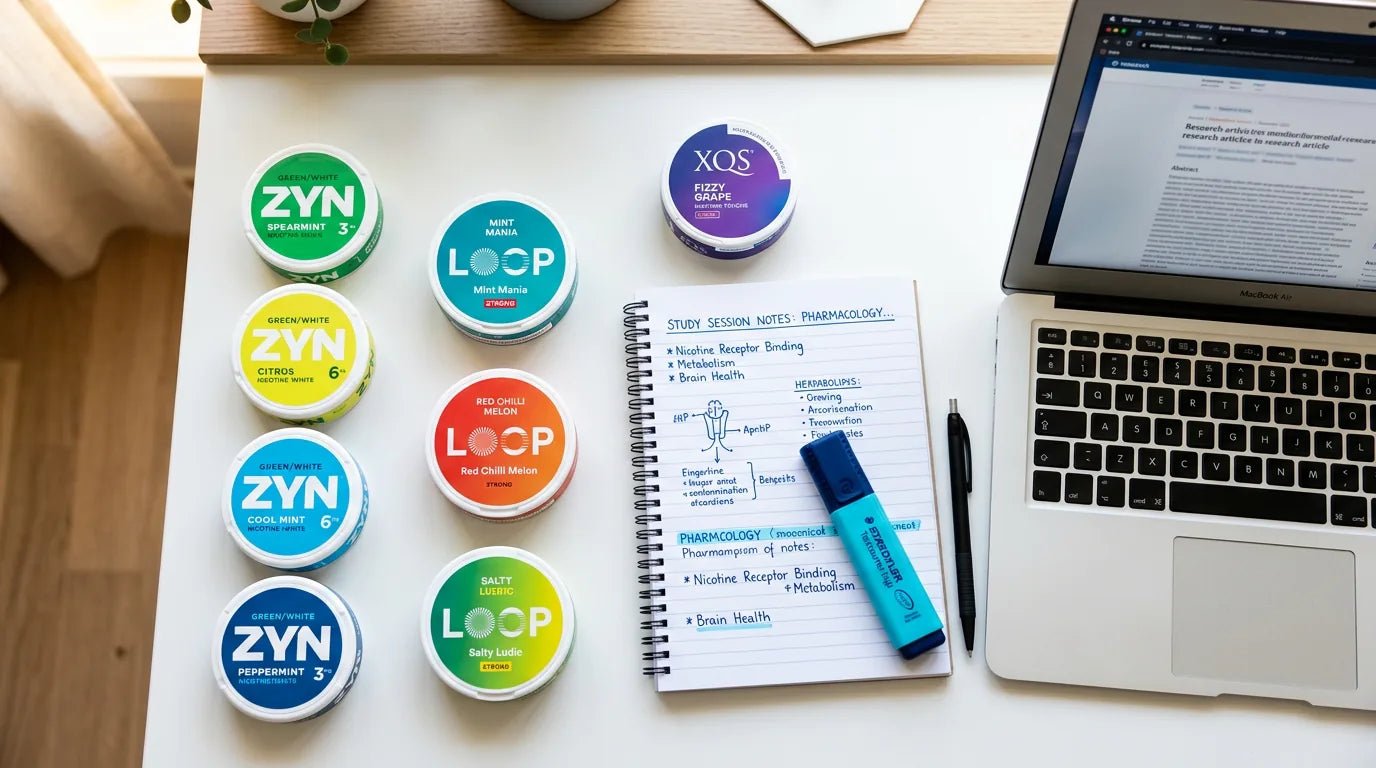
Nicotine pouches are appearing in study sessions across European universities in 2026 — and the science partly explains why. Nicotine pouches for studying work by binding to acetylcholine receptors in the prefrontal cortex, triggering the release of dopamine and norepinephrine: two chemicals directly linked to attention, working memory and motivation. This guide breaks down how that mechanism works, which brands and strengths make sense for focus sessions, and what risks to understand before using nicotine as a study tool.
Key Takeaways
- Nicotine activates acetylcholine and dopamine pathways — the same systems that regulate attention and memory formation
- The focus window lasts roughly 30–40 minutes; effects diminish with daily use as tolerance builds fast
- 3–6 mg pouches are optimal for study sessions — strong enough to feel the lift, light enough not to become a distraction
- ZYN, LOOP and XQS are the brands most frequently cited by students for their clean release and discreet format
- Nicotine is addictive — strategic, occasional use is the only approach that preserves the cognitive benefit long-term
The Neuroscience: How Nicotine Affects Focus and Concentration
Nicotine mimics acetylcholine, one of the brain's primary neurotransmitters involved in learning and sustained attention. When a nicotine pouch releases its content through the gum lining, it binds rapidly to nicotinic acetylcholine receptors (nAChRs) concentrated in the prefrontal cortex — the region responsible for executive function, working memory and focus control.
The downstream effects are measurable. Dopamine rises, improving motivation and alertness. Norepinephrine increases, sharpening attentional control. According to a 2025 study published in Nicotine & Tobacco Research (Oxford Academic), nicotine exposure elevated BDNF levels in the hippocampus in a dose-dependent pattern, directly improving working memory performance. The hippocampus governs the consolidation of new information — precisely what matters during revision sessions.
Most users report a noticeably sharper mental state within 5–10 minutes of placing a pouch. Reaction time improves, distracting thoughts feel easier to filter out, and the ability to hold multiple pieces of information in working memory increases — temporarily. The operative word is temporarily.
How Long Does the Focus Effect Last?
The useful cognitive window runs roughly 30–40 minutes from onset. After that, nicotine levels in the bloodstream begin declining and mental clarity fades back to baseline. This maps almost perfectly onto the Pomodoro technique — 25–50 minute focused work blocks separated by short breaks — that many students already follow.
The critical limitation is tolerance. Daily nicotine use causes nAChRs to desensitise progressively. What begins as a genuine focus enhancement becomes, within weeks, merely a way to reach your normal baseline — you need the pouch to feel okay, not elevated. The cognitive benefits are most pronounced in non-daily users. Spacing sessions by at least 24–48 hours is essential to preserve the effect.
This is why the most effective framework is strategic use: one or two pouches during genuinely high-demand sessions — exam week, a difficult paper deadline, a complex topic you've been avoiding — rather than as a default study companion every time you open a textbook.
Nicotine Pouches vs Coffee for Studying — A Direct Comparison
Students frequently ask whether a nicotine pouch is a meaningful upgrade over a double espresso. The honest answer: they're different tools operating on different timescales. Many experienced users combine both at low doses for complementary effects — coffee for duration, nicotine for the sharp initial spike.
| Factor | Nicotine Pouch (6 mg) | Double Espresso |
|---|---|---|
| Onset time | 5–10 minutes | 15–20 minutes |
| Peak focus window | 30–40 minutes | 45–90 minutes |
| Total useful duration | ~1 hour | 4–6 hours |
| Jitteriness risk | Rare at 3–6 mg | Common with 2+ shots |
| Sleep impact | High if used after 6 PM | High if used after 2 PM |
| Addictive potential | Significant | Mild to moderate |
| Calories | 0 | 0–5 kcal (black) |
For a four-hour revision session, coffee covers the duration more practically. For a 30–45 minute sprint on a particularly difficult topic — working through a complex formula, committing a dense passage to memory — a 3–6 mg pouch may outperform espresso specifically for that window.
Best Nicotine Pouches for Studying in 2026
Not all pouches suit study sessions equally. High-strength options — 16–20 mg — tend to produce a physical sensation (a buzz, mild dizziness) that competes with concentration rather than supporting it. The sweet spot for cognitive work is 3–6 mg with a clean, non-distracting flavour. Browse our ZYN range if you want to start with the most widely used study brand in Europe.
| Brand | Strength | Top Flavour for Focus | Why Students Use It |
|---|---|---|---|
| ZYN | 3 mg / 6 mg | Cool Mint, Spearmint | Even, clean release; the most-cited study pouch by European students |
| XQS | 4 mg | Apple, Arctic Freeze | Light, fruity option — ideal for first-timers wanting a gentle cognitive lift |
| VELO | 4 mg / 7 mg | Ice Cool, Berry Frost | Ultra-slim format — completely discreet in lecture halls and exam rooms |
| LOOP | 9.4 mg (Strong) | Mint Mania, Salty Ludicrous | Stronger hit for experienced users who want one pouch per long session |
| KUMA | 6 mg | Mint, Tropical | Best value on the market — ideal for long revision days on a student budget |
If you're new to nicotine pouches, start with light-strength options (2–4 mg) and work up. Going straight to 6 mg on an empty stomach during a three-hour session is a reliable route to nausea and distraction — the opposite of what you want.
How to Use Nicotine Pouches Effectively for Study Sessions
A few rules that separate strategic cognitive use from building an unintentional dependency:
- Time the placement: place the pouch at the start of a focus block, not mid-session. Onset takes 5–10 minutes, so you want it fully active when the hardest cognitive work begins.
- One pouch per block: a 3–6 mg pouch worn for 30–60 minutes covers one Pomodoro. Stacking pouches back-to-back significantly raises total nicotine intake and accelerates tolerance.
- Stop by 6 PM: nicotine disrupts sleep onset and reduces REM sleep duration. REM is the phase where memory consolidation actually happens — a late-evening pouch can directly undermine the studying you did that afternoon.
- Never use daily: daily use destroys the cognitive benefit within a few weeks. If you're reaching for a pouch every time you open a textbook, you've shifted from enhancement to dependency maintenance.
- Keep 3 mg as your baseline: some sessions, 6 mg feels too strong. Having a lighter option available prevents pushing through discomfort that kills focus faster than no nicotine at all.
The Risks — What Students Need to Know
Nicotine is addictive. That isn't boilerplate — it is the most important fact about the substance. The dopamine and acetylcholine systems that make nicotine useful for focus are the same systems that drive dependency. A 2025 survey from Ohio State University's College of Public Health found over 15% of undergraduates had tried nicotine pouches, with researchers flagging rising dependence rates, particularly among students who shifted from occasional to daily use within weeks of starting.
Short-term side effects at 3–6 mg are manageable: mild gum irritation (more common at 11 mg+), a slight elevation in heart rate, occasional nausea if strength is too high for your tolerance. These resolve quickly once the pouch is removed. Long-term risk is primarily dependence — which may require deliberate, effortful reversal.
The position here is direct: nicotine pouches are a tobacco-free format for adults. If you already use nicotine and want a cleaner delivery method, pouches are a significant improvement over smoking or vaping. If you're considering starting specifically as a study aid, go in with clear eyes — you are adding an addictive stimulant, not a neutral productivity supplement.
Frequently Asked Questions
Can nicotine pouches actually help you concentrate while studying?
Yes — nicotine has documented short-term effects on attention, working memory and alertness by activating dopamine and acetylcholine pathways in the prefrontal cortex. The effect is real and measurable, but lasts 30–40 minutes and diminishes significantly with daily use as receptor tolerance develops.
What strength nicotine pouch is best for studying?
3 mg to 6 mg is the optimal range for cognitive focus work. Higher strengths (11 mg and above) tend to produce a physical buzz that competes with concentration rather than supporting it. ZYN 6 mg and XQS 4 mg are both solid starting points for students new to pouches.
Can you use a nicotine pouch during an exam?
Pouches are discreet, produce no smoke or vapour, and are generally not prohibited in exam halls across Europe. Most students place one 10 minutes before the exam begins to account for the onset delay. Check your specific institution's rules if uncertain — policies vary.
Will nicotine pouches affect my sleep and memory consolidation?
Yes. Using nicotine within two to three hours of sleep disrupts both sleep onset latency and REM duration — the phase where new information is consolidated into long-term memory. An evening pouch can actively undermine the material you spent the day trying to learn. Avoid use after 6 PM on study days.
Are nicotine pouches better than coffee for studying?
They serve different functions. Caffeine provides sustained alertness over 4–6 hours; a nicotine pouch delivers a sharper but shorter focus spike lasting 30–40 minutes. Experienced users sometimes combine a single coffee with a 3 mg pouch for complementary effects. Neither is risk-free when used habitually, and both carry dependency potential.
Final Thoughts
Nicotine pouches offer a real, short-term cognitive boost for studying — but strategy matters more than the product itself. Used once or twice per week during high-demand revision sessions, a 3–6 mg pouch can sharpen focus for a 30–40 minute window without the jitteriness of high-dose caffeine. Used daily, the benefit disappears and dependence takes its place.
If you're an adult who has weighed the trade-offs and wants to explore this as part of a study toolkit, check out the top nicotine pouches for 2026 at The Snus Outlet. Orders over €99 ship free across the EU, with delivery in 2–7 days.