

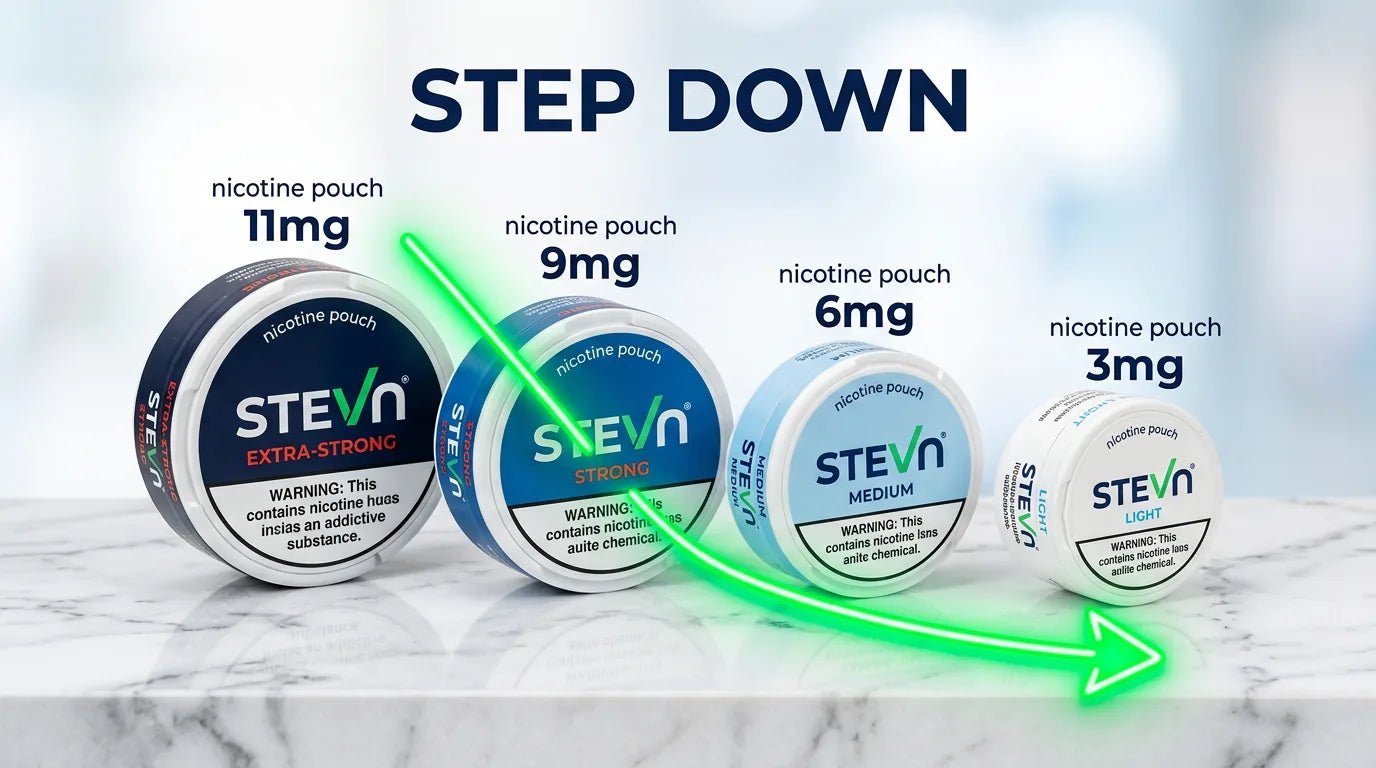
Whether you want to cut back on nicotine for health reasons, reduce your dependence, or work toward quitting entirely, the step-down method is the most effective and sustainable approach. Dropping your nicotine pouch strength gradually — rather than quitting cold turkey — dramatically reduces withdrawal severity and improves long-term success rates. This guide covers everything you need: the four-phase plan, the right brands at each stage, how to handle cravings, and the timeline to expect.
Key Takeaways
- The step-down method works by reducing strength one tier at a time, keeping your pouch count the same until your body adjusts
- Your brain adapts to a new strength level within 3–5 days — resist compensating with extra pouches during this window
- The four phases are: track your baseline → reduce strength → reduce quantity → final quit or hold
- ZYN offers the most complete strength ladder in Europe: 3mg, 6mg, 9mg, 11mg — perfect for a gradual step-down
- Starting the process at all is more important than executing it perfectly — any reduction is a win
Why Step Down Rather Than Quit Cold Turkey?
Cold turkey works for some people — but for most nicotine users, abrupt cessation produces strong withdrawal symptoms including irritability, difficulty concentrating, heightened anxiety, and persistent cravings. The step-down method avoids the worst of those symptoms by allowing the brain to gradually recalibrate its nicotine receptor sensitivity rather than experiencing a sudden drop to zero.
According to NHS guidance on nicotine reduction therapy, a gradual taper approach significantly improves long-term quit rates compared to abrupt cessation. Nicotine pouches are particularly well-suited to a step-down approach because they come in clearly defined, consistent milligram strengths — making it easy to plan and track your reduction with precision.
The goal does not have to be complete cessation. Many users step down simply to reduce their daily nicotine intake and land at a comfortable lower maintenance level (such as 3mg or 6mg) rather than quitting entirely. Both goals are valid uses of this approach.
Know Your Starting Point: Nicotine Strength Tiers Explained
Nicotine pouches sold in Europe are broadly organised into four strength tiers. Knowing where you currently sit is the first and most important step:
| Tier | Strength Range | Examples | Who Is This? |
|---|---|---|---|
| Extra Strong / Ultra | 11mg–20mg+ | ZYN 11mg, ZEUS 12mg, LOOP 16mg, KUMA 11mg, Pablo 20mg+ | Heavy smokers, long-term experienced users |
| Strong | 8mg–11mg | ZYN 9mg, VELO 10mg, XQS 10mg, ZEUS 9mg | Regular users, ex-smokers in maintenance |
| Regular / Medium | 5mg–7mg | ZYN 6mg, VELO 6mg, LOOP 6mg, XQS 6mg | Moderate users, social users |
| Light | 2mg–4mg | ZYN 3mg, VELO 4mg, XQS 4mg, C.R.E.A.M. 4mg | Occasional users, people in final taper phase |
Identify your current tier before you start. Do not skip tiers — moving from Extra Strong directly to Light is too large a jump and will make the process unnecessarily difficult.
The Four-Phase Step-Down Plan
Phase 1: Track Your Baseline (Week 1)
Do not change anything during week 1. Instead, track every pouch: note the time, the strength, and what triggered the use. At the end of the week, calculate your daily average. Multiply your daily pouch count by your current milligrams per pouch — that total is your baseline daily nicotine intake. Understanding your real pattern is more useful than estimating.
Phase 2: Reduce Strength (Weeks 2–3)
Drop to the next strength tier down while keeping your pouch count the same. The lower strength will feel weaker for the first few days — this is expected and normal. Resist the urge to add extra pouches to compensate. Your nicotine receptors will adjust to the new level within 3–5 days. If the jump between tiers feels too large, switching to a different brand that offers an intermediate strength can bridge the gap.
Phase 3: Reduce Quantity (Weeks 4–7)
Once you have adjusted to the new strength, begin cutting one pouch per session. The safest pace is eliminating one pouch every 3–4 days. Start by cutting the automatic, habit-based pouches — the ones you use without a real craving, such as a routine post-lunch pouch or the one you always have during a commute. Keep the pouches that genuinely manage cravings for longer.
Phase 4: The Final Step (Week 8+)
When you are down to 2–3 pouches per day at your lower strength, you have a choice: continue tapering to zero, or establish this as your new maintenance level. Quitting from a baseline of 2–3 light-strength pouches per day produces much milder withdrawal than stopping from 15+ strong pouches. Most users at this stage report mild cravings lasting a few days — not the severe symptoms of cold turkey cessation.
Brand Recommendations at Each Step-Down Stage
| Stage | Target Strength | Best Brands to Use |
|---|---|---|
| Starting point (if 11mg+) | 9mg bridge | ZYN 9mg, VELO 10mg Strong, XQS 10mg |
| Tier 2 reduction | 6mg | ZYN 6mg, VELO 6mg, LOOP 6mg, XQS 6mg, ZEUS 6mg |
| Tier 3 reduction | 3mg–4mg | ZYN 3mg, VELO 4mg, XQS 4mg, C.R.E.A.M. 4mg |
| Final maintenance or exit | 0mg | Nicotine-free pouches (herbal pouches) or complete cessation |
ZYN is the most practical brand for a complete European step-down because it offers 3mg, 6mg, 9mg, and 11mg in the same familiar slim format. You can move through the entire ladder within one brand, keeping flavour, format, and routine consistent while only the strength changes. Browse the full ZYN range at The Snus Outlet — all four European strength tiers in stock.
For the final stages (3mg–4mg), The Snus Outlet's light nicotine pouches collection includes ZYN 3mg, VELO 4mg, XQS 4mg, and C.R.E.A.M. 4mg — the best options available for the tail end of your reduction plan.
How to Handle Cravings During the Step-Down
The adjustment window after each strength reduction is typically 3–5 days. During this window, you may notice sharper-than-usual urges to use a higher-strength pouch or to add extra pouches to compensate. The most effective countermeasures:
- Delay by 10 minutes. Most craving peaks last under 10 minutes. Waiting them out without acting on them reduces their frequency and intensity over time.
- Stay hydrated. Dehydration amplifies nicotine cravings — keeping water intake high during the first week of each tier reduction helps.
- Maintain your routine. If you usually use a pouch after a meal or with a coffee, keep that habit at the lower strength. Disrupting both the strength and the routine at once makes the adjustment harder.
- Track your wins. Noting each day you stayed within your target strength creates visible progress and reinforces the behaviour.
- Do not white-knuckle it. If a specific day is genuinely difficult (high stress, disrupted sleep), it is fine to use one extra low-strength pouch rather than reaching for a higher-strength one. Flexibility is not failure.
Common Mistakes That Derail the Step-Down
- Skipping strength tiers. Jumping from 16mg to 6mg in one step is too large. The discomfort leads to reverting to higher strengths. Always move one tier at a time.
- Compensating with volume. Using 20 pouches at 6mg instead of 10 pouches at 11mg is not a net reduction — it may actually be more total nicotine. Keep count the same when you reduce strength.
- Starting Phase 3 too early. Cutting quantity before your body has adjusted to the new strength makes both reductions happen simultaneously. Wait for the full 3–5 day adjustment window before reducing count.
- Treating a bad day as failure. One difficult day where you used a higher-strength pouch does not invalidate the plan. Return to your target the next morning.
- Not tracking usage. Users who track their baseline consistently report better outcomes. Not knowing your actual daily count makes it impossible to know if the plan is working.
Frequently Asked Questions
How long does a full step-down take?
A complete step-down from Extra Strong (11mg+) to Light (3mg) takes a minimum of 6–8 weeks if you follow the phases correctly — allowing 2–3 weeks for each strength reduction before cutting quantity. Rushing the timeline by moving too fast between tiers increases the risk of reverting to higher strengths. Slower and steadier produces better results than attempting to compress the process.
Can I use multiple brands during my step-down?
Yes — switching brands is sometimes helpful when the exact intermediate strength you need is not available from your usual brand. For example, if you use ZEUS 12mg and want to step to 9mg, ZYN 9mg is a natural bridge. VELO 10mg and XQS 10mg are also useful stepping stones between the 11mg and 6mg tiers. Keeping the same flavour family (e.g. staying with mint across brands) makes the transition feel less disruptive.
What is the lowest strength nicotine pouch available in Europe?
The lowest commonly available strength in the European market is ZYN 3mg per pouch — the lightest option in ZYN's European range. VELO 4mg, XQS 4mg, and C.R.E.A.M. 4mg are also widely available at The Snus Outlet. Some online retailers stock 2mg options from Nordic Spirit and a few smaller brands. Beyond that, nicotine-free herbal pouches are available if you want to maintain the physical habit with zero nicotine.
Is it normal to feel worse before feeling better?
Yes. The first 2–4 days after reducing strength typically involve mild withdrawal symptoms: slightly increased irritability, reduced concentration, and more frequent craving spikes. These are signs the reduction is working — your brain is adjusting. The symptoms peak around day 2–3 and subside significantly by day 5–7. Each subsequent tier reduction is usually easier than the previous one because overall nicotine dependence decreases as you step down.
Should I tell my doctor I am stepping down?
It is generally advisable to mention any nicotine reduction plan to your GP, particularly if you are on medications where nicotine levels can affect drug metabolism (such as antidepressants, antipsychotics, or certain blood pressure medications). As noted by the NHS, nicotine has measurable effects on how several common drugs are processed by the body, and reducing your intake can change medication efficacy. This does not mean you need medical supervision to reduce pouch strength — it is simply worth a conversation at your next appointment.
Final Thoughts
Reducing your nicotine pouch strength is one of the more straightforward self-improvement projects you can undertake — it has a clear method, known timelines, and measurable milestones. The hardest part is the first 3–5 days at each new tier. After that, the new level feels normal and the next step feels achievable. Start from wherever you are, move one tier at a time, and give your brain the adjustment time it needs.
Browse the full range of light and medium nicotine pouches at The Snus Outlet's outlet deals collection — ZYN, VELO, XQS, C.R.E.A.M. and more, with free EU shipping on orders over €99.