

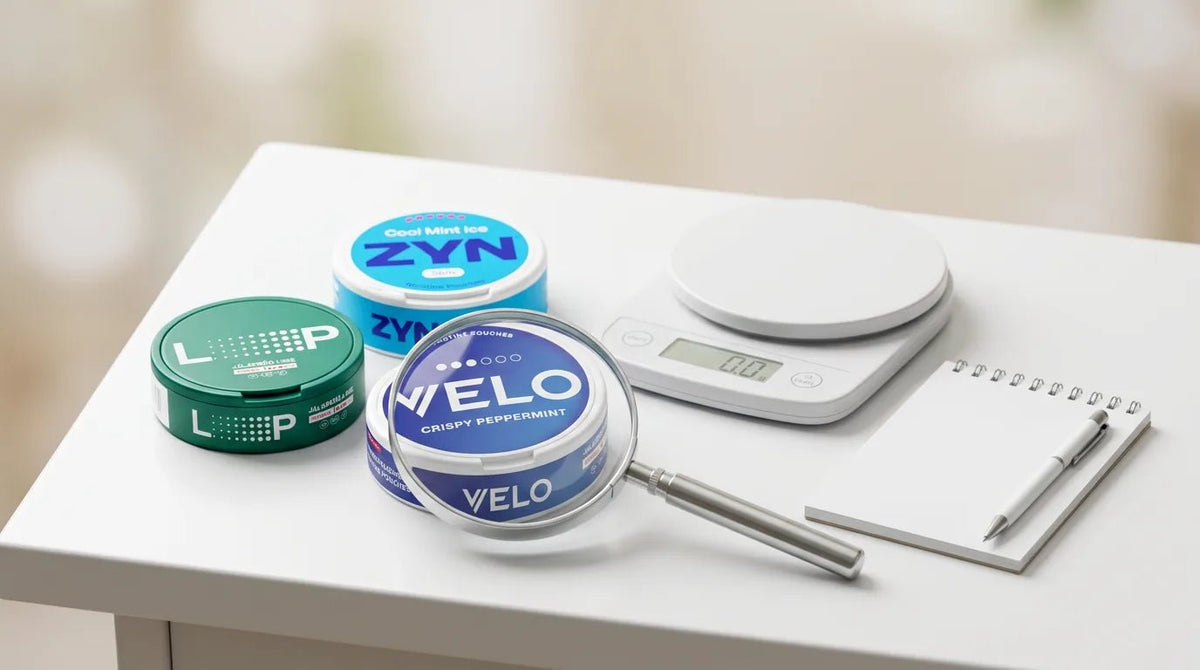
To read a nicotine pouch label, find the nicotine content first, then check whether it is given per gram or per pouch. If it says mg/g, multiply by the weight of one pouch to get the real dose. Then check the net weight, pouch count, ingredients, warnings and best before date. Use this guide with any can from our best nicotine pouches range before you open it.
- mg/g is not mg per pouch: multiply it by the pouch weight in grams
- Pouch weight is net weight divided by pouch count
- Words like Strong and icons such as dots or bolts are brand scales, not standards
- Warning pictograms and ingredient lists tell you a lot, so read them every time
- For adult nicotine users only, and keep cans away from children and pets
Why Pouch Labels Are Confusing
There is no single worldwide label standard for nicotine pouches. Some cans show milligrams per pouch, some show milligrams per gram, and some rely on icons or words.
A Tobacco Control study from German researchers looked at 44 nicotine pouches. Only 15 had the nicotine content labelled in milligrams per pouch or per gram, and 29 used an arbitrary score or ambiguous descriptor. The authors recommended that packaging should clearly state nicotine content in mg per pouch.
So the skill is worth learning. It stops you buying a much stronger pouch than you meant to.
The 7-Step Label Checklist
- Find the nicotine figure. Look for mg/g or mg per pouch on the lid, base or side
- Check the unit. If it says mg/g, it is per gram of pouch material
- Find the net weight. It is printed in grams, such as 10 g or 14 g
- Find the pouch count. It is usually 20 or 22 on a standard can
- Work out the pouch weight. Net weight divided by pouch count
- Calculate the dose. mg/g multiplied by pouch weight gives mg per pouch
- Read the warnings and ingredients. Then check the best before date
Convert mg per Gram to mg per Pouch
The formula is simple: mg/g × pouch weight in grams = mg per pouch. A quick shortcut is that a 0.5 g pouch holds half the mg/g figure.
| On the can | Pouch weight | Dose per pouch | Example |
|---|---|---|---|
| 8 mg/g | 0.5 g | 4 mg | ZEUS and Royal White Light tiers |
| 16.5 mg/g | 0.5 g | 8.25 mg | Royal White Strong |
| 20 mg/g | 0.5 g | 10 mg | ZEUS 20 mg tier |
| 50 mg/g | 0.5 g | 25 mg | ZEUS 50 mg tier |
| 16 mg/g | 0.5 g | 8 mg | One DENSSI can listing |
| 16 mg/g | 0.7 g | 11.2 mg | Another DENSSI can listing |
The ZEUS conversions match those on the ZEUS site, which lists 8 mg/g as 4 mg per pouch and 16.5 mg/g as 8.25 mg. The Royal White figures come from spec sheets such as PouchFox.
The last two rows show why pouch weight matters. Haypp lists a DENSSI can at 16 mg/g with 8 mg per pouch from a 10 g, 20-pouch can, while an independent reviewer measured 11.2 mg per pouch from a 14 g can with 0.7 g pouches. Same mg/g, different dose. Always check your own can.
Work Out Pouch Weight and Can Total
If the pouch weight is not printed, divide the net weight by the number of pouches. This is also how you spot an unusually heavy or light pouch.
| Net weight | Pouch count | Pouch weight | Typical example |
|---|---|---|---|
| 10 g | 20 | 0.5 g | ZEUS cans |
| 11 g | 22 | 0.5 g | Royal White cans |
| 14 g | 20 | 0.7 g | Some larger-pouch cans |
You can also estimate the total nicotine in a can by multiplying the dose per pouch by the count. A ZEUS can at 10 mg per pouch holds around 200 mg across 20 pouches, as 24Nico notes. A Royal White Strong can holds about 181 mg across 22 pouches.
The total is a useful reminder to store cans safely. Our disposal guide covers child and pet safety.
Strength Words, Dots and Bolts
Brands use their own scales. VELO and KUMA cans use rows of dots, C.R.E.A.M uses a strength dot scale, and ZEUS uses lightning bolts. Words such as Light, Normal, Strong and Extra Strong are not standardised across brands.
That means a Strong from one brand can be very different from a Strong from another. The Tobacco Control study described these scores as neither clarified nor harmonised. Treat them as a hint, then do the maths.
For a feel for each level, read our mg per pouch strength guide and our how to choose strength guide.
Warning Pictograms Explained
You may see a small diamond with an exclamation mark or a skull and crossbones. These come from EU chemical labelling rules, and they flag the acute toxicity of nicotine if swallowed.
According to the German BfR, products at 2.5 mg/g or higher must carry the exclamation mark pictogram (signal word Warning), and those above 16.7 mg/g must carry the skull and crossbones (signal word Danger).
| Nicotine content | Pictogram expected | Meaning |
|---|---|---|
| 2.5 mg/g or more | Exclamation mark | Harmful |
| Above 16.7 mg/g | Skull and crossbones | Toxic |
The Tobacco Control study found that some products above 16.7 mg/g did not carry the required label. So use the pictogram as a cross-check against the number, not a replacement. Absence of a symbol does not prove a product is mild.
Health Warning, Ingredients and Contact Details
Rules differ by country. In Sweden, the Public Health Agency requires a health warning and a content declaration. The declaration must list all ingredients in descending order of weight, state the nicotine content and delivery per dose, and recommend keeping the product out of reach of children.
A typical ingredient list is short. One retailer lists Arctic Freeze Strong as cellulose (E460), water, flavouring, nicotine at 1.65%, an acidity regulator (E500) and a sweetener (E955). The nicotine percentage converts easily, because 1.65% equals 16.5 mg/g.
The industry body ENPA has proposed that pouch packaging should also show the pouch weight, manufacturing and best before dates, the maker's contact details and an adult-only mark. That is an industry position, not law, but it is a useful checklist of what a good label includes.
Best Before Dates and Batch Details
Look for a best before date, usually on the base or side of the can. An old can is not automatically unsafe, but flavour and moisture can change. Our guide on using pouches past the date explains what to expect.
If you are tempted by cheap short-dated stock, read our short date pouches guide first. And if a label looks odd, with missing details or poor printing, see how to spot fake nicotine pouches.
Red Flags on a Label
- No nicotine figure at all, only a word or a symbol
- No ingredient list or no manufacturer details
- No health warning about nicotine being addictive
- Net weight and count that do not add up to a sensible pouch weight
- A high mg/g figure with no pictogram, which does not match the rules above
If you spot any of these on a can you already own, check the seller and the batch before using it.
A Note on Shop Listings
Online shop titles often use shorthand. Some of our own product titles use the per-gram figure, such as 16.5 mg or 50 mg. Read these as mg/g, then compare with the printed can.
For example, Royal White Strong is listed as 16.5 mg but works out at about 8.25 mg per pouch. Our Royal White review and Royal White vs ZEUS comparison show this in practice. For prices, our cost per pouch guide uses the same maths.
FAQ: Reading Pouch Labels
What does mg/g mean on a nicotine pouch?
It is the amount of nicotine per gram of pouch material, not per pouch. Multiply it by the pouch weight in grams to get the dose per pouch, so 16.5 mg/g in a 0.5 g pouch is about 8.25 mg.
How do I work out the weight of one pouch?
Divide the net weight on the can by the number of pouches. An 11 g can with 22 pouches gives 0.5 g per pouch, and a 14 g can with 20 pouches gives 0.7 g.
Do all nicotine pouch cans show mg per pouch?
No. A German study of 44 nicotine pouches found that only 15 showed nicotine content in mg per pouch or per gram, and most used scores or descriptors such as Strong that are not standardised.
What do the warning symbols on a nicotine pouch mean?
In the EU, chemical labelling rules call for an exclamation mark (harmful) pictogram above 2.5 mg/g and a skull and crossbones (toxic) pictogram above 16.7 mg/g, according to the German BfR. They flag acute toxicity if swallowed, so keep cans away from children and pets.
Where is the best before date on a nicotine pouch can?
It is usually printed on the base or the side of the can, but formats vary by brand and country. If you cannot find it, check the outer packaging or ask the seller before you buy.
Final Thoughts
Reading a pouch label takes under a minute once you know the formula: mg/g times pouch weight gives the real dose. Check the unit, the weight, the warnings and the date every time you try a new can. Browse the light nicotine pouches if you want a gentle place to start, with free EU shipping on orders over €99. For adult nicotine users only.
Share:
Royal White vs ZEUS Nicotine Pouches: Same Maker, Different Kick
Do Nicotine Pouches Cause Erectile Dysfunction? What the Evidence Says