

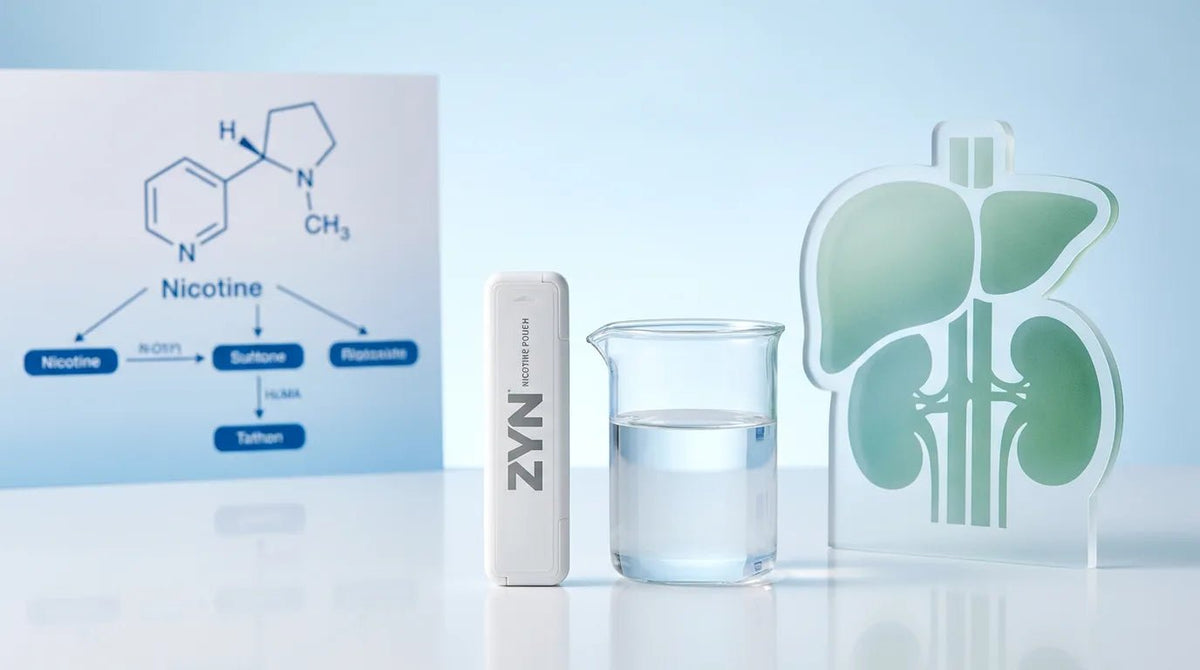
Most people searching "how long does nicotine stay in your system" are actually asking about cotinine — the metabolite that drug tests and insurance screenings look for, not nicotine itself. Nicotine disappears from blood within a few days. Cotinine hangs around for weeks. Understanding the difference, and the biology behind both, is what this article is for — whether you're concerned about a test, quitting, or just curious about what your body does with nicotine after a pouch session.
- Nicotine's half-life is 1–4 hours — it's largely out of your blood within 1–3 days
- Cotinine (the metabolite tests detect) has a half-life of 16–20 hours and stays detectable much longer
- Detection windows: urine up to 3 weeks, blood up to 10 days, saliva up to 4 days, hair up to 3 months
- Nicotine pouches produce the same metabolic pathway as cigarettes — cotinine forms regardless of delivery method
- Factors like genetics, liver function, age, and how heavily you use pouches all affect how fast you clear
Nicotine vs Cotinine: Why the Distinction Matters
When nicotine enters your body — whether from a cigarette, a vape, or a nicotine pouch — it's rapidly broken down by the liver enzyme CYP2A6. The primary metabolite of this breakdown is cotinine. Around 70–80% of nicotine converts to cotinine, which is then further metabolised to 3-hydroxycotinine and eventually excreted through urine.
The reason cotinine matters for detection is simple: it stays in the body far longer than nicotine itself. Nicotine's half-life of 1–4 hours means it's typically undetectable in blood within 24–72 hours after your last use. Cotinine's half-life of 16–20 hours means it can remain detectable in urine for 2–4 weeks in regular users.
Insurance companies, employment health screenings, and clinical quit-smoking studies all use cotinine testing — not nicotine testing — precisely because cotinine provides a much wider detection window and more reliable usage indicator. If you've been told "your test is for nicotine," it almost certainly means cotinine.
Detection Windows by Test Type
| Test Type | What's Detected | Detection Window (Light Use) | Detection Window (Regular Use) |
|---|---|---|---|
| Urine | Cotinine | 3–7 days | Up to 3 weeks |
| Blood | Cotinine / Nicotine | 1–3 days (nicotine); 1–7 days (cotinine) | Up to 10 days (cotinine) |
| Saliva | Cotinine | 1–2 days | Up to 4 days |
| Hair follicle | Nicotine / Cotinine | Up to 90 days | Up to 90 days |
Urine testing is the most common method for nicotine detection — it's cheap, non-invasive, and provides a wide window. The 3mg/mL cotinine threshold is the standard cutoff for most urine tests to distinguish smokers/nicotine users from non-users. Heavy daily users may exceed this threshold for up to 3 weeks after quitting. Light users (1–2 pouches per day at 6mg) typically clear within 7–10 days.
Hair follicle testing is the most persistent method. Nicotine and cotinine are incorporated into the hair shaft as it grows (~1cm per month), meaning a 3cm hair sample can detect nicotine use going back 90 days. Hair tests are rare outside of clinical research and specialist insurance underwriting — most standard workplace screenings use urine.
The Metabolism Pathway: What Your Body Does with Nicotine
Here's the chemistry, simplified. After absorption through the oral mucosa (nicotine pouches) or lung tissue (cigarettes or vapes), nicotine enters the bloodstream and reaches the liver within minutes. The liver enzyme CYP2A6 breaks nicotine down into cotinine. Cotinine is then converted to 3-hydroxycotinine by the same enzyme. Finally, both cotinine and 3-hydroxycotinine are excreted through the kidneys into urine.
The entire pathway from nicotine to urinary excretion takes roughly 48–72 hours for a single low-dose exposure. For regular daily use, the system reaches a steady state — cotinine accumulates in the body because new doses arrive before previous cotinine is fully cleared, which is why regular users take significantly longer to fully clear after stopping.
According to research published in the National Institutes of Health PMC database, cotinine's longer half-life (16–20 hours vs nicotine's 2 hours) makes it the preferred biomarker for nicotine exposure in clinical and epidemiological studies worldwide.
How Nicotine Pouches Compare to Cigarettes for Clearance
The metabolic pathway is identical — nicotine is nicotine, regardless of whether it comes from a cigarette, a vape, or a ZYN 6mg pouch. The body converts it to cotinine the same way. What differs is the dose per session and the absorption curve.
A cigarette delivers approximately 1–2mg of nicotine to the bloodstream very rapidly (pulmonary absorption is faster than sublingual). A ZYN 6mg pouch delivers roughly 1–3mg over 30–40 minutes via the oral mucosa — a slower, more sustained release. The peak nicotine blood level from a pouch is lower and arrives later than from smoking, which affects the subjective "hit" but produces the same cotinine endpoint.
For light pouch users (1–3 pouches/day at 3–6mg), cotinine levels are typically lower than an equivalent-frequency smoker, meaning faster clearance after stopping. Heavy pouch users (8–12 pouches/day at 11–16mg) can accumulate cotinine comparable to heavy smokers, with similar clearance timelines of 2–4 weeks.
Factors That Affect How Quickly You Clear Nicotine
Clearance time is not fixed — several individual factors create significant variation between users:
| Factor | Effect on Clearance |
|---|---|
| CYP2A6 genetics | Fast metabolisers clear nicotine ~50% faster than slow metabolisers. About 3–5% of people are slow metabolisers |
| Age | Older adults clear nicotine more slowly due to reduced liver enzyme activity |
| Liver function | Impaired liver function significantly slows cotinine clearance |
| Kidney function | Reduced kidney function slows urinary excretion of cotinine |
| Frequency of use | Daily heavy users accumulate far more cotinine than occasional light users |
| Hydration | Higher fluid intake increases urine output and speeds cotinine excretion |
| Nicotine strength used | Higher-strength pouches (11–16mg) produce more cotinine per session |
What Nicotine Strength Means for Your Clearance Time
The strength of the nicotine pouch you use directly affects how much cotinine your body generates per session. A ZYN 3mg user consuming 3 pouches a day is exposed to roughly 9mg of nicotine — substantially less than a ZEUS 16mg user on 6 pouches a day (96mg). The cotinine load — and therefore clearance time — is proportionally different.
For users monitoring their nicotine use or planning a reduction, the NHS recommends a step-down approach — progressively reducing nicotine strength over time to allow the body to adjust while cotinine levels gradually decrease. This is why having multiple strength tiers in a single brand (like VELO's 4–17mg range) is useful for structured reduction.
FAQ: Nicotine Clearance for Pouch Users
Does the type of nicotine product (pouch vs cigarette vs vape) affect how long it stays in your system?
The metabolic pathway is identical. Nicotine becomes cotinine regardless of delivery method. The key variables are total nicotine dose and absorption speed — pouches absorb more slowly than cigarettes, producing lower peak blood levels but the same cotinine endpoint over time. Light pouch users may clear faster than equivalent-frequency smokers.
How long after stopping nicotine pouches will I test negative on a urine cotinine test?
For light users (1–3 pouches/day): 7–10 days typically. For regular daily users (5+ pouches/day): 2–3 weeks. For heavy users of extra-strong pouches: potentially up to 4 weeks. These are estimates — individual variation is significant. The best approach is to stop as early as possible before any scheduled test.
Can drinking water speed up nicotine clearance?
Staying well-hydrated increases urine volume and frequency, which does help flush cotinine through the kidneys more efficiently. However, excessive water consumption in an attempt to "flush" for a test is not effective and can produce a diluted sample that flags as suspicious on standard drug test panels.
Does a hair follicle test detect nicotine from pouches?
Yes — hair tests detect cotinine incorporated into the hair shaft during the period the hair was growing. Since hair grows approximately 1cm per month, a standard 3cm sample covers 90 days of usage regardless of product type. There is no way to clear a hair follicle test except waiting for the affected hair to grow out.
Will switching from cigarettes to nicotine pouches help me clear faster?
If you switch to lower-strength pouches and reduce your total daily nicotine consumption, yes — your cotinine load will decrease and clearance will be faster once you stop. A full switch from cigarettes to same-dose nicotine pouches at equivalent frequency produces similar cotinine levels. The benefit comes from dose reduction, not the delivery method change itself.
Final Thoughts
The science is clear: nicotine itself is a fast-mover, but cotinine — what tests actually measure — is the persistent metabolite that determines your detection window. Regular nicotine pouch users should count on 2–3 weeks for urine clearance after stopping, with variation based on genetics, dose, and frequency. For anyone managing their nicotine intake with this in mind, stepping down to lower-strength pouches is the most practical approach.
The full range from 3mg entry-level through to 16mg extra-strong is available at The Snus Outlet. Browse all strengths and brands — free EU shipping on orders over €99.
Share:
How Long Do Nicotine Pouches Last? Session Duration and Shelf Life Explained
Best Nicotine Pouches for Ex-Smokers 2026: The Complete Switching Guide