

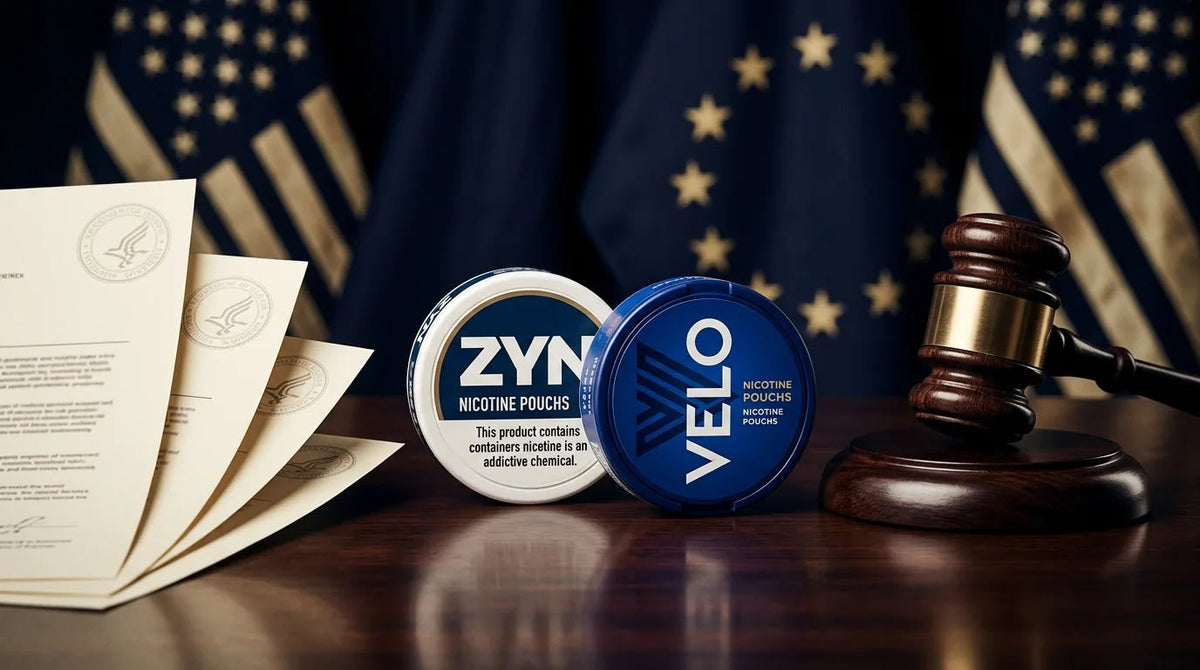
The US Food and Drug Administration is on the verge of its most significant nicotine policy shift in years. According to reporting by the Wall Street Journal on September 23, 2026 — confirmed by Reuters — the Trump administration is preparing to unveil measures that would accelerate market authorizations for smoke-free nicotine products including ZYN, VELO, and other tobacco-free nicotine pouches. Combined with the August 21 PMTA authorization for 11 ZYN ULTRA products and a separate legal challenge from Altria that could upend the entire approval framework, the US regulatory landscape for nicotine pouches is shifting fast — and it matters for European consumers too.
- The FDA is expected to announce simplified PMTA requirements and faster review timelines for nicotine pouches and vaping products "in the coming days" as of September 23
- ZYN ULTRA — 11 new higher-strength products — received FDA marketing authorization on August 21, 2026
- Altria's Helix Innovations (on! pouches) and NJOY filed a federal lawsuit on September 2, 2026 challenging the PMTA framework as unlawful
- ZYN already holds FDA Modified Risk Tobacco Product (MRTP) authorisation from June 30, 2026 — a first for any nicotine pouch brand globally
- The EU's TPD3 revision remains deadlocked with December 2026 proposal target in doubt — creating a growing transatlantic regulatory contrast
The FDA Acceleration: What the WSJ and Reuters Reported
On September 23, 2026, the Wall Street Journal reported that the Trump administration is preparing to announce changes to how the FDA reviews market applications for smoke-free nicotine products. The FDA is expected to revisit the 2021 PMTA rule — the framework that has governed how companies like PMI/Swedish Match (ZYN), BAT (VELO), and Altria apply for marketing authorisation in the United States. The proposed changes are expected to simplify some of the scientific study requirements that applicants must submit and to shorten overall review timelines.
Reuters confirmed the reporting on September 24, citing "people familiar with the matter." The specific measures had not been formally announced as of this writing, but the direction is clear: the administration is signalling that the current PMTA burden is too high and that smoke-free alternatives to cigarettes should receive a faster pathway. This aligns with broader deregulatory priorities under the current administration and with the increasing body of scientific evidence supporting nicotine pouches as lower-risk alternatives to combustible tobacco.
For context: the 2021 PMTA rule established stringent review requirements that have created a significant backlog. Many smaller manufacturers have been unable to afford the full PMTA process, and even large companies like ZYN and VELO have faced multi-year timelines for individual product authorisations. Simplifying the framework — particularly for tobacco-free products like nicotine pouches that contain no combustion — is a logical policy step supported by harm-reduction advocates, though opposed by groups that argue any reduced scrutiny risks giving unapproved products tacit market access.
ZYN ULTRA: 11 New Products Authorised on August 21
Just five weeks before the acceleration announcement, the FDA authorised 11 new ZYN ULTRA products through the standard PMTA pathway on August 21, 2026. The authorisation was granted to Swedish Match USA, Inc. — a PMI subsidiary — and covers ZYN ULTRA products spanning multiple strengths and flavours not previously available in the US market. The FDA's Center for Tobacco Products stated that the authorisations met the standard of being "appropriate for the protection of public health."
ZYN ULTRA expands the brand's US strength ceiling beyond its current S1–S6 range (1.5mg to 11mg). The new products include higher-concentration options that bring ZYN's US range closer to the 16–17mg strengths available in Europe. This is significant because US users who have been getting stronger products from European retailers now have access to higher-strength ZYN domestically — reducing one of the key reasons American consumers imported from European retailers like those operating in the Scandinavian market.
The ZYN ULTRA authorisation follows the landmark June 30, 2026 MRTP decision for 20 existing ZYN products, which allowed ZYN to market those products with an explicit claim that switching completely from cigarettes to ZYN "reduces exposure to harmful chemicals." That was the first-ever Modified Risk authorization for any nicotine pouch globally — a watershed regulatory moment that validated the broader category's harm-reduction profile in the most rigorous regulatory system in the world.
The Altria Lawsuit: A Deeper Challenge to the PMTA Framework
On September 2, 2026, two Altria subsidiaries — Helix Innovations (makers of on! nicotine pouches) and NJOY (e-cigarettes) — filed a federal lawsuit in the US District Court in Lubbock, Texas, challenging the FDA's PMTA authorization system. The plaintiffs are asking the court to declare the 2021 PMTA rule unlawful. Their core argument, according to reporting by 2FIRSTS, is that faster FDA reviews — while welcome — "do not resolve problems in the underlying regulatory framework."
Altria's position is that even an accelerated PMTA system remains structurally flawed in ways that disadvantage smaller competitors and create arbitrary outcomes. The lawsuit seeks a more fundamental reset of the approval process rather than the procedural simplification the FDA announcement is expected to deliver. The distinction matters: the FDA's planned announcement is an administrative fix within the existing framework; the Altria lawsuit challenges the framework's legal validity.
The outcome of the litigation is highly uncertain — federal challenges to FDA rulemaking are complex and slow-moving. But the lawsuit signals that even major tobacco-harm-reduction brands are dissatisfied with the current approval architecture and are willing to use legal force to change it. For consumers, the immediate effect is noise: a lawsuit in progress tends to create regulatory uncertainty, which may slow some approval timelines even as the administration pushes to speed others up.
US vs Europe: A Growing Regulatory Contrast
| Jurisdiction | Current Status | Direction of Travel |
|---|---|---|
| United States | ZYN holds MRTP; ZYN ULTRA authorized; FDA acceleration imminent | Progressively more permissive — faster approvals, simplified PMTA likely |
| Sweden | Snus and nicotine pouches both legal; most permissive EU member | Stable; Sweden's EU membership preserves domestic exemption for snus |
| EU (most markets) | Nicotine pouches legal but sit outside TPD; patchwork national rules | TPD3 proposal expected December 2026 but negotiations deadlocked; unclear |
| Spain | Draft decree under review — nicotine cap revised upward to 4mg proposal | Uncertain; government revised cap from 1mg to 4mg in September 2026 |
| Australia | Full ban since July 24, 2026 — no legal pathway | Restrictive; most closed major market globally |
| Norway / EEA | Market approval scheme in place since July 2021 | Stable regulatory environment |
The contrast between the US and EU trajectories is striking. The US, which only began authorising nicotine pouches through its PMTA pathway in recent years, is now moving toward faster approvals and has already issued a harm-reduction marketing authorisation for ZYN. The EU, whose markets have had nicotine pouches on shelves since the mid-2010s, is still debating whether and how to formally regulate them under a revised Tobacco Products Directive. European consumers and businesses are operating in a patchwork environment that may be partially resolved when the December 2026 TPD3 proposal is published — or may remain fragmented if negotiations stay deadlocked.
What This Means for European Nicotine Pouch Users
For most European consumers, the FDA's US-market activities are informational rather than directly actionable — the regulatory developments don't change what you can buy or where. But they matter for three reasons. First, ZYN's global product development follows US regulatory approvals: the MRTP authorisation and ZYN ULTRA authorization signal that PMI has the regulatory confidence to invest further in the ZYN product line globally, including European markets. More FDA-authorized ZYN products typically means more innovation reaching European shelves 12–18 months later.
Second, the EU TPD3 debate is influenced by international precedent. The FDA's formal recognition of ZYN as a modified-risk product gives European harm-reduction advocates a credible regulatory reference point — the world's most rigorous tobacco regulator has put its institutional approval behind the nicotine pouch category. That evidence will feature prominently in TPD3 consultations. Third, the Altria lawsuit may eventually yield reformed US approval rules that provide a template for how other regulators — including the European Commission — think about balancing innovation incentives against public health scrutiny.
In the near term, the products you can order from The Snus Outlet remain fully available across the EU, including the strongest ZYN, VELO, LOOP, KUMA, XQS, and ZEUS options. Free EU shipping on orders over €99.
FAQ: FDA and Nicotine Pouch Regulation
What is the PMTA and why does it matter for nicotine pouches?
PMTA stands for Premarket Tobacco Product Application — the US FDA's mandatory approval process for tobacco and nicotine products. Any product not grandfathered in before 2007 must receive PMTA authorisation before it can legally be sold in the US. For nicotine pouches, this means each product variant must demonstrate through scientific evidence that it is "appropriate for the protection of public health." The process is expensive and time-consuming, which is why the planned simplification is significant for manufacturers of all sizes.
What does ZYN's MRTP mean for European consumers?
The FDA's Modified Risk Tobacco Product authorisation for 20 ZYN products (June 30, 2026) means that in the US, ZYN can legally state that completely switching from cigarettes to ZYN reduces exposure to harmful chemicals. This doesn't change ZYN's legal or marketing status in Europe directly, but it represents the world's most rigorous regulatory body formally endorsing ZYN as a lower-risk alternative — a precedent with major implications for how European regulators will assess the category.
Will EU nicotine pouch rules change in late 2026?
The EU's TPD3 process is still targeting a December 2026 proposal from the European Commission, but negotiations between member states remain deadlocked as of September 2026. Spain's government recently revised its proposed national nicotine cap upward from 1mg to 4mg — a positive sign for consumers — but EU-level harmonisation is unlikely to take full effect until 2027 at the earliest, even if a proposal emerges this year. Nicotine pouches currently sit entirely outside the TPD framework, so the status quo continues in most EU markets regardless of when TPD3 progresses.
Final Thoughts
The nicotine pouch industry is navigating one of its most consequential regulatory periods since the product category emerged. The FDA's imminent acceleration announcement, ZYN ULTRA's recent authorisation, and Altria's lawsuit are all part of a broader renegotiation of how governments regulate smoke-free nicotine products. The direction of travel in the US is toward greater regulatory recognition of harm reduction; in the EU, the pace is slower but the science being produced by US regulators is building the evidence base. For consumers, the practical reality is unchanged: the best nicotine pouches in Europe remain fully available, better-regulated and better-understood than at any point in the category's history.
Share:
Nicotine Pouches for Dog Walking: The Hands-Free Alternative That Works Outdoors
Helwit Nicotine Pouches Review 2026: Every Flavour and Strength Ranked