

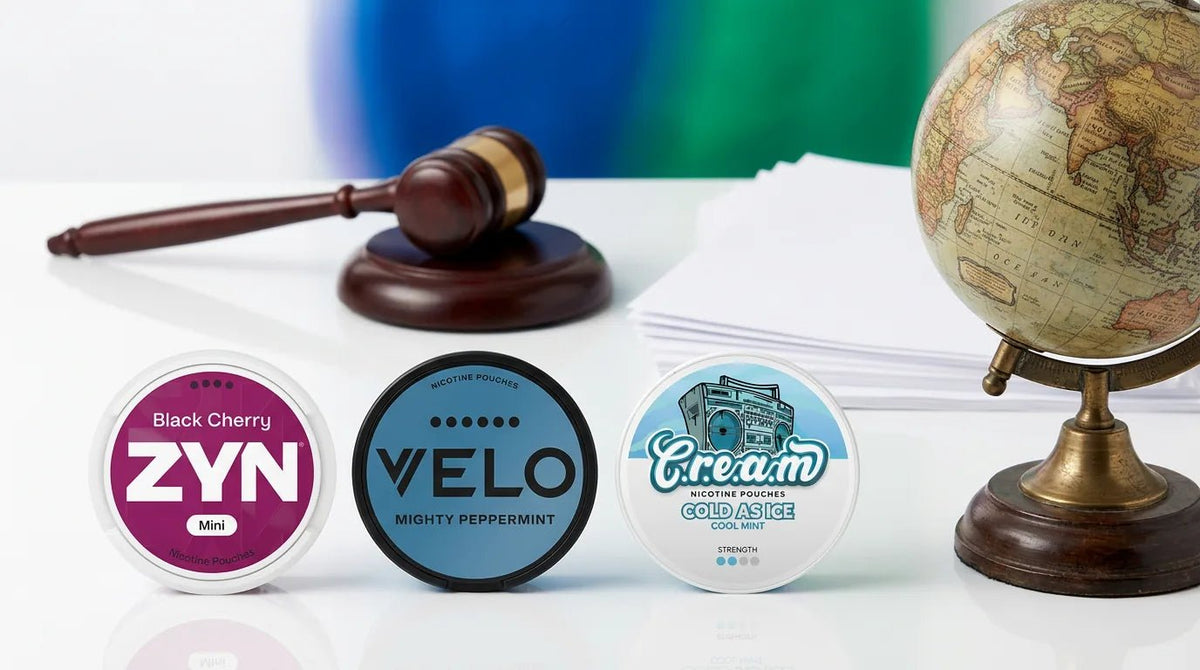
India is the latest big market to tighten its grip on tobacco-free nicotine pouches. In September 2026 the national health ministry told every state to act against unapproved pouches, after years of rising online sales of brands like ZYN. So are nicotine pouches legal in India? The short answer is no, not as a regular consumer product. This guide explains what the rules say, why the law was unclear for so long and how the picture differs from Europe. It is information only, not legal advice.
- Nicotine pouches are not approved or licensed in India, and the government treats unapproved sale as a breach of its drug law
- A health ministry advisory dated 18 September 2026 asks states to run surveillance and take enforcement action, including online
- India's drug advisory board has recommended no new nicotine formulations be approved
- Tobacco-control and e-cigarette laws do not clearly cover pouches, which is why a legal grey area existed until now
- Rules are very different in the EU, where pouches are sold under national rules; always check your own country
Are Nicotine Pouches Legal in India?
Not in the way you can buy them in much of Europe. The Indian health ministry's advisory states that nicotine pouches are not approved or licensed as nicotine replacement therapies under India's therapeutic framework. It adds that unauthorised manufacture, sale, distribution and storage breaches the Drugs and Cosmetics Act, 1940. You can read the wording in the Ministry of Health and Family Welfare advisory.
Importantly, there is still no law that bans pouches by name. Vaping Post notes that no legislation specifically targets nicotine pouches and that the government is treating them as unauthorised medicines instead. That distinction matters, as we explain below.
Timeline: How India Got Here
| Date (2026) | What happened |
|---|---|
| 2 April | Sale of imported nicotine pouches banned in duty-free shops at Mumbai airport |
| June | An ICMR-NICPR study found pouches in 7 of 10 cities studied and in around 9% of tobacco retail outlets |
| 27 August | The Drugs Technical Advisory Board (DTAB) discussed applications for 2 mg, 4 mg and 6 mg pouches and recommended no new nicotine formulation be approved |
| 16 September | DTAB minutes published, according to Reuters |
| 18-19 September | Health ministry advisory to states (dated 18 September on the ministry site; Reuters reports the letter as sent on 19 September) |
| 22 September | Bombay High Court upholds the airport duty-free ban |
The August decision is documented in the official minutes of the 94th DTAB meeting. They record that the regulator had received applications for 2 mg, 4 mg and 6 mg pouches proposed for smoking cessation, and that the board recommended "that no new nicotine formulation be approved henceforth in public interest".
Why Was the Law Unclear?
Indian laws were written for cigarettes, chewing tobacco and vapes, not for tobacco-free pouches. As the Indian Express explains, each major law leaves a gap:
| Law | Why it does not neatly apply |
|---|---|
| COTPA 2003 (tobacco control) | Its definition of tobacco products does not include tobacco-free pouches |
| E-Cigarettes Act 2019 | Pouches do not heat anything or produce aerosol |
| Food safety law | FSSAI says nicotine cannot be added to food products |
| Drugs and Cosmetics Act 1940 | The route the government is now using: unapproved pouches are treated as unlicensed drugs |
The ministry's advisory takes the drugs route. It says pouches qualify as a drug under Section 3(b) of the Act and that unapproved sale is in breach of Section 18(c).
What the September Advisory Tells States to Do
The advisory asks states and union territories to identify pouches being manufactured, imported, stored, sold or distributed in their area. It also asks for coordinated surveillance across retail, online, social media, e-commerce and delivery platforms. Where products are unapproved or unlicensed, states are told to take action under the relevant law.
It also notes that Andhra Pradesh, Tamil Nadu, Haryana and Himachal Pradesh have already started action under the drug law. Separately, Karnataka, Punjab, Haryana and Chandigarh have notified extracted nicotine as a poison. Reuters adds that the directive cites drug-law powers for search, seizure and prosecution of sellers, and that popular brands such as ZYN and White Fox are widely sold in the country, with consumption among people aged 18 to 40.
What Is Still Legal in India?
Approved nicotine replacement therapy is unaffected. Conventional gums, lozenges and patches remain authorised, according to Vaping Post. Under the Drug Rules, certain gums and lozenges with less than 2 mg of nicotine are also exempt from licensing and prescription, per the Indian Express. The key point is that approval status, not the nicotine itself, is what separates legal products from unlawful ones.
What About Travel and Imports?
The Mumbai airport duty-free ban shows that imported pouches are under scrutiny, even in shops that sell to international travellers. Vaping Post reports that the Bombay High Court ruled duty-free shops remain subject to Indian law, though it did not decide whether a pouch is legally a medicine. If you travel to India, check current rules with the authorities before you pack any pouches.
What Could Happen Next?
Several questions are still open. Vaping Post reports that the regulator was expected to address, in the coming weeks, whether a tobacco-free nicotine pouch is legally a medicine. The Bombay High Court declined to decide that point. Until it is settled, enforcement will keep running through the drug law, and sellers who cannot show approval face the greatest risk.
The DTAB recommendation also closes the most obvious legal path. Companies had applied to market pouches as smoking-cessation aids, but the board advised that no new nicotine formulation be approved. That makes a licensed pouch market in India unlikely in the near term.
How to Check Pouch Rules in Any Country
- Find the legal category. Is the pouch treated as a tobacco product, a food, a consumer product or a medicine? The category decides who can sell it.
- Check age limits. Most countries that allow pouches restrict sales to adults.
- Look for strength and flavour caps. Some markets limit nicotine per pouch or ban certain flavours.
- Check cross-border rules. Personal import and online sales are often treated differently from shop sales.
- Use official sources. Government or regulator pages beat forum posts every time.
India vs Europe: A Quick Comparison
| Question | India | EU (general picture) |
|---|---|---|
| Approach | Unapproved drug under drug law | National consumer or tobacco-style rules, varying by country |
| Status for consumers | Sale is being actively targeted | Widely sold, with age limits and strength caps in some countries |
| Direction of travel | Tighter enforcement, no new approvals | Debate over EU-wide tax and product rules |
Even inside Europe the rules differ. See our guides for Spain, Germany and Norway, and our October 2026 news roundup for the latest on EU policy.
Health Concerns Behind the Crackdown
India's National Tobacco Control Programme told the drug board that nicotine pouches "are addictive", "pose independent health risks" and "have not been established as effective smoking-cessation aids", as reported by Tobacco Asia. The ministry also stressed the risk to children. Pouches are tobacco-free, but they still contain nicotine, which is addictive, so they are for adults only.
The ICMR-NICPR study cited by the Indian Express found pouches sold in 445 flavours, with strengths of up to 120 mg. Wide flavour choice and very high strengths are exactly what regulators everywhere worry about.
What This Means If You Live in Europe
Nothing changes for orders delivered inside the EU. The Snus Outlet ships within the EU, with free shipping on orders over €99. Still, India is a good reminder that pouch rules are set country by country and can change fast. Before you order, check what applies where you live, and only buy if you are an adult nicotine user. Popular EU choices include VELO, LOOP, C.R.E.A.M, ZEUS, XQS and KUMA.
FAQ: Nicotine Pouches in India
Are nicotine pouches banned in India?
There is no law that bans them by name, but the government treats unapproved pouches as unlicensed drugs and has told states to take enforcement action.
Why are pouches not covered by India's tobacco law?
The tobacco-control act covers specified tobacco products, and tobacco-free pouches are not in its definition.
Can I bring nicotine pouches into India?
Imports are under scrutiny, and the Mumbai airport duty-free ban was upheld by the Bombay High Court. Check current rules with the authorities before travelling.
Are nicotine gums and patches still legal?
Yes. Approved nicotine replacement therapies such as gums, lozenges and patches remain authorised.
Does the Indian crackdown affect European orders?
No. It applies to India. Rules inside the EU are set by each country.
Final Thoughts
India's message is clear: unapproved nicotine pouches are on the enforcement list, and no new approvals are planned. If you live in the EU, the rules are very different, but they are worth watching. Browse the best sellers in our best nicotine pouches of 2026 collection and enjoy free EU shipping on orders over €99.
Share:
Short Date Nicotine Pouches: Are Discounted Cans Really Worth Buying?
Nicotine Pouches for DIY and Home Renovation: A Smoke-Free Workshop Guide