
Five days from now, on July 22, 2026, Philip Morris International reports its second-quarter earnings — and all eyes will be on one product: ZYN. The world's dominant nicotine pouch brand has become PMI's most closely watched growth story, nearly doubling the company's share price in two years and reshaping the global nicotine industry from the ground up. The first-quarter 2026 numbers told a nuanced story — shipment declines that looked alarming on the surface but were entirely explained by inventory dynamics, with underlying consumer demand still growing at double digits. Here's what the data actually says about ZYN in 2026, what it means for the wider market, and what European consumers should expect next.
Key Takeaways
- ZYN holds ~61% of the US nicotine pouch market by retail dollar value and ~56% by volume in Q1 2026, according to Nielsen data cited in a New York Times analysis.
- US ZYN shipments were 155 million cans in Q1 2026 — the 23.5% year-on-year decline was entirely inventory-driven, not a demand signal. Consumer offtake grew +10%.
- The global nicotine pouch market sold 34 billion pouches in 2025, up 660% from 2020, and is projected to reach $25 billion by 2028.
- In the UK, ZYN sales volume grew 400% between December 2024 and December 2025 — one of the fastest product growth curves in FMCG history.
- PMI reports Q2 2026 earnings on July 22, 2026 — analyst consensus expects a sharp shipment recovery and continued offtake growth.
The Numbers That Actually Matter
PMI's Q1 2026 earnings call carried a deceptively complex ZYN story. On the headline: US ZYN shipments fell 23.5% year-on-year to approximately 155 million cans. That's the number that got attention. But the company's CFO walked through exactly why this happened: at the end of 2025, downstream retailers had built up an estimated 25 million cans of surplus ZYN inventory, and Q1 2026 was the normalization period. Consumer demand — the number that actually matters — grew by 10%, as tracked by Nielsen across US convenience stores and mass merchants.
PMI's own analysts put the underlying Q1 volume at approximately 175 million cans once the inventory distortion is stripped out. For context, the company has guided Q2 2026 underlying shipments at approximately 180 million cans, Q3 at 205 million, and Q4 at 200 million — a trajectory that puts full-year US ZYN volume well above 700 million cans. PMI's investor relations page has described ZYN as growing at "high single-digit" to "double-digit" rates across all key markets, with smoke-free products now representing 43% of PMI's total net revenue in Q1 2026.
International Surge: The More Important Number
The US story gets the headlines, but the international ZYN trajectory is arguably the more significant signal for European consumers. PMI's Q1 2026 data shows modern oral shipments excluding the mature Nordic markets grew +42% year-on-year on a comparable basis, with consumer offtake up "well over 50%". That's the number that reflects what's happening across the newer European markets — the UK, Germany, Switzerland, Eastern Europe — where ZYN is still in a rapid penetration phase rather than a mature equilibrium.
The UK numbers illustrate this most vividly. According to trade data reported by Tobacco Insider, UK oral nicotine products recorded a 42.5% increase in value and 46% increase in units sold in Q1 2026 versus Q1 2025. ZYN specifically saw a staggering 400% sales volume increase between December 2024 and December 2025. In 2026, PMI even launched ZYN Menthol Ice at 16.5mg in the UK — the highest-strength ZYN product introduced in the country to date — signalling confidence in a market ready for premium and high-strength formats.
The Global Market Behind the Brand
ZYN doesn't exist in isolation. It's the leading product in a category that has undergone one of the most explosive growth trajectories in consumer goods history. According to a June 2026 report by tobacco industry watchdog STOP, 34 billion nicotine pouches were sold globally in 2025 — a 660% increase from 2020. The market is projected to reach $25 billion USD annually by 2028. For context, that would make it larger than the entire global energy drink market as it stood in 2023.
ZYN's dominance within this category is PMI's core growth thesis. But the broader category growth also drives demand for every brand in the space — VELO (BAT), LOOP, ZEUS, XQS, C.R.E.A.M and KUMA are all benefiting from the same consumer shift away from combustible tobacco toward smokeless alternatives. Category awareness created by ZYN's scale lifts all boats.
FDA MRTP — What It Did for ZYN's Market Position
The June 30, 2026 FDA decision to grant Modified Risk Tobacco Product authorisation to 20 ZYN products was a landmark moment that goes beyond regulatory compliance. It means ZYN can now legally state that using ZYN instead of cigarettes puts users at lower risk of mouth cancer, heart disease, lung cancer, stroke, emphysema, and chronic bronchitis. No other nicotine pouch brand in the world holds this authorisation. It creates a regulatory moat that competitors will take years to replicate — because MRTP applications require billions in clinical investment and years of FDA review.
In Europe, where the regulatory equivalent (the EU TPD3 framework) is still under consultation with an August 14, 2026 deadline and enforcement unlikely before 2029–2030, the FDA MRTP signals where the regulatory trajectory is heading. ZYN has effectively demonstrated the regulatory standard of evidence that will eventually be required of all brands in major markets. The companies investing in that scientific validation now — primarily PMI and BAT — are positioning for long-term regulatory advantage.
What to Expect from Q2 2026 Earnings (July 22)
PMI guided for Q2 2026 underlying US ZYN shipments of approximately 180 million cans — a sequential improvement from Q1's inventory-depressed 155 million. The inventory normalization that dragged Q1 is expected to be largely complete, meaning Q2 shipments should more closely reflect actual consumer demand again. Analyst consensus projects ZYN US volumes to grow approximately 21% to ~13.8 billion pouches in 2027 from the 2026 base, as reported by Octagon AI's forecast models.
For European markets specifically, watch for the international oral smoke-free volume figure — the non-Nordic ex-US scope that's been running at 40–50%+ growth. Any significant acceleration or deceleration there would be a direct signal of European market trajectory, which in turn affects distribution, pricing and product availability across the continent.
What This Means for Consumers: Prices, Availability and Competition
The commercial implications of ZYN's dominance are mixed for European buyers:
- Prices: ZYN's premium positioning means it will never be the cheapest option. The category growth, combined with PMI's investment in distribution, should keep prices relatively stable — but the introduction of excise taxes across several European markets (Germany, Denmark, upcoming in others) will push retail prices up industry-wide over 2026–2027. Buy ahead of announced tax changes.
- Availability: Wider distribution means more channels. ZYN's UK Menthol Ice 16.5mg launch is a sign of PMI investing in high-strength formats for mature markets. More variants and strengths will become available in more markets over the next 12 months.
- Competition keeps ZYN honest: The growth of XQS, ZEUS, LOOP and KUMA means ZYN doesn't have pricing freedom. The category-wide boom is driving entry of lower-price brands that cap ZYN's ability to raise prices freely. For consumers, this is the best possible outcome.
- EU-specific shopping: Shoppers based in the EU can compare country-tailored pricing and VAT-inclusive checkout for ZYN and other brands at Snusify, our dedicated European storefront.
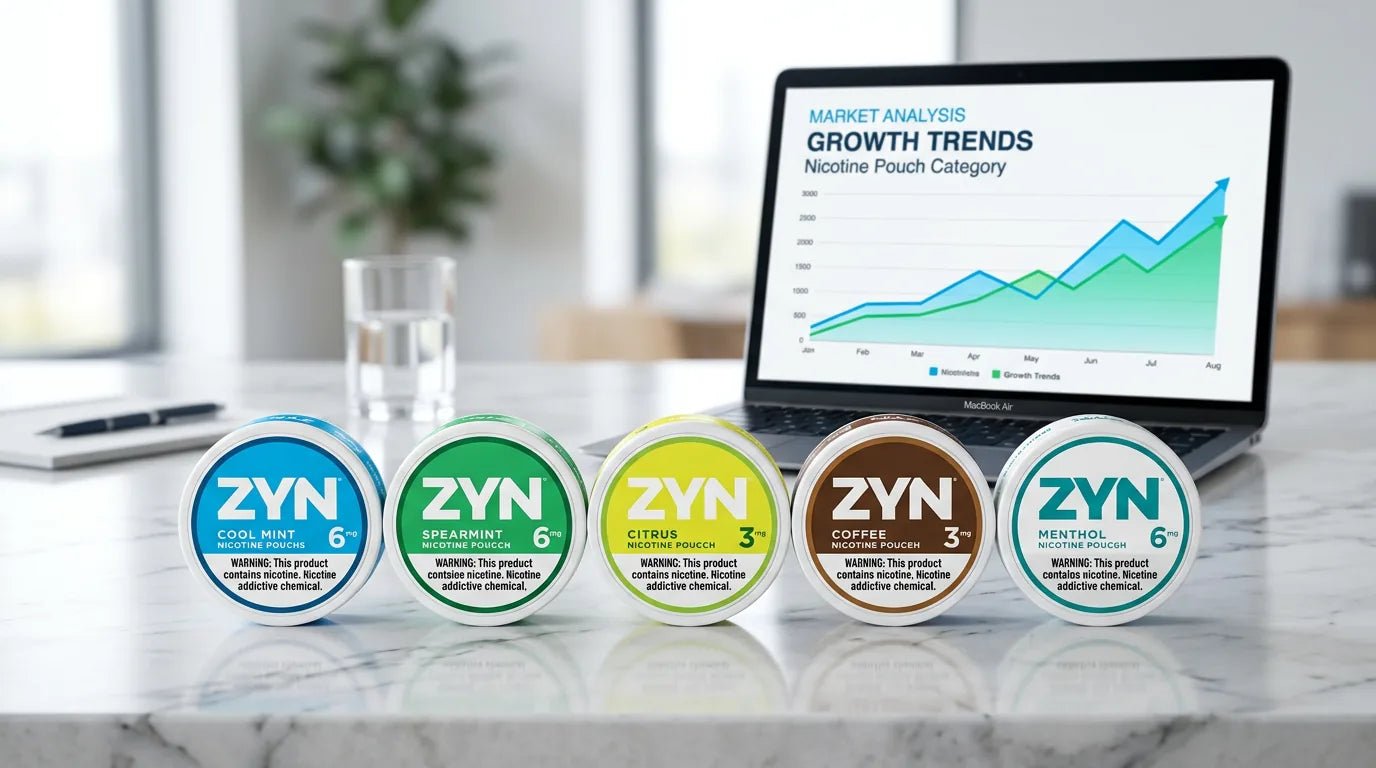
If you're buying ZYN regularly, The Snus Outlet stocks the full ZYN range — Cool Mint, Spearmint, Menthol, Citrus, Coffee and more — at competitive European prices, with fast delivery across the continent.
The Broader Picture: Which Other Brands Are Growing?
ZYN's rise is the headline, but it's not the only story. VELO — BAT's flagship pouch brand — is expanding aggressively across European markets and competing directly with ZYN in the 6–15mg range. XQS and ZEUS are carving out value-leadership positions in markets where consumers are price-sensitive but unwilling to sacrifice quality. LOOP's dual-chamber technology has created a genuinely differentiated product that holds a loyal premium audience. And KUMA and C.R.E.A.M compete on entry-level pricing for high-volume users.
The category growth forecast of $25 billion by 2028 leaves room for all of these brands to grow — and for new entrants like ALP (Tucker Carlson/Conor McGregor) to build meaningful volume from scratch. The nicotine pouch market is still in the early phase of a multi-decade consumer shift. The brands selling the most units in 2028 may not even exist today.
Frequently Asked Questions
How many ZYN pouches are sold in a year?
Based on PMI's 2026 guidance and trajectory, US ZYN volumes are projected to exceed 700 million cans per year in 2026, equivalent to roughly 14 billion individual pouches. Internationally, volumes are growing even faster in percentage terms from a smaller base — particularly in the UK and non-Nordic European markets. Total global ZYN volume across all markets likely runs at well over 1 billion cans annually.
Who owns ZYN nicotine pouches?
ZYN is produced by Swedish Match AB, a Swedish company acquired by Philip Morris International (PMI) in late 2022 for approximately $16 billion — one of the largest tobacco industry acquisitions ever. Swedish Match developed ZYN from its roots in traditional snus, and launched it in the US market in 2016. Today PMI oversees ZYN's global distribution and expansion strategy while Swedish Match manages production in Gothenburg, Sweden.
Is ZYN still growing in 2026?
Yes — significantly. Despite a Q1 2026 shipment decline that was entirely inventory-driven, underlying consumer offtake grew +10% in the US (Nielsen) and international volumes grew well over 50% outside mature Nordic markets. ZYN holds approximately 61% US dollar market share and continues to expand into new European markets. PMI's full-year 2026 guidance anticipates continued high single-digit to double-digit smoke-free volume growth.
What does the FDA MRTP authorisation mean for ZYN in Europe?
The FDA's June 30, 2026 MRTP authorisation allows ZYN to make reduced-risk claims in the US market. In Europe, no equivalent EU-level approval exists yet — the European regulatory framework (TPD3) is still under consultation. However, the FDA decision validates the scientific evidence behind ZYN's risk profile and signals the direction of global regulatory convergence. It gives ZYN a significant credibility advantage over competitors in markets where consumers and regulators scrutinise health claims.
Final Thoughts
The ZYN growth story in 2026 is a masterclass in category creation. A product that barely existed outside Scandinavia in 2018 is now the dominant consumer goods story for one of the world's largest tobacco companies, driving a global market transformation measured in the hundreds of billions of pouches per year. PMI's Q2 earnings on July 22 will add the next data point — but the direction is clear. Browse the full nicotine pouch range at The Snus Outlet — ZYN, VELO, LOOP, XQS, ZEUS, KUMA and more, at the competitive pricing that keeps this category growing for everyone.