

Sweden smoke-free status became official in 2026 — and nicotine pouches played a central role in making it happen. With daily smoking down to just 3.7%, Sweden is now the first country in the world to fall below the WHO's 5% smoke-free threshold. No other EU country has come close. This article breaks down the data behind Sweden's landmark achievement and what it means for nicotine pouch users and buyers across Europe.
- Sweden's daily smoking rate is now 3.7% — the world's first country below the WHO's 5% smoke-free threshold.
- The drop was driven by a combination of high cigarette taxes and legal access to snus and nicotine pouches as alternatives.
- Among Swedes aged 18–29, just 2.9% smoke daily — while 29% use snus or nicotine pouches.
- Sweden has 44% fewer tobacco-related deaths than the EU average. The data points to substitution, not just restriction.
- Browse the full best nicotine pouches of 2026 — the brands driving this shift, available across the EU.
What "Smoke-Free" Means — and Why Sweden Got There First
Smoke-free status is defined by the World Health Organisation as fewer than 5% of the population being daily smokers. WHO estimates tobacco kills over 700,000 people in Europe every year — making this threshold a meaningful public health target, not an arbitrary number.
Sweden crossed that line on 25 October 2025, according to calculations by Swedish economist David Sundén using Public Health Agency of Sweden data. The April 2026 report from CAN — the Swedish Council for Information on Alcohol and Other Drugs — confirmed the milestone with hard figures: 3.7% daily smoking prevalence across the adult population in 2025, down from roughly 15% a decade earlier.
No other EU country is close. France sits at around 30% daily smoking prevalence. Germany is at approximately 25%. The EU average remains above 20%. Sweden is outlying — and the reason why tells you a great deal about what actually reduces smoking.
The Role of Snus and Nicotine Pouches in Sweden's Achievement
Sweden's approach has never been purely restrictive. While other EU countries focused almost entirely on banning, taxing, and stigmatising tobacco, Sweden simultaneously made lower-risk alternatives readily available. Snus — the oral tobacco product legally sold in Sweden under its EU exemption — has been the dominant alternative for decades. Nicotine pouches, which contain no tobacco leaf, have accelerated the trend in the years since their mainstream launch around 2018.
The substitution data is clear. CAN's 2026 report shows snus use rising from 13% to 18% of the adult population since 2013 — almost exactly mirroring the fall in smoking. Among women aged 18–29, daily smoking collapsed from 19% in 2013 to 6% in 2025, while daily snus use climbed from 6% to 17% in the same period. These trends did not happen in isolation: people stopped smoking because they had somewhere to go.
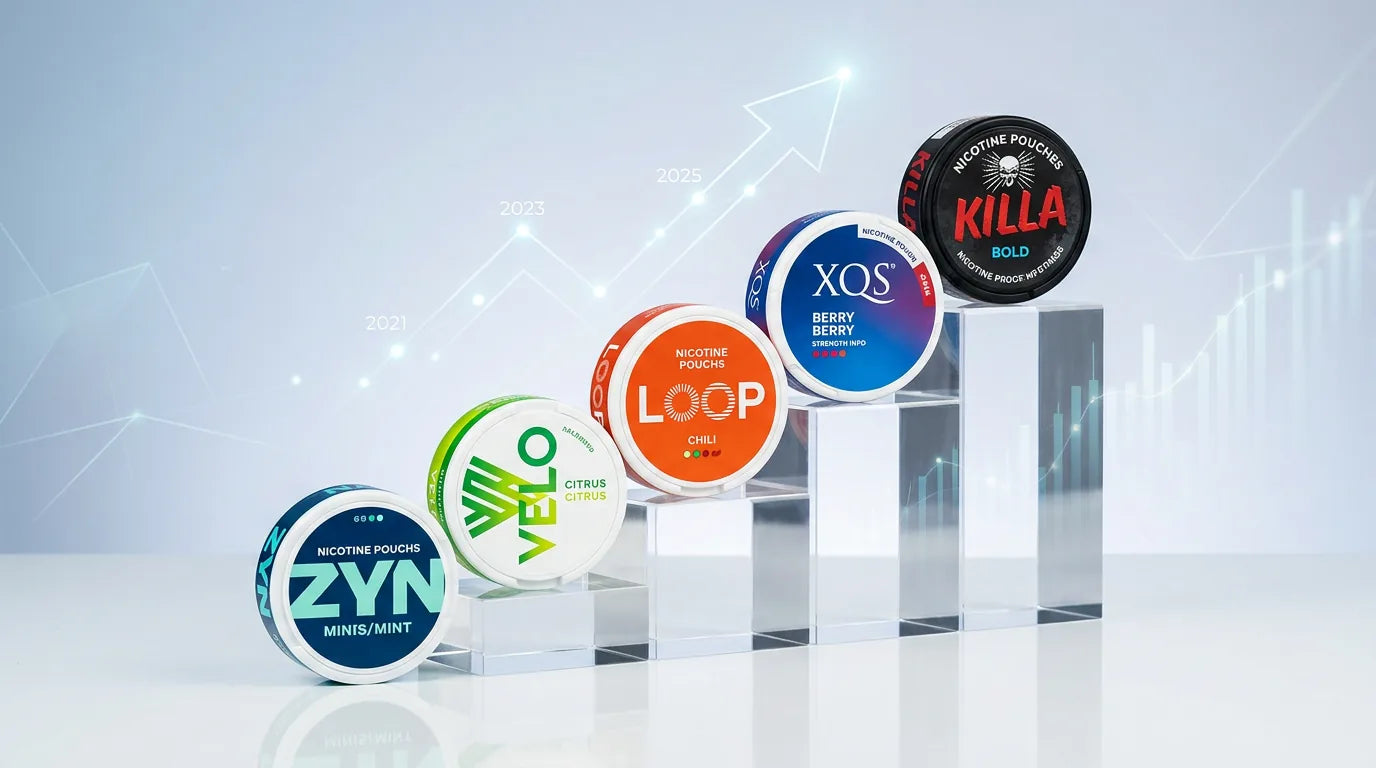
Nicotine pouches fit into this ecosystem differently from snus. They are tobacco-free, lower-profile in social settings, and available in a wider flavour range — which has driven adoption among both existing snus users and younger adults who might never have used snus. The Swedish nicotine pouch market now includes brands like ZYN (developed by Swedish Match in Gothenburg), LOOP, and XQS, all of which were built specifically on this harm-reduction premise.
Sweden's Smoking Decline: The Key Numbers
| Year | Daily Smoking Rate (Sweden) | Snus / Nicotine Pouch Use (18–29) |
|---|---|---|
| 2013 | ~14% | ~15% (snus only) |
| 2018 | ~8% | ~20% (snus + early pouches) |
| 2022 | ~6% | ~25% (snus + pouches growing) |
| 2024 | 4.6% | ~28% |
| 2025 | 3.7% | 29% |
The inverse relationship is consistent across every data point. As tobacco alternatives became more available and more socially normalised, smoking fell — not incrementally, but at pace. Since 2013, Sweden cut its smoking rate by more than 60%. For context: the EU average smoking rate has fallen by roughly 20% in the same period.
Sweden also has the EU's lowest rate of lung cancer. Cancer incidence overall is 41% lower than the EU average, and tobacco-related mortality is 44% lower, according to 2024 public health data. These are structural outcomes — the result of years of substitution, not a recent statistical blip.
The Swedish Model: Can the Rest of Europe Follow?
"The Swedish model" has become shorthand in public health debates for a harm-reduction approach to tobacco. Three components define it: high cigarette taxes, accessible alternatives, and normalisation of substitution. In January 2025, Sweden reinforced this by raising cigarette taxes by 10% while simultaneously cutting the tax on snus by 20% — a deliberate policy signal about which direction it wants consumers to go.
Whether the rest of Europe can replicate this is the live debate in 2026. The obstacles are significant. Most EU countries do not permit snus sales under the EU Tobacco Products Directive — only Sweden has an exemption. Nicotine pouches sit in a regulatory grey area in most member states, and proposed frameworks like TPD3 could either normalise them or restrict them depending on how the legislation lands.
France banned nicotine pouches in April 2026. Spain has proposed similar restrictions. These moves go in the opposite direction from the Swedish model — prioritising restriction over substitution. Whether the outcomes follow a different trajectory to Sweden's will only become clear over the next decade, but the public health data from Sweden is difficult to ignore at a policy level.
What Sweden's Success Means for Nicotine Pouch Buyers in 2026
For European buyers, the Swedish achievement has two practical implications. First, the category you are buying into is proven. The link between accessible nicotine alternatives and reduced smoking harm is not theoretical — Sweden has run the experiment at national scale for over a decade, and the results are measurable in cancer rates and mortality statistics.
Second, regulatory risk is real. The EU is not Sweden. Individual member states are moving in different directions, and the outcome of TPD3 discussions will shape what pouches are available, in what strengths, and at what prices, across the EU over the next five years. For buyers in markets currently without restrictions — Germany, Italy, Austria, the UK — now is the period of maximum product availability and choice.
It is also worth understanding the brand landscape in this context. ZYN was created by Swedish Match in Gothenburg — the same Swedish innovation culture that drove the original snus category. LOOP and XQS are also Swedish-founded brands. These products were not designed incidentally as nicotine delivery vehicles — they came out of a country that has spent 30 years refining the idea that there is a better way to deliver nicotine than combustion.
The Brands Representing the Swedish Model in 2026
| Brand | Origin | Key Formats | Strength Range |
|---|---|---|---|
| ZYN | Swedish Match, Sweden | Slim dry, Mini dry | 3–11 mg |
| LOOP | Haypp Group, Sweden | Slim dry | 9.4–14 mg |
| XQS | Sweden | Slim dry | 4–12 mg |
| VELO | BAT (British American Tobacco) | Slim moist | 4–11 mg |
| KILLA | GN Tobacco, Sweden | Slim, Strong | 16–43 mg |
All of the major brands driving nicotine pouch adoption across Europe are now available through The Snus Outlet — including a full breakdown of how they differ from snus for readers new to the category.
Frequently Asked Questions
When did Sweden officially become smoke-free?
Sweden crossed the WHO smoke-free threshold — below 5% daily smoking prevalence — on approximately 25 October 2025, according to calculations by economist David Sundén based on Public Health Agency data. The April 2026 CAN report confirmed the figure has since dropped further to 3.7% daily smoking. This makes Sweden the first country in the world to meet this definition.
Did nicotine pouches actually help Sweden go smoke-free?
The data is consistent with substitution: snus and nicotine pouch use rose in near-direct proportion to the decline in smoking, especially among younger adults. Among 18–29 year olds, 29% now use snus or nicotine pouches while only 2.9% smoke daily. Correlation is not causation, but the scale and consistency of the data across age groups and genders makes coincidence an unlikely explanation.
Can I order Swedish nicotine pouch brands across the EU?
Yes. Brands including ZYN, LOOP, XQS and KILLA ship freely under EU single market rules to all member states where nicotine pouches are not specifically restricted. The full 2026 collection at The Snus Outlet ships from Stockholm, with free EU delivery on orders over €99 and a 2–7 day delivery window across most of Europe.
Will the EU adopt the Swedish model for nicotine pouch regulation?
Not uniformly. TPD3 is still under discussion and individual member states are taking divergent approaches in 2026 — France has banned pouches, Spain has proposed restrictions, while Germany, Italy and most of Central Europe currently have no specific legislation. The EU is unlikely to adopt a single position quickly, which means regulatory patchwork will continue for the near term.
What is the difference between snus and nicotine pouches as used in Sweden?
Traditional Swedish snus contains tobacco leaf and is subject to the EU-wide snus sales ban (Sweden has an exemption). Nicotine pouches are tobacco-free — made from plant fibre, nicotine, and flavourings — and fall outside the snus directive. Pouches are legally available for purchase across the EU, including via online retailers. Read the full nicotine pouches vs snus comparison for a detailed breakdown.
Final Thoughts
Sweden's smoke-free achievement is not a footnote — it is the most significant public health data point in the nicotine category in a generation. A 60% reduction in smoking over 12 years, in a country of 10 million people, with measurable outcomes in cancer rates and mortality, did not happen by accident. It happened because people had genuine, accessible alternatives to cigarettes.
The brands that made those alternatives possible — ZYN, LOOP, XQS and others developed in Stockholm and Gothenburg — are the same ones available at The Snus Outlet today. Browse the full 2026 range, with free EU shipping on orders over €99 and fast tracked delivery across Europe.