

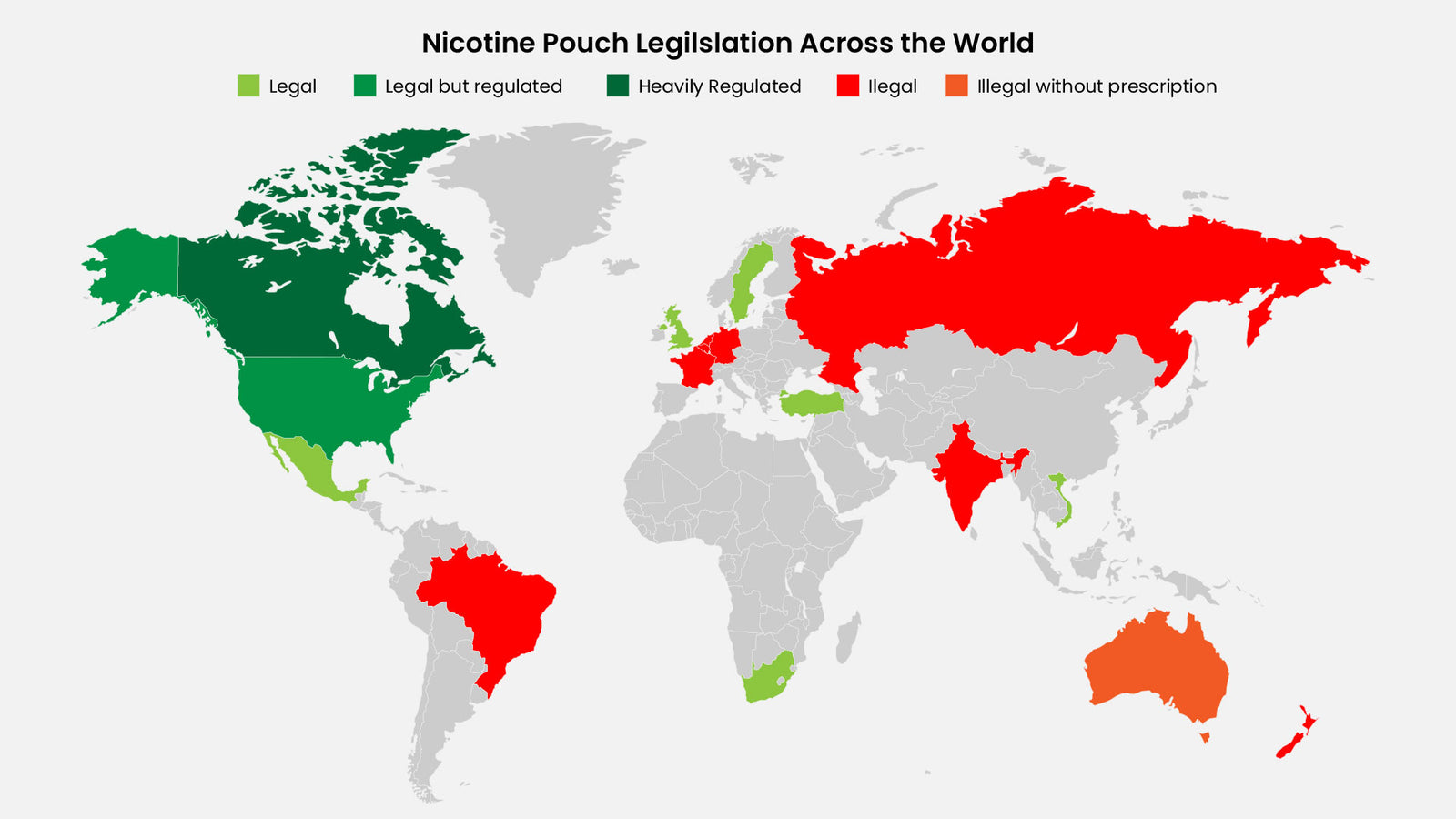
- Both the Netherlands and Belgium have banned the retail sale of nicotine pouches — the Netherlands from January 2025, Belgium from October 2023
- Personal possession and use are not criminalised in either country — the bans target sale and distribution, not consumers
- Online ordering from EU-based international retailers exists in a grey zone — some buyers in both countries continue to order, though the legal basis is less clear-cut than in countries where retail is permitted
- EU-wide regulation (TPD3) is in development and is expected to create a harmonised framework by 2027–2028 — this could reopen or further restrict both markets
- The Snus Outlet ships across Europe — check thesnusoutlet.com for current shipping availability to your country
If you are searching for nicotine pouches in the Netherlands or Belgium, you will quickly run into contradictory information. Some retailers say they ship there freely. Others say it is fully banned. The reality, as of 2026, sits somewhere in between — and understanding it properly requires separating retail law from personal use rules, and domestic bans from international online ordering.
This guide gives you the honest picture: what is actually banned, what is not, what other EU buyers do, and where the regulations are heading.
The Netherlands: Retail Sale Banned Since January 2025
The Netherlands moved to ban the retail sale of nicotine pouches at the start of 2025, covering both physical stores and online retail operating within the country. The Dutch government's reasoning centred on public health concerns, particularly the appeal of flavoured, high-strength products to young people — a concern echoed across several European health ministries in 2024 and 2025.
The key distinction in Dutch law is between sale/distribution (banned) and personal possession and use (not criminalised). A Dutch resident who already has nicotine pouches, or who receives them from a retailer operating outside Dutch jurisdiction, is not committing a criminal offence under the personal use provisions. The enforcement focus is on domestic sellers and distributors, not individual consumers.
That said, the legal basis for ordering from an international EU retailer is genuinely less established in the Netherlands than in countries like Germany or Switzerland. The Dutch RIVM (National Institute for Public Health and the Environment) monitors nicotine product regulation actively, and the situation may evolve as EU-level harmonisation progresses.
Belgium: Retail Sale Banned Since October 2023
Belgium was one of the first EU countries to act, formally banning nicotine pouches in October 2023. The Belgian ban covers production, sale, and distribution — driven by concerns that nicotine pouches were attracting young consumers who had never previously used nicotine. The Belgian Ministry of Health classified them alongside other nicotine products subject to public health restrictions.
As in the Netherlands, the Belgian ban targets commercial sale and distribution rather than individual consumers. Personal possession is not specifically criminalised, though the formal legal position on receiving international shipments for personal use carries more risk than in markets where retail is permitted.
Enforcement of the Belgian ban has been notably inconsistent — some domestic retailers reportedly continued selling through 2024, and online availability through international channels has remained accessible for determined buyers. This reflects the broader EU challenge of enforcing national product bans in an online, cross-border marketplace.
How Do These Bans Compare to Neighbouring Countries?
The contrast between the Netherlands and Belgium and their immediate neighbours is stark:
| Country | Retail Sale | Personal Use | Online Order (from EU retailer) |
|---|---|---|---|
| Netherlands | Banned (Jan 2025) | Not criminalised | Grey zone — legally ambiguous |
| Belgium | Banned (Oct 2023) | Not criminalised | Grey zone — higher legal risk |
| Germany | Restricted (food law) | Legal | Widely practised, legally grey |
| UK | Fully legal | Legal | Fully legal |
| Sweden | Fully legal | Legal | Fully legal |
| Denmark | Legal (restricted from Apr 2026) | Legal | Legal |
| France | Effectively banned (2025–2026) | Not criminalised | Heavily restricted |
The pattern across Western Europe is one of significant regulatory fragmentation. The EU has no unified position — each member state applies whatever national framework it considers appropriate under the current absence of specific EU-level guidance on tobacco-free nicotine pouches.
Why Were These Bans Introduced?
Both the Dutch and Belgian bans were driven by a combination of factors that are worth understanding in context:
- Youth appeal: The flavour variety and discreet format of nicotine pouches raised concerns among health authorities about use among minors — particularly given the lack of a clear regulatory framework to enforce age restrictions on sale
- Classification uncertainty: Because nicotine pouches were not covered by the existing Tobacco Products Directive (TPD2), national authorities had to classify them under existing food, pharmaceutical, or consumer product law — frameworks that did not fit well, creating enforcement gaps
- The snus precedent: Both Belgium and the Netherlands are accustomed to treating oral nicotine products restrictively — traditional tobacco snus has been banned for sale across the EU (except Sweden) since 1992, and there was regulatory instinct to treat pouches similarly despite their tobacco-free composition
According to the European Commission's tobacco product information page, the current Tobacco Products Directive does not cover tobacco-free nicotine pouches, which is precisely the regulatory gap that led to national-level bans forming the patchwork map we see today.
What Is TPD3 and How Will It Change Things?
The Tobacco Products Directive revision (TPD3) is the EU's forthcoming attempt to bring nicotine pouches under harmonised EU law for the first time. As of early 2026, the directive is in the pre-drafting consultation phase and is not expected to come into full effect before 2027–2028.
TPD3 is expected to introduce EU-wide standards covering: nicotine content caps per pouch, packaging and labelling requirements, age restriction enforcement mechanisms, and restrictions on flavour profiles (similar to the menthol/tobacco-only flavour limits already applied to cigarettes). Critically, TPD3 is not expected to introduce an EU-wide ban — rather, it aims to create a consistent regulatory floor that all member states would apply.
For Netherlands and Belgium buyers, the question is whether TPD3 leads their governments to replace outright bans with a regulated-access model (similar to what the UK and Sweden already have), or whether it reinforces existing restrictions. Most regulatory observers expect the former — a harmonised framework with age controls and nicotine caps rather than categorical prohibition.
What Are the Best Legal Alternatives for Dutch and Belgian Buyers?
For buyers in restricted markets who want nicotine alternatives that are clearly legal and accessible, the options currently include:
- Nicotine replacement therapy (NRT) products: Nicotine gums, patches, and lozenges are available through pharmacies and are fully legal in both countries. They carry formal quit-smoking indications and are widely stocked. Brands like Nicorette and Nicotinell cover the mainstream NRT range.
- Ordering from EU specialist retailers: Many Dutch and Belgian buyers continue to order through international EU-based retailers. The legal risk falls primarily on the seller rather than the individual consumer purchasing for personal use — but buyers should be aware of the ambiguity and make their own informed decision.
- Monitoring regulatory developments: TPD3 implementation in 2027–2028 may fundamentally change the landscape. Following updates from WHO tobacco regulation updates and the European Commission is the best way to stay current.
FAQ: Nicotine Pouches in Netherlands and Belgium
Are nicotine pouches completely illegal in the Netherlands?
The retail sale of nicotine pouches has been banned in the Netherlands since January 2025. Personal possession and use are not criminalised. The legal status of ordering from an international retailer for personal use is ambiguous — the enforcement focus is on domestic sellers, not individual consumers, but buyers should be aware the situation is not clear-cut.
Can I buy nicotine pouches online and have them shipped to Belgium?
Belgium banned the sale of nicotine pouches in October 2023. While some international online retailers still ship to Belgium, this exists in a legal grey zone. The ban formally covers production, sale, and distribution. Individual enforcement against consumers receiving personal-use quantities has been limited, but legal risk exists. Buyers should make an informed decision based on their own comfort with that ambiguity.
Why are nicotine pouches banned in these countries but legal in Sweden and the UK?
Regulatory history and classification matter. Sweden has a long oral nicotine culture (snus) and a different national regulatory approach. The UK treats tobacco-free nicotine products as general consumer goods, not tobacco products. The Netherlands and Belgium applied stricter precautionary frameworks, partly influenced by concerns about youth appeal and the absence of a specific EU regulatory framework for these products.
Will nicotine pouches become legal in the Netherlands and Belgium in the future?
Possibly. The forthcoming EU TPD3 directive aims to harmonise regulation across member states, and many observers expect this to push countries toward a regulated-access model rather than outright prohibition. Implementation is expected around 2027–2028 at the earliest.
What brands are popular in these markets?
Before the bans, ZYN, VELO, LOOP, and XQS were among the most popular brands in both countries. These brands remain available through international retailers like The Snus Outlet for buyers in other European markets, with outlet prices up to 60% off and free EU shipping over €99 from Stockholm.
Final Thoughts
The Netherlands and Belgium represent the most restrictive end of the European nicotine pouch spectrum in 2026. The retail bans are real, the enforcement is primarily directed at commercial sellers, and the personal use situation is legally ambiguous rather than explicitly prohibited for consumers. TPD3 will likely bring clarity — but not before 2027 at the earliest.
If you are in a country where nicotine pouches are fully accessible, The Snus Outlet has the full range of ZYN, VELO, LOOP, XQS, KUMA, C.R.E.A.M, ACE, and more — with outlet deals up to 60% off, free EU shipping over €99, and delivery in 2–7 days from Stockholm.