

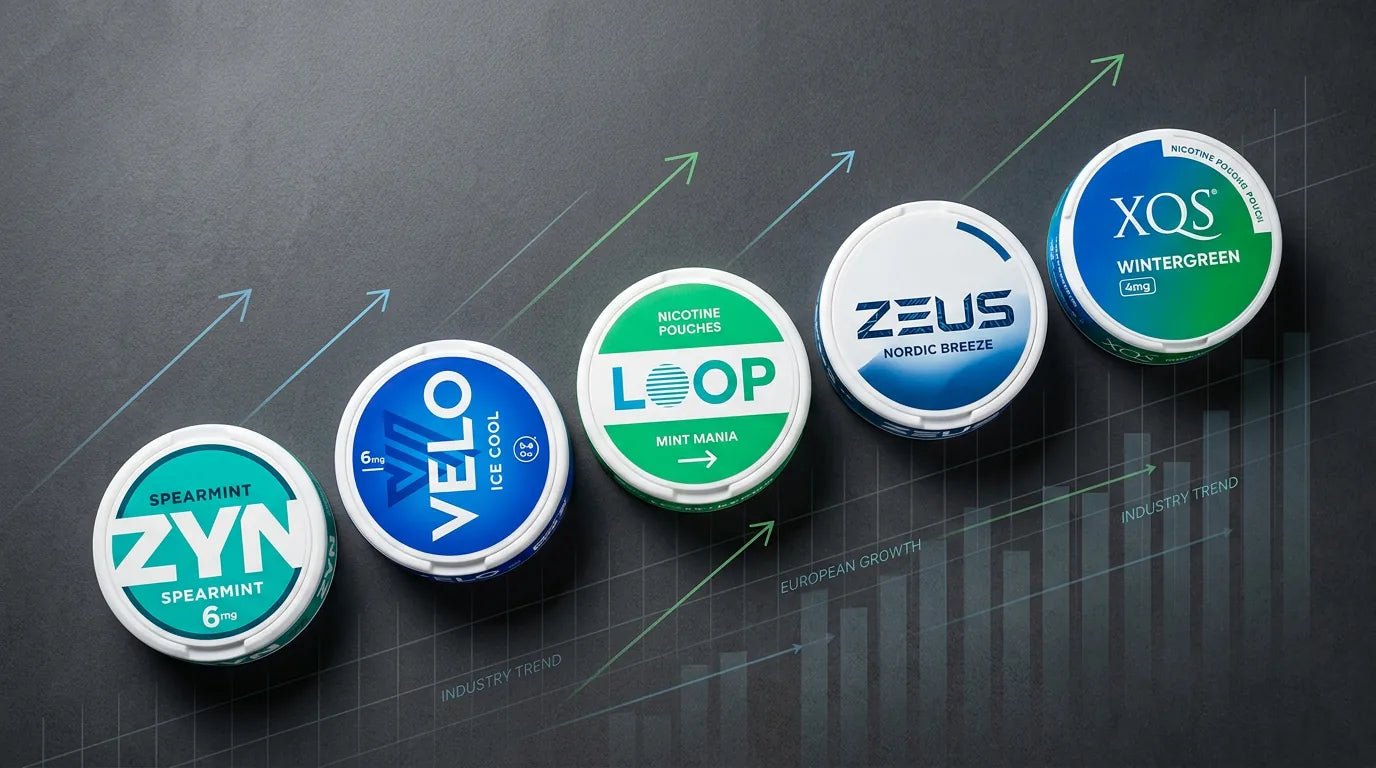
The nicotine pouch market in Europe is growing faster than almost any other consumer product category in 2026 — and the data backs that up. The global market stands at $9.9 billion this year and is projected to hit $56.7 billion by 2035. Europe accounts for 26% of that, at roughly $2.47 billion in 2026 alone. If you have noticed more brands, more flavours, and more people using nicotine pouches around you, you are watching one of the most significant consumer shifts in the tobacco and nicotine industry in decades.
- The global nicotine pouch market is worth $9.9 billion in 2026, growing at 19.4% annually — set to reach $56.7 billion by 2035
- Europe represents $2.47 billion of that total, driven by the UK, Germany, and the Nordic countries
- Philip Morris International leads with ~26% global market share through ZYN; BAT follows closely via VELO
- Production capacity is expanding fast: PMI extended its Czech Republic facility, BAT scaled up in the US to supply Europe
- Regulatory tightening is coming — EU flavour restrictions and nicotine caps are in discussion for 2027–2028
The Global Picture: A $9.9 Billion Market in 2026
The numbers from independent analysts are consistent and striking. According to Global Market Insights (March 2026), the nicotine pouch market is valued at $9.9 billion in 2026, growing at a compound annual rate of 19.4% through 2035. At that pace, it will more than quintuple in size within a decade — a trajectory almost unheard of in consumer staples.
For context: the category barely existed before 2016. ZYN launched in the US in 2016. VELO rolled out across Europe from around 2019. By 2025, ZYN alone was shifting over 900 million cans per year globally, and the US FDA formally authorised the brand in January 2025. The European story has followed a similar arc, but with its own regional dynamics and regulatory complexity.
Persistence Market Research (May 2026) pegs Europe's share at $2.47 billion, making it the world's second-largest regional market behind North America. That figure represents serious commercial weight — and explains why every major tobacco company is pivoting production capacity toward the category.
Europe's Regional Breakdown: Who Is Buying?
Not all European markets are equal. Adoption varies sharply by country, shaped by culture, regulatory stance, and familiarity with oral nicotine formats like snus.
| Country / Region | Share of European Market | 2026 Estimated Value | Key Driver |
|---|---|---|---|
| UK | ~20% | ~$494 million | Strong vaping culture migrating to pouches; government harm-reduction support |
| Germany | ~18% | ~$445 million | High cigarette consumption; flexible product classification; broad retail availability |
| Nordic countries (SE, DK, NO, FI) | ~22% | ~$543 million | Snus heritage; early adopter market; highest per-capita usage globally |
| Poland | ~7% | ~$173 million | Rapid growth from low base; affordable brands gaining traction |
| Rest of Europe | ~33% | ~$815 million | Emerging markets: Italy, Spain, Czech Republic, Belgium, Austria |
The Nordic countries are the original home of oral nicotine — Sweden's smoke-free success story is the most-cited case study in the industry. But Germany and the UK are the growth engines in 2026, driven by large populations, established retail infrastructure, and adult consumers actively seeking cigarette alternatives.
Who Controls the Market? The Key Players in 2026
Five companies dominate the global nicotine pouch category. At the top is Philip Morris International (PMI), with approximately 26% market share, almost entirely built on the ZYN brand. PMI acquired Swedish Match (ZYN's creator) in 2022 for $16 billion — one of the most consequential acquisitions in tobacco industry history — and has been integrating it aggressively across European markets ever since.
British American Tobacco (BAT) follows closely, primarily through VELO (rebranded from Lyft). BAT has invested heavily in production capacity for VELO, announcing in March 2025 an expansion of its Tobaccoville, North Carolina facility specifically to accelerate European and global supply. VELO is now one of the most widely distributed pouch brands across the EU.
| Company | Key Brand(s) in Europe | Market Position | 2025–2026 Move |
|---|---|---|---|
| Philip Morris International | ZYN | Global leader (~26%) | Czech Republic expansion; Kutná Hora production scale-up (July 2025) |
| British American Tobacco | VELO, Lyft | Close second | Tobaccoville facility expansion to support EU supply (March 2025) |
| Imperial Brands | Nordic Spirit, Skruf | Premium niche | Focus on Scandinavia and Western Europe premium tier |
| Swedish Match / Fiedler & Lundgren | LOOP, XQS, White Fox | Indie/specialist segment | Innovation-led launches; strong EU online presence |
| Independent Brands | ZEUS, C.R.E.A.M, KUMA | Value/challenger segment | Gaining share via price and online retail |
Below the top three, the market has a significant long tail of independent and challenger brands that are growing rapidly through online channels. Brands like ZEUS, C.R.E.A.M, LOOP and KUMA compete aggressively on price and are often available at 30–50% below the cost of ZYN or VELO in specialist online stores. That price gap is a major growth driver for online retail specifically.
What Is Driving the Growth?
Four structural trends are fuelling the European nicotine pouch expansion in 2026, and they are not going away anytime soon.
- Cigarette decline accelerating: EU smoking rates have fallen from 26% in 2014 to under 19% in 2026. Adult smokers are switching — and nicotine pouches are one of the cleaner exit ramps available.
- Venue and workplace bans: Indoor smoking bans, increasingly strict vaping restrictions, and social norms around odour are pushing nicotine users toward tobacco-free, smoke-free, vapour-free alternatives.
- Format appeal: Pouches are discreet, flavoured, and require no accessories. They fit neatly into modern daily routines — commuting, office work, travel, social situations.
- Online retail expansion: EU cross-border e-commerce means consumers in Ireland, Poland, or Romania can access the full European product range at competitive prices, often at €3–6 per can versus €8–12 at local retailers.
New Technology and Innovation: What's Coming
The category is not standing still on product technology. Swedish firm Emplicure has developed Seratek®, a patented pouch technology designed to deliver nicotine more efficiently at lower stated strengths — meaning consumers could get equivalent satisfaction from a 6 mg pouch that previously required 12 mg. The company announced plans in late 2025 to pursue FDA regulatory clearance in the US, with European rollout implications expected to follow.
On the flavour side, manufacturers are pushing into more premium and lifestyle-oriented profiles — cold brew coffee, tropical fruit, menthol variants engineered to last 45–60 minutes rather than 20–30. LOOP, XQS, and ZEUS have all launched or announced extended-duration variants for the European market in the first half of 2026.
Format is also evolving. Mini and slim formats now account for an estimated 40% of European pouch sales, driven by consumers who prioritise discretion above all else. Several brands are moving toward fully compostable or recyclable can materials — a product-level response to sustainability concerns that increasingly shape purchasing decisions in Northern European markets.
The Regulatory Shadow: EU Rules and the WHO Warning
Growth this fast attracts regulatory attention. In May 2026, the WHO published a warning that some nicotine pouch brands were targeting younger audiences through flavouring and marketing strategies, and called on member states to tighten oversight. This adds momentum to EU-level discussions about extending Tobacco Products Directive rules explicitly to nicotine pouches.
The broad outlines of what is being discussed at EU level include: nicotine caps (a proposed 20 mg/g limit across all oral nicotine products), flavour restrictions similar to those already applied to cigarettes, standardised warning labels, and possible age-verification requirements for online sales. France moved pre-emptively with a court-ordered ban in April 2026, though enforcement for cross-border online orders remains complex.
For consumers in 2026, the practical upshot is: current product availability is good, but the window for unrestricted flavour variety at current price points may be shorter than it was three years ago. Stocking up on preferred products from established EU retailers now, while the full range is available, is a pragmatic response to incoming restrictions.
What This Means If You Are Buying Pouches in Europe
The market dynamics have clear implications for where and how you buy. First, online is almost always cheaper than retail — the EU market structure means specialist online stores carry the full brand and flavour range at prices 30–60% below pharmacy or convenience store prices. Second, challenger brands represent serious value: C.R.E.A.M, ZEUS, KUMA, and XQS deliver comparable or superior quality to the Big Tobacco-backed names at significantly lower prices per can.
Third, regulatory changes may affect product availability in specific markets — France being the most live example. If you are in a market with pending legislation, buying from a reliable EU cross-border retailer locks in your access to the current range before any restrictions take effect.
Browse the outlet deals section at The Snus Outlet for the best prices across ZYN, VELO, LOOP, ZEUS, C.R.E.A.M, XQS and KUMA — with free EU shipping on orders over €99.
FAQ: Nicotine Pouch Market 2026
How big is the nicotine pouch market in Europe in 2026?
Europe's nicotine pouch market is valued at approximately $2.47 billion in 2026, representing around 26% of the global total, according to Persistence Market Research. The UK, Germany, and the Nordic countries account for the majority of European sales volume.
Which brand has the biggest market share in nicotine pouches globally?
Philip Morris International leads globally with approximately 26% market share, almost entirely through ZYN. BAT follows closely via VELO. The top five players — PMI, BAT, Imperial Brands, Turning Point, and Altria — hold around 64% of the global market collectively.
Will EU regulations restrict nicotine pouches?
Regulatory tightening is likely in the 2027–2028 timeframe based on current EU legislative discussions. Proposed measures include nicotine caps, flavour restrictions, and standardised labelling. France has already moved with a domestic ban, and the WHO issued a warning in May 2026 regarding youth-targeting by some brands. However, cross-border online sales remain largely unaffected for now.
Why are nicotine pouches growing so fast in Europe?
Four main drivers: declining smoking rates and a need for alternatives; stricter indoor smoking and vaping bans; the format's discreet, smoke-free appeal for modern lifestyles; and the expansion of affordable online retail giving consumers across all EU markets access to the full product range at competitive prices.
Final Thoughts
The nicotine pouch market is not a niche trend — it is a $9.9 billion industry growing at nearly 20% annually, with Europe at the centre of the story. Big Tobacco has bet tens of billions of dollars on this category, production capacity is scaling globally, and innovation is accelerating. For consumers, that means more choice, better products, and real price competition — especially through online specialist retailers. The regulatory environment will tighten in the coming years, but in 2026 the range is wide and the prices are competitive. Explore the full range at The Snus Outlet's best pouches of 2026 — free EU shipping over €99.