
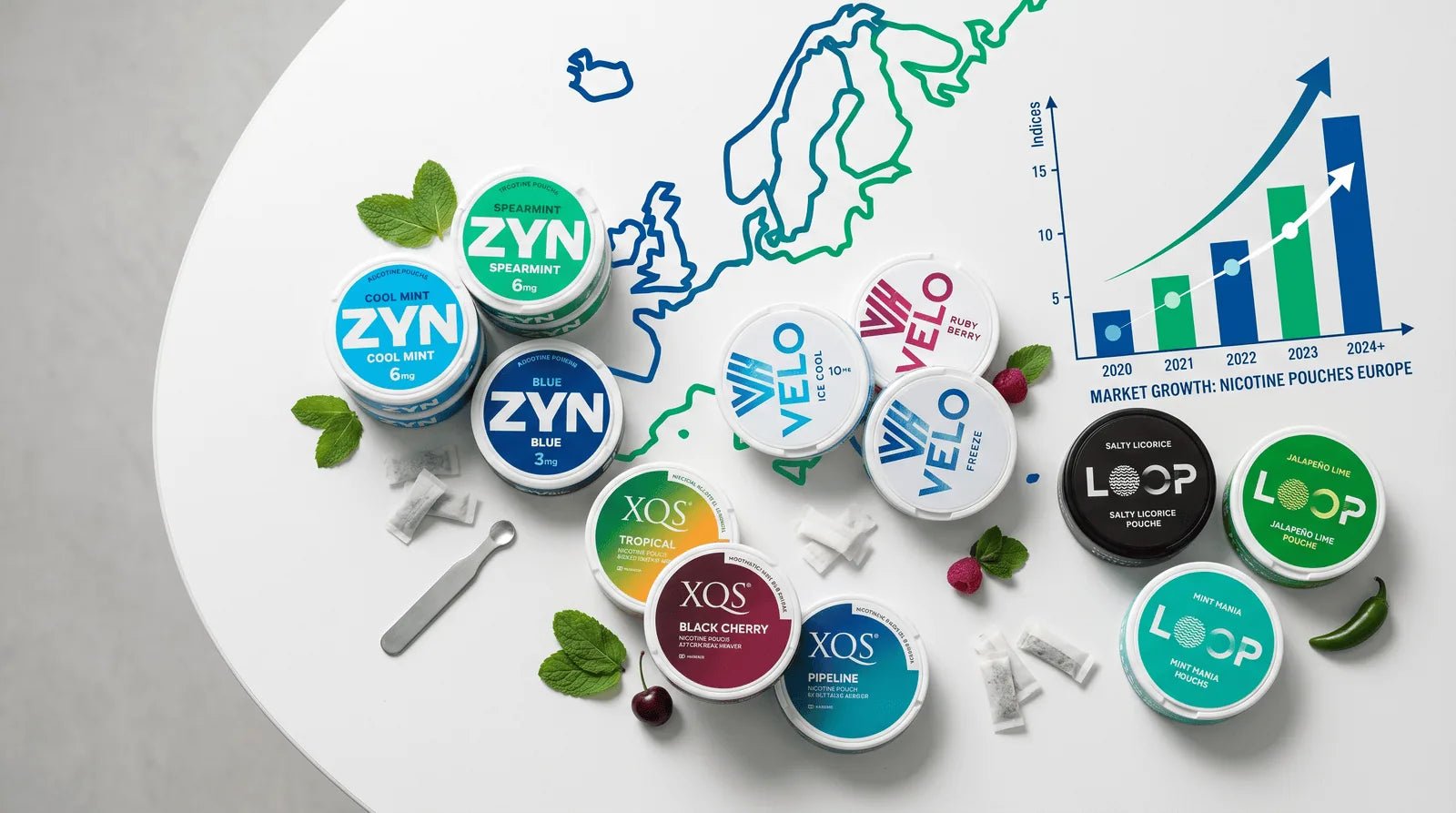
- The global nicotine pouch market is valued at $8.63 billion in 2026 — Europe is the largest single region.
- The European market is growing at a CAGR of roughly 19–29% per year, depending on the analyst — one of the fastest-expanding consumer categories on the continent.
- Germany leads European sales with a 20.9% market share, followed by the UK (14.3%) and France (13.45%).
- The shift away from cigarettes and the ban on disposable vapes is accelerating pouch adoption across Central and Western Europe.
- For consumers, the growth means more competition, better prices, and wider product ranges — shop the latest at the best nicotine pouches of 2026.
Nicotine pouches are no longer a niche product. In 2026, they represent one of the most dynamic consumer categories in Europe — growing faster than energy drinks a decade ago and reshaping how millions of people consume nicotine. The numbers are striking, and if you buy pouches regularly, they tell a story that matters to you directly.
How Big Is the European Nicotine Pouch Market in 2026?
The global nicotine pouch market was valued at approximately $8.63 billion in 2026, according to The Business Research Company — up from $6.69 billion in 2025, a year-on-year increase of roughly 29%. Europe is the largest region by market share, ahead of North America and Asia-Pacific combined.
Within Europe specifically, market analysts at Cognitive Market Research put the European segment at around $556 million in 2025, rising toward $3.75 billion by 2033 at a compound annual growth rate of 26.9%. Even the more conservative estimates project a market that doubles in size every three to four years. That is not a trend — that is a structural shift.
To put this in context: the category barely existed in most European countries before 2018. Within eight years, it has become a multi-billion-dollar industry with mainstream retail presence across convenience stores, pharmacies, and online channels.
Which Countries Are Leading European Growth?
The European market is not uniform — growth rates and adoption vary significantly by country. Based on available market data, here is how the landscape looks in 2026:
| Country | Share of European Market | Key Characteristics |
|---|---|---|
| Germany | ~20.9% | Largest market by volume, strong DACH-region growth |
| United Kingdom | ~14.3% | High adoption rate, supportive harm-reduction policy |
| France | ~13.45% | Fast-growing, driven by vape-to-pouch switchers |
| Italy | ~11.88% | Heated tobacco strong, but pouches gaining share |
| Spain | ~7.59% | Younger demographic driving adoption |
| Sweden/Scandinavia | ~6% | Highest per-capita penetration worldwide |
| Rest of Europe | ~26% | Eastern Europe the fastest-growing subregion |
Germany's dominance reflects a population of over 80 million combined with a growing awareness of harm-reduction alternatives. The UK, despite being outside the EU, operates with a notably progressive public health approach — NHS guidance actively promotes nicotine alternatives to cigarettes, which has helped normalise the pouch category. Scandinavia leads the world in per-capita terms due to its long history with oral nicotine products.
What Is Driving the Boom?
Several structural forces are pushing the market upward simultaneously. None of them look like they are going away soon.
1. The smoke-free movement. Sweden became the first country in the world to achieve "smoke-free" status — defined as below 5% smoking prevalence — in 2024. According to the World Health Organization's tobacco fact sheet, smoking kills over 8 million people per year globally. Governments across Europe are under political pressure to reduce those numbers, and nicotine pouches fit neatly into harm-reduction frameworks as a smokeless, tobacco-free alternative.
2. Disposable vape bans. In 2024 and 2025, the UK, France, Belgium, and several other European nations banned or began phasing out disposable e-cigarettes. Millions of consumers who relied on disposable vapes were left looking for alternatives. Nicotine pouches — no device, no refill, no regulation — absorbed a meaningful slice of that demand.
3. Retail expansion. Pouches have broken out of specialist tobacco shops and into convenience stores, petrol stations, supermarkets, and online subscription services. Wider availability drives volume regardless of consumer awareness.
4. Price and value. As production scales up, prices are falling. European manufacturers and online retailers like The Snus Outlet's outlet deals section are offering competitive pricing that makes pouches cheaper per-use than smoking in most markets.
The Brands Dominating European Sales
Three global conglomerates dominate the supply side. Swedish Match (owned by Philip Morris International) manufactures ZYN, by far the world's best-selling brand. ZYN alone generated over $3 billion in US sales in 2025 and continues expanding its European footprint aggressively. British American Tobacco produces VELO, the most widely distributed brand in European convenience retail. Philip Morris also owns its own competing brands targeting different market segments.
The European market also has strong challenger brands. LOOP, produced by FN Tobak in Sweden, has built a loyal following for its long-release formula and bold flavours. XQS, ZEUS, and C.R.E.A.M are gaining ground among price-sensitive and flavour-driven consumers. KUMA has become a go-to for buyers looking for value without sacrificing quality. Browse the full range — including ZYN, VELO, LOOP, and XQS — at The Snus Outlet.
What This Means for Consumers
Market growth is almost always good news for consumers. More competition between brands means more flavours, more strengths, and lower prices. The number of distinct nicotine pouch SKUs available in Europe has roughly tripled since 2022. What started as a handful of mint and citrus options is now a full spectrum of fruit, coffee, berry, herbal, and cooling formats across strengths from 2 mg to 50+ mg.
Online retail is also maturing fast. Subscription services, bulk-order discounts, and outlet pricing mean that committed users can access premium-brand pouches at a fraction of their convenience store price. At The Snus Outlet, free EU shipping kicks in over €99, and the outlet section regularly features deals up to 60% off on overstocked and short-dated products.
Risks on the Horizon
The market faces real headwinds too. Flavour bans are the biggest near-term risk — several European countries are discussing restrictions on non-tobacco flavours similar to what has already been applied to e-cigarettes. Since flavoured products drive the majority of sales, widespread bans could meaningfully slow growth. Taxation is the other pressure point: as pouches become mainstream, excise taxes that previously applied only to tobacco are being extended or newly applied to nicotine pouches in multiple jurisdictions.
The EU Tobacco Products Directive currently does not explicitly regulate tobacco-free nicotine pouches at the Union level — oversight is patchy and country-by-country. This regulatory fragmentation creates uncertainty for both manufacturers and consumers, particularly those ordering across EU borders. A revised TPD framework is expected before 2030, and its scope will significantly shape how the market develops.
FAQ: European Nicotine Pouch Market 2026
How big is the nicotine pouch market in Europe?
The European nicotine pouch market was estimated at around $556 million in 2025 and is growing at a compound annual rate of approximately 27%. The broader global market, of which Europe is the largest single region, was valued at $8.63 billion in 2026 according to The Business Research Company.
Which European country buys the most nicotine pouches?
Germany is the largest European market by revenue, with around a 20.9% share. The UK and France follow. In per-capita terms, Scandinavian countries — particularly Sweden, Denmark, and Norway — lead the world due to their long history with oral nicotine products.
Are nicotine pouches legal across Europe?
Yes, in most European countries. Tobacco-free nicotine pouches are legal to buy and use across the EU, UK, and most of Europe. However, minimum age requirements apply (18+ in all markets), and some countries impose restrictions on online sales or flavours. Always check local rules before ordering. See our UK and Germany guides for country-specific detail.
Why are nicotine pouch sales growing so fast?
The three main drivers are the smoke-free movement (government pressure to reduce smoking), the ban on disposable vapes in key European markets, and rapid retail expansion into mainstream channels. According to WHO data, smoking remains the leading cause of preventable death globally — which keeps policy momentum firmly behind harm-reduction alternatives.
Which brands are most popular in Europe?
ZYN and VELO are the two biggest-selling brands by volume across Europe. ZYN dominates in Scandinavia and the UK; VELO has the broadest retail distribution across Central and Western Europe. Challenger brands including LOOP, XQS, ZEUS, and KUMA are growing fast in the value and flavour segments. Browse all brands at The Snus Outlet 2026 best picks.
Final Thoughts
The numbers do not lie: nicotine pouches are one of the fastest-growing consumer categories in Europe, and the structural forces behind that growth — harm reduction policy, vape bans, retail expansion — are not reversing. If you are already a pouch user, this means more choice, better prices, and broader availability year on year. If you are still deciding, there has never been a better time to try.
At The Snus Outlet, we stock the leading European brands — ZYN, VELO, LOOP, XQS, ZEUS, and more — with free EU shipping over €99 and outlet deals up to 60% off. Shop the 2026 collection today and see what the fastest-growing market in Europe is stocking up on.
Share:
Best Nicotine Pouches for Sports and Active Lifestyles: The 2026 Guide
Best Nicotine Pouches for Disposable Vape Users: The 2026 Switcher's Guide