

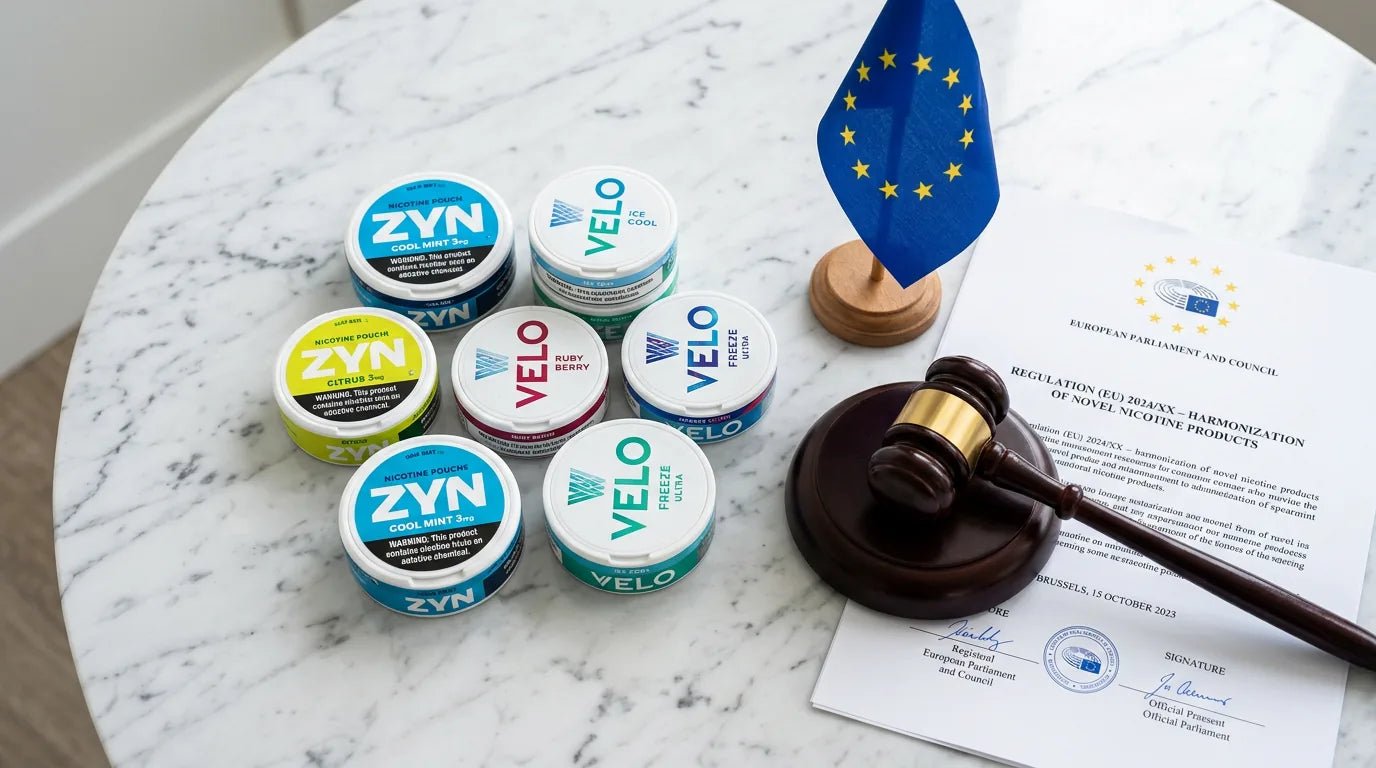
The EU Tobacco Products Directive 3 (TPD3) is the most significant regulatory event on the horizon for nicotine pouch users in Europe. Unlike its predecessor, TPD3 will explicitly cover tobacco-free nicotine pouches for the first time — bringing the entire category under EU-wide product standards, health warnings, and possible flavour restrictions. The proposal hasn't landed yet, but the groundwork laid in April 2026 makes its direction clear. Here's a plain-language breakdown of where things stand and what it actually means for buying pouches in Europe.
Key Takeaways
- TPD3 is not yet law — the EU Commission is expected to publish its legislative proposal by end of 2026, with actual rules not taking effect until approximately 2029–2030
- Nicotine pouches are insufficiently covered by the current TPD2 — this is the EU Commission's own assessment from April 2026
- Key changes expected: mandatory health warnings, EU-wide age verification, standardised nicotine limits, and possible flavour restrictions on fruity and sweet profiles
- A separate Tobacco Excise Directive revision (already proposed in July 2025) would add tax to nicotine pouches — this is a different legislative track running in parallel
- Nothing changes for purchasing right now — pouches remain fully legal and available across the EU
What Is TPD3 and Why Does It Matter?
The Tobacco Products Directive (TPD) is the EU's primary legislative framework for regulating nicotine and tobacco products. The current version, TPD2 (Directive 2014/40/EU), was passed in 2014 and covers cigarettes, roll-your-own tobacco, smokeless tobacco, and e-cigarettes. It sets rules on health warnings, ingredients, packaging, and market notifications.
The problem is that TPD2 was written before tobacco-free nicotine pouches existed at scale. The directive's definitions don't cleanly fit the category, leaving regulation fragmented — each EU member state has been handling pouches independently. Sweden regulated them in 2024. Romania followed in March 2024. Denmark set its own rules. France's Constitutional Court banned them outright in April 2026. The result is a patchwork that TPD3 is specifically designed to replace.
According to the European Commission's official tobacco product regulation page, the fitness check published on 2 April 2026 concluded that the current TPD framework has been "broadly effective" for traditional tobacco products but explicitly acknowledged that novel nicotine products including pouches are "insufficiently covered." That language is the trigger for the revision process.
Where TPD3 Stands in Mid-2026
The EU's legislative process is multi-stage and slow. Here is where things actually are in May 2026:
- April 2026: EU Commission publishes its official evaluation (fitness check) of TPD2 — the starting pistol for the TPD3 revision process
- April 2026: The EU's own Regulatory Scrutiny Board issued a negative opinion on the evaluation, stating the evidence base is incomplete and that around a dozen member states failed to provide required data. This creates some procedural friction.
- End of 2026 (target): EU Commission plans to publish its legislative proposal for TPD3 — this is the actual draft law
- 2027–2028 (estimate): European Parliament and Council review, amendment, and negotiation
- 2028–2029 (estimate): Final text adopted, transposition period begins for member states
- 2029–2030 (earliest realistic): New rules enter into force across the EU
The negative Scrutiny Board opinion is worth noting: it doesn't block the process, but it signals that the Commission's evidence base is contested. The reform is coming — but its exact shape is not yet locked in, and stakeholder consultation will be significant.
What TPD3 Is Expected to Change for Nicotine Pouches
Based on the Commission's evaluation, industry submissions, and the direction of recent national legislation across the EU, here are the changes most likely to make it into TPD3 for nicotine pouches:
| Area | Current Situation | Likely Under TPD3 |
|---|---|---|
| Health warnings | No EU-mandated standard; varies by country | Mandatory standardised health warnings on all packaging (similar to e-cigarettes) |
| Nicotine cap | Patchwork — Romania 20 mg, Denmark 20 mg, others unregulated | EU-wide harmonised cap, likely 20 mg per pouch |
| Age verification | 18+ in some countries; not universal online | Mandatory 18+ with digital age verification for e-commerce |
| Flavour restrictions | Unrestricted across most EU markets | Likely restrictions on fruit, sweet, and beverage-inspired flavours to reduce youth appeal |
| Packaging | Brand-standard packaging, no EU restrictions | Possible plain-packaging requirements, colour/imagery restrictions |
| Track & trace | Not required for pouches | EU-wide Track & Trace 2.0 system for authenticity and illicit trade prevention |
| Product notification | Varies; no unified EU system | Standardised EU submission for all products before market entry |
Of these, flavour restrictions represent the highest commercial impact for buyers. The political direction in Brussels is toward limiting sweet, fruity, and beverage-inspired flavour profiles across all novel nicotine products — the same approach that has already restricted vape flavours in some member states.
The TPD3 Track vs the Excise Directive Track
There are two parallel EU regulatory processes affecting nicotine pouches in 2026, and it's worth keeping them separate because they move on different timelines and have different impacts.
The Tobacco Products Directive (TPD3) — the subject of this article — covers product standards: packaging, warnings, flavours, nicotine limits, and track and trace. It's about what pouches can look like and contain.
The Tobacco Taxation Directive revision (COM(2025) 580, published July 2025) is a separate proposal that would bring nicotine pouches into the EU excise duty framework for the first time. This is about price — specifically, a harmonised minimum tax rate applied to pouches across member states. This proposal requires unanimous Council approval and is moving more slowly as a result. The existing post on The Snus Outlet blog covers this taxation angle in depth.
In short: TPD3 determines what you can buy; the Excise Directive affects what you'll pay for it. Both are in motion simultaneously.
The France Situation — A Preview of What Stricter Rules Look Like
France's April 2026 court ruling ordering a ban on nicotine pouches is the most dramatic example of what national-level restriction looks like before TPD3 arrives. France's ban isn't an EU policy — it's a French constitutional court decision — but it illustrates the direction that some member states are pushing.
France's reasoning centred on the categorisation of nicotine pouches as a "novel nicotine product" not properly covered by existing EU rules, giving member states room to act independently. TPD3 is specifically designed to close this gap by creating a harmonised EU framework — which, ironically, could prevent France-style outright bans in the future by establishing that pouches are regulated rather than simply ungoverned.
TPD3 may result in pouches being more restricted in some countries and less restricted in others — the net direction is toward uniform product standards that are stricter on packaging and flavours but also provide clearer legal status across the bloc.
What Should Pouch Users Do Right Now?
The straightforward answer: nothing has changed yet. The full range of ZYN, VELO, LOOP, C.R.E.A.M, ZEUS, XQS, and KUMA products remains legal and available for delivery across the EU in 2026. TPD3 hasn't been proposed yet, let alone passed.
If anything, the possibility of future flavour restrictions makes 2026 a good time to explore the full range of available flavours while the selection is at its widest. Fruity and sweet profiles — from ZYN Citrus to VELO Berry Frost to XQS Elderflower — are the formats most likely to face future restrictions if TPD3 follows the same path as EU e-cigarette regulation.
On pricing: if the Tobacco Excise Directive passes, pouch prices across the EU will rise moderately — likely 10–30% depending on member state implementation. This is a reason to consider stocking up at current prices, particularly on brands you use regularly. Orders over €99 at The Snus Outlet qualify for free tracked EU delivery, and the outlet deals section has discounts on selected lines year-round.
Frequently Asked Questions
What is TPD3 and when will it affect nicotine pouches?
TPD3 is the proposed third revision of the EU Tobacco Products Directive — the main law governing nicotine and tobacco products across all EU member states. The European Commission is expected to publish its legislative proposal by end of 2026. After that, the European Parliament and Council negotiate the final text, and member states transpose it into national law. The earliest realistic date for TPD3 rules to take effect is 2029–2030.
Will TPD3 ban nicotine pouches in the EU?
No. TPD3 is expected to regulate nicotine pouches — not ban them. The EU Commission's direction is toward bringing pouches under the same product standards framework as e-cigarettes: health warnings, age verification, track and trace, and possible flavour restrictions. An outright EU-wide ban is not on the table. Individual member states (like France) can ban products under current rules, but TPD3 would actually limit that flexibility by establishing a harmonised framework.
Are fruity nicotine pouches at risk under TPD3?
Yes — fruity, sweet, and beverage-inspired flavours are the most likely candidates for restriction under TPD3. The EU has already restricted sweet vape flavours in several countries, and the Commission's approach to novel nicotine products consistently targets flavour profiles that are considered appealing to minors. A total ban on all flavours is unlikely, but restrictions on specific fruity/candy-style profiles are a realistic outcome.
How is TPD3 different from the EU's Tobacco Excise Directive revision?
They are two different legislative tracks running simultaneously. TPD3 (Tobacco Products Directive) covers product standards: packaging, health warnings, flavours, nicotine limits. The Tobacco Excise Directive revision (proposed July 2025 as COM(2025) 580) covers taxation — it would introduce a harmonised EU-wide minimum excise duty on nicotine pouches for the first time. TPD3 determines what products can look like and contain; the Excise Directive determines what they cost. Both are in progress; neither is final.
Should I stock up on nicotine pouches before EU regulations tighten?
There is no regulatory emergency right now — full range availability across the EU is unchanged in 2026. However, if you have preferred fruity or sweet flavour profiles, 2026 is a reasonable time to explore the widest available selection before potential future restrictions narrow options. Any price increases from the Excise Directive would take several years to arrive even if the proposal passes.
Final Thoughts
TPD3 is real, it is coming, and nicotine pouches are explicitly in scope for the first time. The timeline is years away and the exact rules aren't set yet — but the direction is clear: stricter product standards, mandatory health warnings, possible flavour limits, and EU-wide age verification. That's a more regulated market, not a banned one.
Browse the full current range while the widest selection remains available — ZYN, VELO, LOOP, XQS, ZEUS, C.R.E.A.M, and KUMA all shipping to the EU with free tracked delivery on orders over €99.