

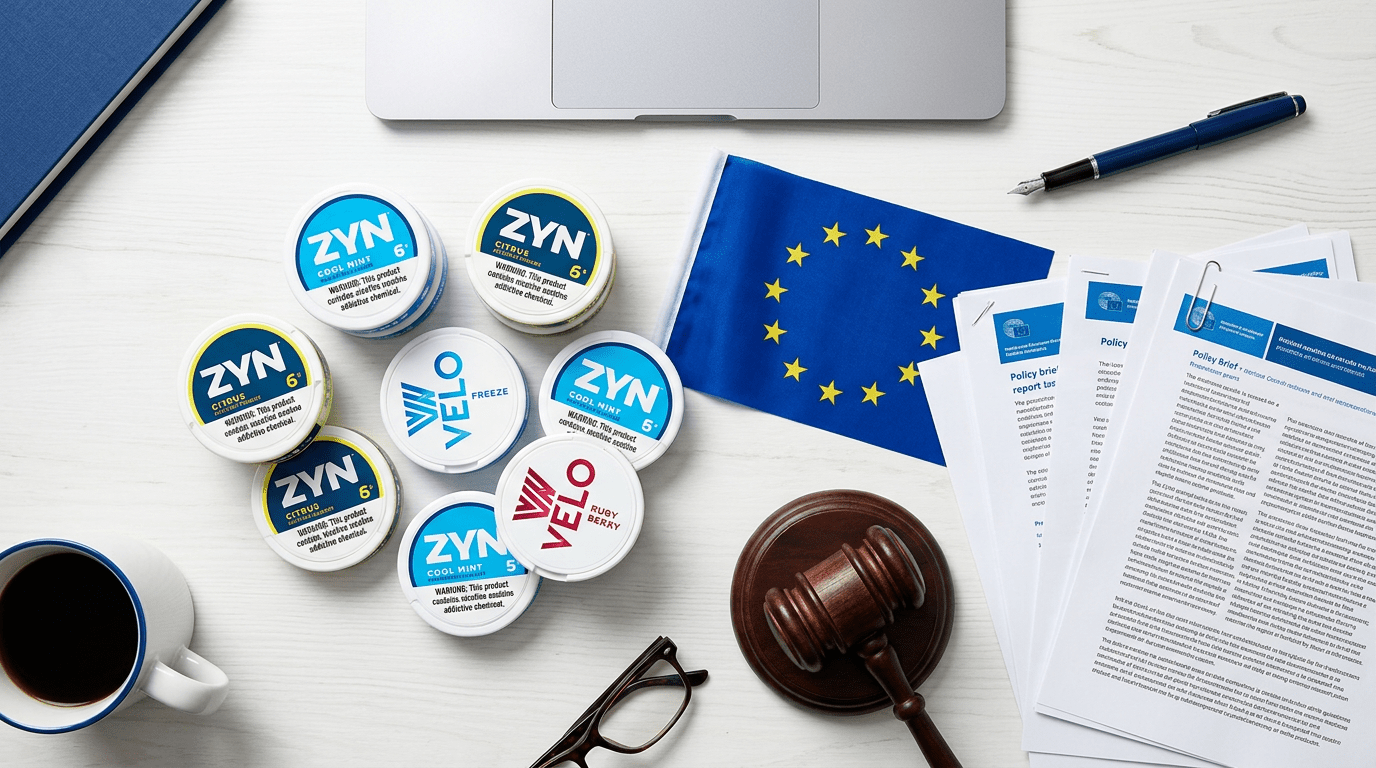
- The EU's third revision of the Tobacco Products Directive (TPD3) will bring nicotine pouches under formal EU-wide regulation for the first time — but a full draft is not expected until mid-2026, with full implementation unlikely before 2028.
- France banned nicotine pouch sales in April 2026, though a court has partially suspended the decree pending a June 2026 ruling on manufacturing and export.
- Poland is preparing legislation to ban flavoured pouches, and Spain is considering a 0.99mg cap that would effectively ban standard products.
- Markets where pouches remain openly available: Sweden, UK, Italy, Germany (personal import), Switzerland, Denmark (with restrictions).
- For consumers in open markets like these, the practical impact of TPD3 won't arrive until 2028 at the earliest — but watching which direction national rules move is important right now.
The European nicotine pouch regulatory landscape is moving faster in 2026 than at any point since the products entered mainstream markets. France has moved to ban them outright. Poland is drafting restrictions. Spain is considering a cap so low it would functionally ban all standard products. And at the EU level, the long-awaited TPD3 framework — which will set the rules across all member states — is finally approaching a concrete draft. Here's everything you need to know.
For buyers in open markets, browse our full best nicotine pouches for 2026 selection — shipping from Stockholm with free EU delivery on orders over €99.
What Is TPD3 and Why Does It Matter for Nicotine Pouches?
The EU's Tobacco Products Directive (TPD) is the primary EU-level legal framework governing cigarettes, e-cigarettes, heated tobacco, and related nicotine products. The current version, TPD2, was adopted in 2014 and has been transposed into national law across all EU member states. The critical issue: nicotine pouches did not exist at commercial scale when TPD2 was drafted. They are not covered by it.
This has created a regulatory patchwork — the same product faces completely different legal treatment depending on which EU country you're in. The third revision, TPD3, aims to fix this by bringing tobacco-free nicotine pouches formally within scope and setting EU-wide standards that all member states must implement. According to the European Parliament legislative tracker, the Commission's work programme includes the TPD revision as an active file, with a formal draft proposal expected in mid-2026.
Even when the draft is published, the legislative process takes 12–24 months to pass, followed by a two-year national transposition period. The realistic timeline for TPD3 to come into full effect is around 2028 at the earliest. For now, national rules remain the only rules that matter — and those are changing fast.
What TPD3 Is Expected to Include
Based on Commission consultation documents, EU Parliament positions, and policy discussions as of 2026, the most likely elements of a TPD3 framework for nicotine pouches include:
- Formal product definition — tobacco-free oral nicotine products will have a legal category for the first time
- Maximum nicotine content per pouch — proposals in circulation suggest a 20–30mg cap; products above this threshold (Pablo 50mg, Cuba Ninja 66mg) would not be permitted
- Flavour restrictions — fruit, sweet, and dessert flavours are under the most pressure; a phased restriction similar to the 2020 menthol cigarette ban is widely discussed
- Standardised health warnings and labelling — minimum font size, nicotine content disclosure, and health warnings on all packaging
- Age verification requirements — harmonised 18+ minimum across all member states
- Track-and-trace systems — anti-counterfeiting measures similar to those applied to cigarettes
No ban on pouches themselves is being proposed at the EU level. The direction is toward regulation, not prohibition. The European Commission's tobacco products page describes the revision as aimed at ensuring that all nicotine-delivery products are subject to "consistent public health protections" — harm reduction-compatible language that supports continued adult access under a structured framework.
France: Banned Since April 2026 — With a Legal Twist
France is the highest-profile market closure of 2026. A government decree published in September 2025 banned the manufacture, sale, and import of nicotine pouches effective April 2026. The ban is based on the French Public Health Code's prohibition on products intended for oral use that release nicotine without containing tobacco — a classification France applied specifically to pouches.
However, the story has a twist. A domestic nicotine pouch manufacturer challenged the decree before France's Council of State. In early 2026, the Council suspended the manufacturing and export elements of the decree pending a final ruling expected in June 2026. The marketing prohibition remains in full effect. For practical purposes: nicotine pouches cannot be sold in France, and online delivery from EU retailers into France carries meaningful legal risk for the buyer. This is a market to avoid until the June ruling clarifies the situation.
Poland: Flavour Ban Legislation in Preparation
Poland is one of the larger Central European markets for nicotine pouches, but that access may be narrowing. The Polish government is preparing legislation that would ban flavoured nicotine pouches, targeting the fruit, sweet, and dessert flavour profiles that represent the majority of the European pouch market. As of mid-2026, the legislation has not passed, and the timeline for its enactment is unclear. But the direction of travel is explicit — Polish authorities have publicly stated their intent to restrict the flavour range available to consumers.
Our Poland nicotine pouches collection is still available for personal import while the legal framework remains open. Watch this space.
Spain: The 0.99mg Cap That Would End the Market
Spain has proposed a nicotine cap of 0.99mg per pouch. To put that in context: ZYN's lightest variant contains 3mg. A 0.99mg cap would not regulate the nicotine pouch market in Spain — it would eliminate it. No commercially available product from any mainstream brand comes close to that threshold. As of mid-2026, this is still a proposal, and implementation timelines are undefined. But if enacted as drafted, Spain would effectively move into the same category as Belgium and the Netherlands in terms of market access.
UK: The Tobacco and Vapes Bill Advances
The UK — operating independently from the EU since 2020 — is progressing its own framework through the Tobacco and Vapes Bill, which was advancing through Parliament in early 2026. The bill proposes age-of-sale restrictions with clearer enforcement, advertising and promotion limitations, and powers allowing ministers to introduce future rules on nicotine content, flavours, and packaging without requiring separate primary legislation. Crucially, no ban on nicotine pouches is proposed. The bill brings them into a structured framework, not out of the market. The UK remains a strong open market for adult buyers.
Where Nicotine Pouches Stand Across Europe in Mid-2026
| Country | Current Status | Change Coming? |
|---|---|---|
| Sweden | Legal, widely available, taxed | No major change expected — model market |
| UK | Legal, widely available | Tobacco & Vapes Bill: more structure, no ban |
| Italy | Legal (Law 15/2022), excise tax applied | Stable — no restrictions announced |
| Germany | Grey area, personal import OK | Reclassification debate ongoing |
| Switzerland | Legal (framework since Oct 2024) | Stable |
| Denmark | Legal, restricted (9mg cap, tobacco/menthol only) | Framework in place since April 2026 |
| Austria | Legal, moving to tobacco monopoly system 2026 | Online sales may face new restrictions |
| Portugal | Legal, new excise tax from 2026 | Stable — regulatory formalisation |
| Poland | Currently open | Flavour ban legislation in preparation |
| Spain | Currently open | 0.99mg cap proposed — would be effective ban |
| France | Banned (marketing prohibition in effect) | Court ruling expected June 2026 |
| Belgium / Netherlands | Banned | No change expected |
What the Swedish Success Story Means for EU Policy
One of the most significant data points in the EU policy debate is Sweden's achievement: in 2025, Sweden became the first EU country to fall below 5% daily smoking prevalence — the WHO's definition of a smoke-free society. Nicotine pouches, alongside traditional snus, played a direct role in that transition. Sweden's harm-reduction model — regulating smokeless products rather than banning them — is now being cited by industry groups and some public health researchers as evidence that access to regulated alternatives reduces combustible tobacco use at the population level. According to WHO data on tobacco harm reduction, eliminating combustion is the single largest driver of health benefit in tobacco harm reduction strategies.
Frequently Asked Questions
Will TPD3 ban nicotine pouches across the EU?
No evidence suggests an outright ban is the intended outcome. EU policy documents consistently frame TPD3 as a harmonisation and standards-setting exercise — bringing pouches within scope with age limits, labelling, and content standards, not prohibiting them. The most likely model is a regulated adult-access framework, similar to how cigarettes are governed, not an outright ban.
When will TPD3 actually take effect?
A formal Commission draft is expected mid-2026. Legislative passage typically takes 12–24 months after that. Member states then have two years to transpose the directive into national law. Realistically, TPD3's rules will not come into full effect before 2028, and some provisions could have phased implementation timelines beyond that.
Can I still buy nicotine pouches online if I live in Europe?
It depends on your country. Sweden, UK, Italy, Switzerland, Germany (personal import), Portugal, and Denmark (restricted range) are all open for adult buyers as of mid-2026. France, Belgium, and the Netherlands are effectively closed. Poland and Spain are open for now but have restrictions in preparation. For buyers in open markets, The Snus Outlet ships from Stockholm with free EU delivery on orders over €99. Shop our full range at best nicotine pouches 2026.
Will ultra-strong pouches (Pablo 50mg+) be banned by TPD3?
Very likely, if TPD3 adopts a 20–30mg nicotine cap. Current policy documents in circulation from EU consultations consistently reference a 20mg threshold as a benchmark. Products like Pablo Exclusive 50mg and Cuba Ninja 66mg significantly exceed this. If you use these, buying while they remain accessible is a reasonable position — browse our ultra-strong nicotine pouches collection while stock is available.
Are flavoured pouches at risk of being banned in the EU?
Flavour restrictions are among the most actively discussed elements of TPD3. The precedent from the 2020 menthol cigarette ban under TPD2 is frequently cited. Fruit, sweet, and dessert flavours are the most at-risk category. Mint and menthol flavours are generally considered more likely to survive any restriction (as seen in Denmark, which retained menthol while banning others). No flavour ban is in force at the EU level as of mid-2026, but the risk is real for a 2028+ timeframe.
Final Thoughts
The regulatory environment for nicotine pouches in Europe is the most active it has ever been. France has closed, Poland and Spain are moving toward restrictions, and the TPD3 framework that will set EU-wide rules for the first time is approaching its first formal draft. For buyers in open markets — Sweden, Italy, UK, Germany, Switzerland — this is still a fully accessible market with a wide, high-quality product range.
Stock up while the range is at its broadest. Browse everything in stock at The Snus Outlet's 2026 picks, with free EU shipping on orders over €99 and delivery from Stockholm in 2–7 days. If ultra-strong formats or specific fruit flavours matter to you, now is the time to buy — the regulatory direction is clear, even if the timeline isn't.