

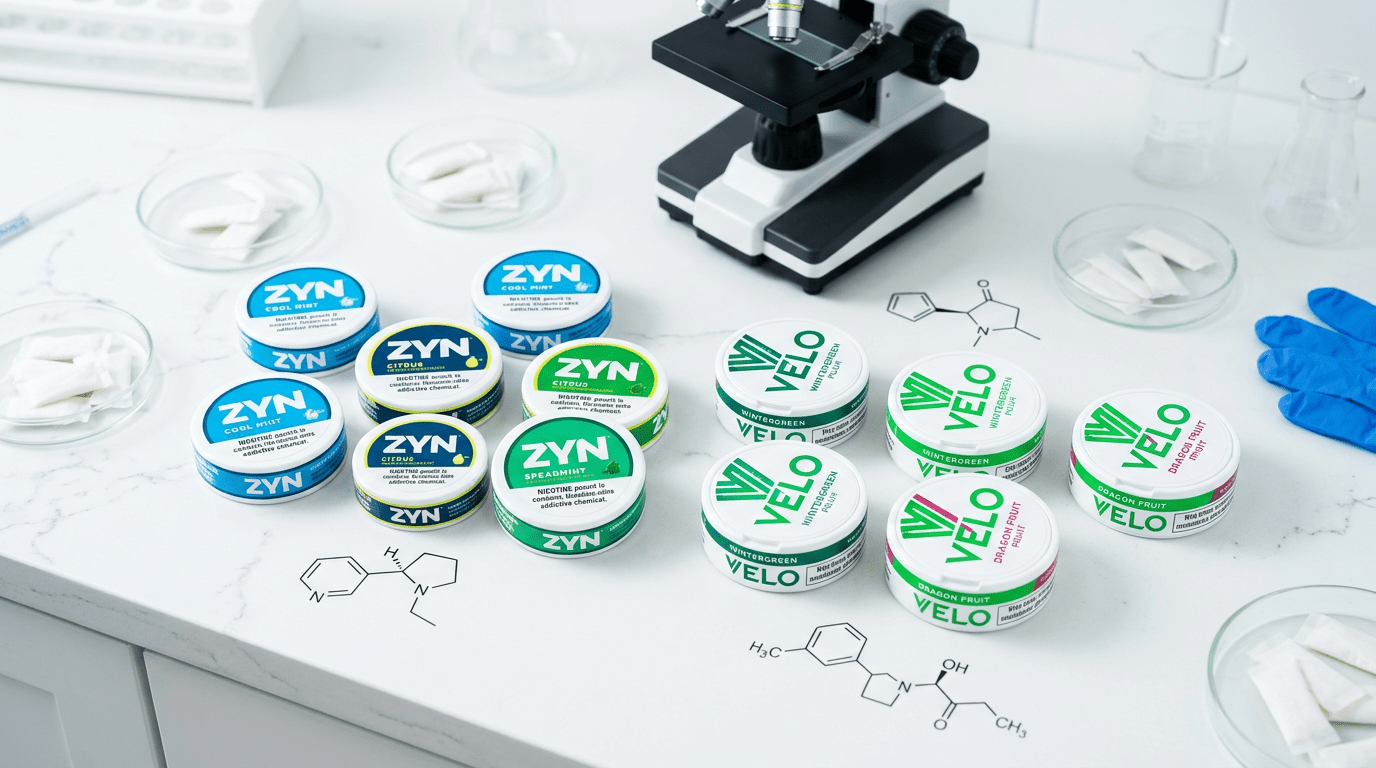
- Nicotine itself is not classified as a carcinogen by major health authorities.
- Nicotine pouches contain no tobacco leaf, which means no tar, no combustion, and dramatically lower levels of tobacco-specific nitrosamines (TSNAs) than cigarettes or snus.
- A BMJ Tobacco Control study found TSNA levels in pouches up to 90x lower than in snus and up to 25x lower than in cigarettes.
- Researchers at Harvard T.H. Chan School of Public Health concluded that ZYN "presents significantly lower health risks than smoking."
- Long-term epidemiological data on pouches is still limited — the honest answer is much lower risk than smoking, but not zero.
If you've been googling "do nicotine pouches cause cancer," you're asking the right question. The short answer: current evidence suggests they carry dramatically lower cancer risk than cigarettes or snus — but the science is still maturing. Here's everything you need to know, explained clearly.
Explore our best nicotine pouches for 2026 — all tobacco-leaf-free, all rigorously sourced from Scandinavian manufacturers.
What Actually Causes Cancer in Tobacco Products?
Before we talk about pouches, it helps to understand what makes traditional tobacco products so dangerous. Cigarettes generate over 70 known carcinogens when tobacco burns — including tar, polycyclic aromatic hydrocarbons (PAHs), formaldehyde, benzene, and acrolein. None of these come from combustion alone; many are baked into the tobacco leaf itself.
The most relevant group for any tobacco-derived product are tobacco-specific nitrosamines (TSNAs) — compounds like NNN (N-nitrosonornicotine) and NNK that form during tobacco curing and processing. TSNAs are classified as Group 1 carcinogens by the International Agency for Research on Cancer (IARC). They're found in snus, chewing tobacco, cigarettes — and in trace amounts, in some nicotine pouches.
Nicotine itself, by contrast, is not on the IARC carcinogen list. It's addictive and has cardiovascular effects, but calling it a direct cancer-causer is scientifically inaccurate.
Do Nicotine Pouches Contain Carcinogens?
This is where it gets nuanced. Nicotine pouches are tobacco-leaf-free — they use pharmaceutical-grade nicotine extracted or synthesised separately. This removes the primary source of TSNAs. But researchers have asked: are there any trace TSNAs remaining from nicotine extraction, or from other manufacturing steps?
A 2024 study published in BMJ Tobacco Control tested a range of nicotine pouches on the market. Key findings:
- TSNAs were detectable in 26 of the tested products — but at trace levels.
- Maximum NNN detected: 13 ng per pouch.
- For comparison: snus averages 1,190 ng NNN per gram and cigarettes deliver 33–323 ng per stick.
- That puts pouches at roughly 25–90x lower TSNA exposure than comparable tobacco products.
The Cleveland Clinic notes that nicotine pouches "aren't considered to be carcinogens" precisely because they contain no tobacco leaves — the root source of most dangerous nitrosamines.
What Does Harvard Say About Nicotine Pouches and Cancer?
Researchers at Harvard T.H. Chan School of Public Health have weighed in directly. Professor Vaughan Rees stated that ZYN "presents significantly lower health risks than smoking, because it does not contain cancer-causing chemicals."
That's a meaningful endorsement from one of the world's top public health institutions. It doesn't mean pouches are risk-free — but it draws a clear line between the risk profiles of pouches and combustible tobacco.
The No-Combustion Advantage
One of the biggest reasons pouches are considered lower risk than cigarettes is simple: there is no burning. Combustion is the single biggest generator of carcinogens in tobacco use. When tobacco burns, it creates:
- Tar (a cocktail of hundreds of chemicals)
- Polycyclic aromatic hydrocarbons (PAHs)
- Carbon monoxide
- Formaldehyde (from burning)
- Benzene and acrolein
Pouches produce none of these. The nicotine is absorbed through the gum membrane, not inhaled. This is why health researchers consistently classify pouches as substantially less harmful than cigarettes — even when they can't yet say "completely safe."
Pouches vs. Snus: How Do They Compare on Cancer Risk?
| Factor | Nicotine Pouches | Snus (Swedish) | Cigarettes |
|---|---|---|---|
| Contains tobacco leaf | No | Yes | Yes |
| Combustion | No | No | Yes |
| TSNAs present | Trace (max 13 ng NNN) | High (1,190+ ng NNN/g) | High (33–323 ng NNN) |
| Tar exposure | None | None | High |
| IARC classification | Not classified | Group 1 carcinogen | Group 1 carcinogen |
| Long-term cancer data | Limited (product is new) | Decades of data | Extensive data |
Snus has decades of epidemiological data — and while it's less risky than cigarettes, it is still classified as a Group 1 carcinogen by IARC due to its tobacco leaf content and TSNA levels. Nicotine pouches, with their trace TSNA levels and tobacco-free formulation, sit in a fundamentally different risk category.
What the Latest 2026 Research Shows
A February 2026 review published in Frontiers in Oral Health (PMC12926464) examined what happens when smokers switch completely to nicotine pouches. The conclusion: switching may substantially reduce exposure to established carcinogens compared to continued smoking.
The caveat researchers consistently flag is that no long-term epidemiological data exists yet for nicotine pouches specifically. The products are simply too new — widespread use only began in the late 2010s. We won't have decades-long outcome data for another 10–20 years. This is the honest scientific position: evidence strongly suggests much lower risk, but we can't yet provide the same certainty we have about cigarettes.
Brands Available at The Snus Outlet: What You're Actually Buying
Every brand we stock at The Snus Outlet is tobacco-leaf-free by design. Here's a quick look at how the major brands compare for those thinking about health profile:
- ZYN — Manufactured by Swedish Match, one of the most studied brands in nicotine pouch research. No tobacco, no combustion additives.
- VELO — BAT's flagship pouch brand, pharmaceutical-grade nicotine, no tobacco leaf content.
- LOOP — Swedish-made with a focus on clean ingredients and long-lasting nicotine delivery.
- ZEUS and XQS — Popular Scandinavian brands, both tobacco-leaf-free with strong flavour focus.
Free EU shipping on orders over €99. Most EU orders arrive in 2–7 days from our Stockholm warehouse.
Frequently Asked Questions
Are nicotine pouches carcinogenic?
Based on current evidence, nicotine pouches are not classified as carcinogens. They contain no tobacco leaf and produce no combustion. TSNAs have been detected in trace amounts in some products, but at levels far below those found in snus or cigarettes. The Cleveland Clinic and Harvard researchers both describe them as carrying significantly lower cancer risk than tobacco products.
Is nicotine itself a carcinogen?
No. Nicotine is not classified as a carcinogen by IARC, the WHO, or major regulatory bodies. It is addictive and has effects on heart rate and blood pressure, but it is not the compound in tobacco that causes cancer — TSNAs, tar, and combustion byproducts are the primary culprits.
Are nicotine pouches safer than snus for cancer risk?
Yes, by all current measures. Snus contains tobacco leaf and is classified as a Group 1 carcinogen by IARC. Nicotine pouches contain no tobacco leaf, and TSNA levels in tested pouches are up to 90x lower than in snus. This is a meaningful difference in risk profile.
Can I use nicotine pouches to reduce my cancer risk if I currently smoke?
Research suggests that switching completely from cigarettes to nicotine pouches substantially reduces exposure to established carcinogens. A 2026 Frontiers in Oral Health review supports this conclusion. The key word is completely — dual use (pouches and cigarettes) does not provide the same risk reduction as a full switch.
Why is long-term cancer data unavailable for nicotine pouches?
Nicotine pouches only gained mainstream traction in the late 2010s. Cancer studies require long-term follow-up of users — typically 10–30 years. That data simply doesn't exist yet. Current assessments are based on chemical composition analysis, toxicological studies, and comparisons to better-studied products like snus and cigarettes.
Final Thoughts
The science on nicotine pouches and cancer is clearer than many people think — and more honest than many marketing claims suggest. Current evidence strongly indicates that pouches carry dramatically lower cancer risk than cigarettes or snus, primarily because they contain no tobacco leaf and produce no combustion. Nicotine itself is not a carcinogen.
That said, long-term outcome data doesn't exist yet. The responsible position is: much safer than smoking based on everything we currently know — not a guaranteed zero-risk product.
If you're switching from cigarettes or snus and want to explore tobacco-leaf-free alternatives, browse our full range of best nicotine pouches for 2026 — with free EU shipping over €99 and delivery from Stockholm in 2–7 days.