

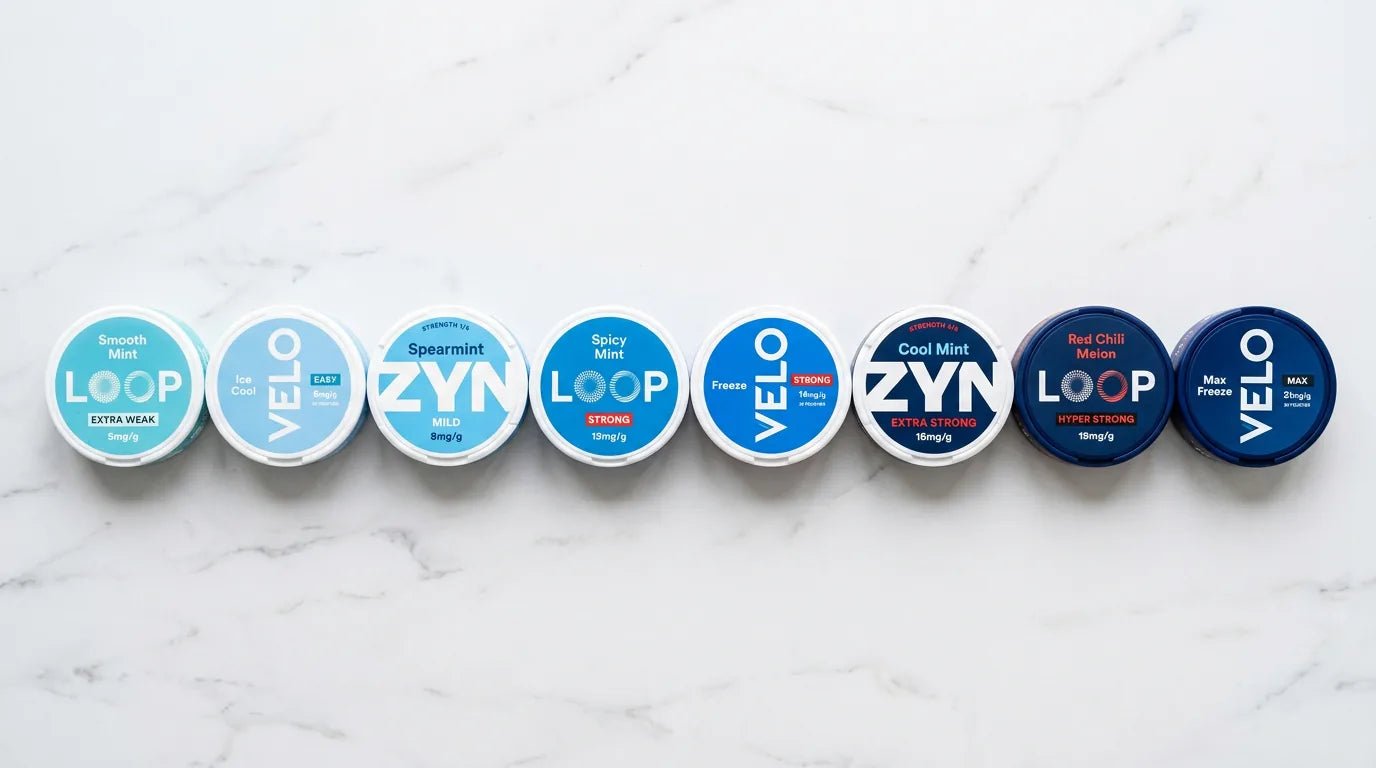
Choosing the right nicotine pouch strength is the single most important decision you'll make as a new or switching user — get it wrong in either direction and the product simply won't work for you. Too low and you'll still get cravings. Too high and you'll feel dizzy, nauseous or uncomfortable. This guide covers every strength tier from 1.5mg to 20mg+, maps them to real user profiles, and shows you exactly which brands hit each level — so you can make the right call on your first try.
Key Takeaways
- Nicotine pouch strength is measured in mg per pouch — this tells you how much nicotine is in each individual pouch, not the whole can.
- The EU mainstream range runs from 1.5mg (very light) to 20mg (ultra-strong), with ultra-strong niche brands reaching 50mg+.
- Beginners and light smokers should start at 3–6mg. Former pack-a-day smokers typically need 9–13mg to feel satisfied.
- Starting too strong is the most common mistake — nausea and headache are the immediate signals you're above your tolerance.
- You can always move up. Starting low and adjusting after 5–7 days is far better than starting high and having a bad experience.
What the mg Number Actually Means
Every nicotine pouch can shows a mg figure — this is the milligrams of nicotine per individual pouch, not per can. A can of ZYN 6mg containing 20 pouches holds a total of 120mg across the can, but each pouch delivers 6mg. This is what you're comparing when you look at strength.
Some European brands (particularly Scandinavian ones) list strength as mg/g (milligrams per gram of weight) rather than mg per pouch. To convert: multiply the mg/g figure by the pouch weight in grams. A 13mg/g pouch weighing 0.7g delivers approximately 9.1mg per pouch. Where possible, compare mg-per-pouch figures directly.
One more thing worth knowing: a 3–4mg nicotine pouch delivers roughly the same amount of absorbed nicotine as a light smoker gets from a single cigarette, according to data from the NHS Nicotine Replacement Therapy guidance. This makes the 3–6mg range the natural starting point for most switching smokers.
The Five Strength Tiers Explained
European retailers and brands broadly agree on five categories, though the exact mg boundaries vary slightly between companies. Here is the standard framework used across the EU in 2026.
| Tier | Strength Range | Best For | Expected Feel |
|---|---|---|---|
| Low | 1–4mg per pouch | Beginners, never-users, step-down users | Mild, gentle buzz. Almost no tingle. Easy to tolerate. |
| Normal / Regular | 4–6mg per pouch | Light-to-moderate smokers, daily vape users | Noticeable nicotine satisfaction. Slight gum tingle. |
| Strong | 6–13mg per pouch | Regular smokers (10–20/day), experienced pouch users | Clear, fast nicotine effect. Stronger gum tingle. |
| Extra Strong | 13–20mg per pouch | Heavy smokers, high-tolerance users, hookah/dip users | Intense, rapid onset. Strong tingling. Not for beginners. |
| Ultra Strong | 20mg+ per pouch | Very high-tolerance users, former heavy chewing tobacco users | Extremely intense. Can cause dizziness in non-tolerant users. |
Which Strength Should You Start With?
Your starting strength depends almost entirely on your existing nicotine history. Do not let marketing language about "normal" or "regular" influence your choice — those labels refer to averages across the user base, not to what is normal for you specifically.
| Your Background | Recommended Starting Strength | Why |
|---|---|---|
| Never used nicotine before | 1.5–3mg | Even 3mg can feel intense on a completely clean system. Start at the absolute bottom. |
| Casual or social smoker (under 5/day) | 3–4mg | Matches light daily absorption. Start here and reassess after one week. |
| Light daily smoker (5–10/day) | 4–6mg | This tier covers average EU smoker nicotine intake from a half-pack habit. |
| Moderate smoker (10–20/day) | 6–9mg | A pack-a-day habit typically calls for a strong-tier pouch to avoid cravings. |
| Heavy smoker (20+/day or two packs) | 9–13mg | High tolerance built over years requires a proportional strength level. |
| Experienced vape user (high nicotine e-liquid, 20mg+) | 6–11mg | Vaping delivers nicotine faster than pouches — a slight downward adjustment is usually right. |
| Current snus or dip user | 11–16mg | Snus and dip deliver high nicotine levels. Match or come close to your current product. |
| Stepping down from a higher-strength pouch | One tier below current | Drop one level at a time, spending at least 7 days at each tier before stepping down again. |
If you're genuinely unsure where to start, 6mg is the most common "middle ground" for new EU pouch users. It satisfies most daily smoker cravings without overwhelming those with moderate tolerance. The beginner-friendly range at The Snus Outlet is a good starting point to browse options in the 3–6mg zone.
Which Brands Cover Which Strength Levels?
Not all brands cover the full spectrum. Here's how the main brands in the European market map to the strength tiers — useful if you already have a flavour preference and want to find the right strength within that brand.
| Brand | Low (1–4mg) | Normal (4–6mg) | Strong (6–13mg) | Extra Strong (13–20mg) |
|---|---|---|---|---|
| ZYN | 1.5mg, 3mg | 6mg | 9mg, 11mg, 13.5mg | 16.5mg Max |
| VELO | 4mg | 4–6mg | 10–11mg | 17mg Mighty |
| LOOP | 5mg | 5–8mg | 12–16mg | 20mg Hyper Strong |
| XQS | 4mg | 4–8mg | 10–14mg | 20mg |
| ZEUS | 4mg | 4–6mg | 8–12mg | 16–20mg+ |
| KUMA | 3–4mg | 6mg | 8–12mg | 16mg |
| C.R.E.A.M | — | 5mg | 10–15mg | 20mg |
| Pablo | — | — | 16mg | 25–50mg (ultra-strong niche) |
For beginners, ZYN and KUMA offer the most accessible entry points — ZYN's 1.5mg Mini is the lightest mainstream option on the market. For high-tolerance users who need more, LOOP 20mg and ZEUS cover the upper end without going into ultra-strong territory. You can browse the full strength range in the strongest nicotine pouches collection at The Snus Outlet.
Warning Signs You Are at the Wrong Strength
Your body gives clear feedback within the first few uses. Knowing what to look for saves you from weeks of an unsatisfying experience in either direction.
Signs your strength is too high
- Dizziness or light-headedness within 5 minutes of placing a pouch
- Nausea or stomach discomfort, especially on an empty stomach
- Headache that starts 10–15 minutes into use
- Rapid heartbeat or feeling jittery and anxious
- An overwhelming gum tingle that is genuinely uncomfortable rather than pleasant
Signs your strength is too low
- No noticeable nicotine effect even after 15–20 minutes
- Persistent cravings immediately after removing the pouch
- Needing to use two or more pouches in a row to feel satisfied
- Returning to cigarettes or other nicotine products within the same session
If you experience too-high symptoms, remove the pouch immediately and rinse your mouth with water. The effects pass quickly — nicotine from a pouch does not stay in your system for long once removed. Drop one strength tier on your next purchase.
How to Adjust Your Strength Over Time
Nicotine tolerance builds quickly and also fades quickly. The practical approach is to spend at least 7 full days at any new strength before deciding to move. A single bad experience on day one is not reliable data — your body needs time to calibrate.
If you're stepping up because the current level isn't satisfying cravings: move up by one tier, not two. Going from 6mg to 9mg is a manageable step. Going from 6mg to 13mg in one jump risks a repeat of the too-high symptoms.
If you're stepping down to reduce nicotine intake: the same one-tier-at-a-time rule applies. A well-documented approach from quit-smoking research is to stay at each step for two to four weeks before moving down again. Rushing the step-down is the most common reason it fails.
Our ZYN strength guide shows how one brand's full range — from 1.5mg to 16.5mg — maps to each tier if you want to see the full ladder in action for a single brand.
Frequently Asked Questions
Can I use a high-strength pouch occasionally even if I normally use low strength?
Yes, but understand the risk. If your regular strength is 4mg and you use a 16mg pouch, the nicotine dose is four times your normal intake. You are very likely to experience dizziness or nausea. Occasional high-strength use is not inherently dangerous for a healthy adult, but it is almost guaranteed to be uncomfortable if you have not built the tolerance. Stick within one tier above your normal strength for unplanned changes.
Is 6mg strong for a first-time pouch user who smokes occasionally?
For a social or very occasional smoker, 6mg can feel noticeably strong in the first session — especially if the pouch is a Slim format (which tends to deliver more intensely than a Mini). Starting at 3mg is the safer choice. If 3mg feels underwhelming after a week, step up to 6mg. Most occasional smokers settle comfortably at 6mg after a brief adjustment period.
Why does the same mg feel different across brands?
Several factors affect how a 6mg pouch feels compared to another brand's 6mg. Pouch moisture affects release speed — wetter pouches release nicotine faster and feel more intense initially. Pouch size matters: a Slim pouch has more contact area than a Mini, increasing absorption rate. The pH adjusters in the pouch formulation also influence how quickly nicotine crosses the oral mucosa. Brand claims of "6mg" can therefore produce noticeably different experiences in practice.
What is the maximum strength that is considered safe for daily use?
There is no universally defined "safe maximum" for daily nicotine pouch use because tolerance, body weight, age and health status all vary between individuals. Most mainstream brands cap their EU range at 16–20mg per pouch as a practical limit for daily users. Strengths above 20mg (Pablo, Siberia, CUBA Black) are marketed as niche ultra-strong products and carry higher risk of adverse effects for users without very high pre-existing tolerance. If you are unsure whether a product is right for your health situation, consult your GP.
Final Thoughts
Getting your nicotine pouch strength right is a one-time calibration process — once you find your level, the rest is just picking your favourite flavour. Start at the bottom of your estimated range, give it a week, and adjust from there. You're far more likely to get it right on the second try than to wish you'd started lower.
The full strength range — from ZYN 1.5mg Mini through to LOOP 20mg Hyper Strong — is stocked at The Snus Outlet, with free EU delivery on orders over €99. Browse the beginner-friendly range or jump straight to the strongest options depending on where you sit on the scale.