
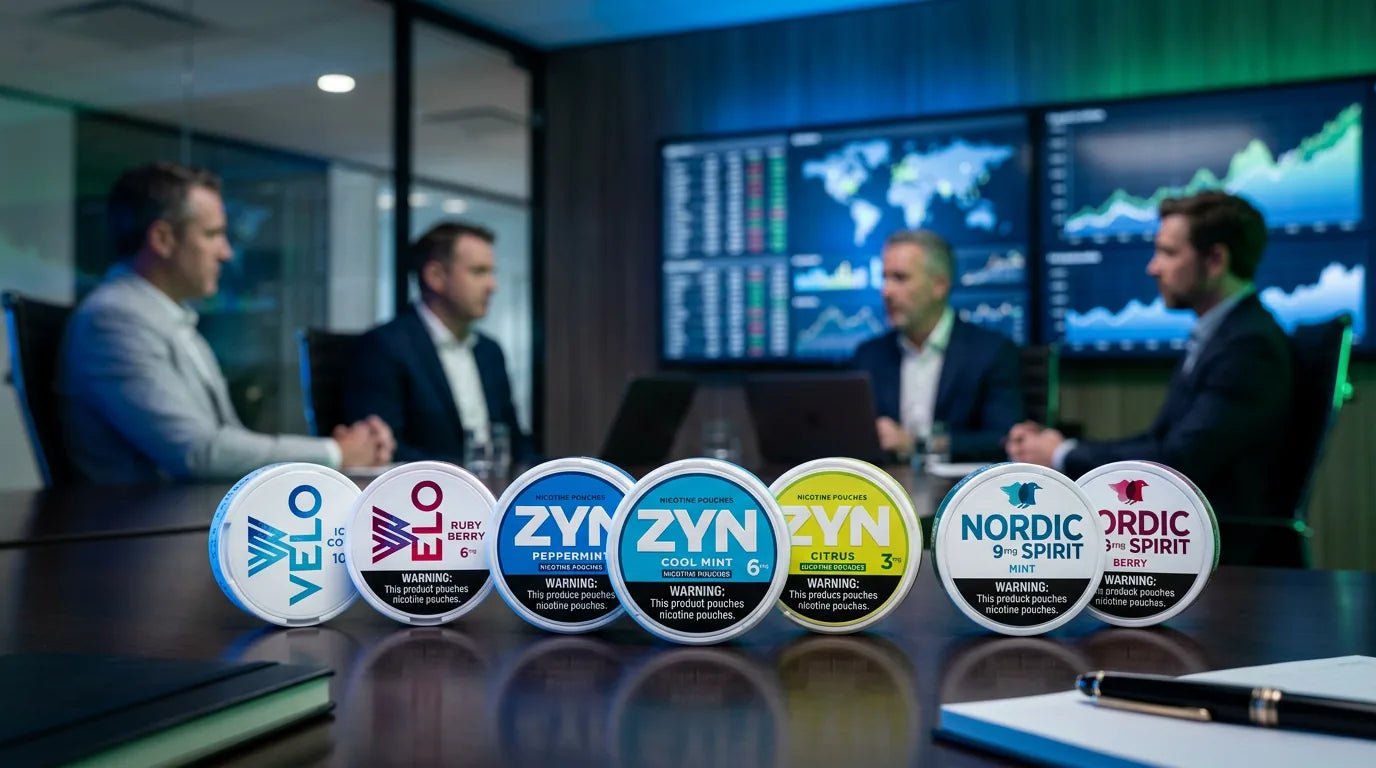
Big tobacco's nicotine pouch pivot is no longer a strategy on paper — it is the industry's operating reality in 2026. Philip Morris International (PMI), British American Tobacco (BAT) and Japan Tobacco International (JTI) have collectively committed billions to building tobacco-free oral nicotine businesses, with ZYN, VELO and Nordic Spirit as their flagship products. Here is what that strategic shift actually means, how it is playing out this year, and what European buyers can expect as corporate competition drives better products and prices across the category.
Key Takeaways
- PMI acquired Swedish Match for ~$16 billion in 2022 specifically to own ZYN, a tobacco-free pouch brand that holds approximately 70% of the US nicotine pouch market
- BAT's VELO is the European market leader with close to six times the volume share of its nearest competitor, and expects global pouch industry revenue to nearly triple by 2030
- JTI's Nordic Spirit is the established third player, built methodically across the UK and Scandinavian markets since 2019
- Nicotine pouch gross margins are three times higher than cigarettes — the financial logic driving every major tobacco company into this category
- More corporate competition means more range, faster innovation, and downward price pressure for EU buyers
The Scale of the Pivot: Why Big Tobacco Went All-In
The numbers explain the decision clearly. Market research by HDin Research estimates the combined US and European oral nicotine market at between $9 billion and $15 billion by the end of 2026, with a projected compound annual growth rate (CAGR) of 7.5–14.5% through 2031. This is one of the fastest-growing legal consumer product categories in the world.
BAT's February 2026 CAGNY investor presentation goes further: the company forecasts nicotine pouch industry revenue to nearly triple by 2030. It also disclosed that nicotine pouches carry a gross profit per unit three times higher than combustibles, with a 40% category contribution margin and the fastest payback period of any product in BAT's portfolio — just 12 months after launch.
These figures put real pressure on tobacco executive strategy. Cigarette volumes are declining globally. Pouch volumes are growing fast. The pivot is not speculative — the category economics are already confirmed.
Browse the best nicotine pouches available in Europe for 2026 at The Snus Outlet, stocked directly from the brands driving this transformation.
PMI and ZYN: How a $16 Billion Bet on Swedish Match Played Out
PMI's commitment to tobacco-free products is anchored in one deal: the $16 billion acquisition of Swedish Match in 2022. Swedish Match's most valuable asset was ZYN — a tobacco-free nicotine pouch launched in the US market in 2014 and now the dominant brand in the category, holding approximately 70% of the US nicotine pouch market share.
For 2026, PMI's "Execution 2026" strategy focuses on two parallel tracks: expanding ZYN internationally and managing regulatory complexity in the US. Q4 2025 showed US nicotine pouch volumes up 19% quarter-on-quarter. Q1 2026 brought a complication: US ZYN shipments fell 23.5%, which PMI attributed to distributor inventory adjustments rather than demand erosion. PMI also trimmed its full-year EPS guidance to $8.36–$8.51, citing regulatory uncertainty and rising competition from VELO.
Despite the US friction, PMI's structural position is intact. The company has committed $1 billion in US manufacturing capacity for ZYN, coming fully online in 2026 — ending the supply shortages that constrained growth in 2023 and 2024. Internationally, ZYN's rollout across Europe and Asia-Pacific is the clean growth story, and European buyers are seeing an expanding ZYN range as a direct result. Smoke-free products now account for over 41% of PMI's total net revenues, against total revenues exceeding $40 billion in 2025.
BAT and VELO: European Leader, Targeting Global Dominance
If ZYN owns the US, VELO owns Europe. BAT's nicotine pouch brand holds close to six times the volume share of its nearest European competitor, per BAT's own 2026 CAGNY investor documentation. That figure reflects VELO's early-mover advantage in Scandinavia and Western Europe, built on consistent distribution and a broad product range that spans 4 mg through 11 mg across multiple flavour profiles.
BAT's corporate ambition is direct: it intends to be a "predominantly smokeless business by 2035." The company has VELO distributed across 140 markets and reaching 11 million retail outlets globally. In 2026, VELO Plus — described by BAT as the fastest-growing product within the nicotine pouch range — is receiving the bulk of commercial investment. BAT expects VELO to outpace even the rapid growth of the broader category through to 2030.
The full VELO range at The Snus Outlet covers the brand's European portfolio: VELO 4 mg through 10 mg in Freeze, Berry Frost, Mighty Peppermint and beyond. For a category where BAT holds dominant European share, the breadth of the range reflects genuine R&D investment rather than just marketing spend.
According to BAT's February 2026 CAGNY investor presentation, senior US public health officials have recognised the reduced-risk potential of the nicotine pouch category relative to combustibles. The FDA also launched a pilot programme in September 2025 to accelerate its PMTA review process for nicotine pouches — a regulatory signal with significant long-term implications for market legitimacy.
JTI and Nordic Spirit: The Steady Third Player
Japan Tobacco International is the world's third-largest tobacco company — parent of Winston, Camel (outside the US), Benson & Hedges and Silk Cut. In the nicotine pouch market, their flagship product is Nordic Spirit, launched in 2019 with a deliberate focus on the UK and Scandinavian markets before expanding further.
Nordic Spirit has not generated the same press volume as ZYN or VELO, but it has built a consistent and credible position in its target markets. In the UK, where VELO and ZYN compete most directly, Nordic Spirit holds meaningful shelf presence — particularly strong in convenience retail. The format is slim, strengths run from 6 mg to 9.6 mg, and the flavour range focuses on Spearmint, Elderflower, Bergamot and Mint.
JTI's approach to the category is methodical rather than aggressive. Unlike PMI's structural acquisition or BAT's explicit 2035 smokeless target, JTI has expanded Nordic Spirit market-by-market without the same investor theatre. The brand serves as a credible third option — particularly where ZYN supply is constrained or VELO's dominance creates demand for alternatives.
What the Big Tobacco Pivot Means for EU Pouch Buyers
For buyers, the corporate arms race has straightforward consequences: more range, more competition on price, and faster product development across the board.
When three of the largest consumer goods companies globally are investing heavily in the same category, the result is an accelerating innovation cycle. Format improvements — drier pouches, longer-lasting flavour, better fit — are driven by competition. Price pressure between VELO and ZYN at the premium tier creates downward pricing pressure across the whole category, benefiting independent brands like LOOP, ZEUS and XQS that operate alongside them.
EU distribution is also improving structurally. If BAT's projection of industry revenue nearly tripling by 2030 is directionally correct, the investment in EU logistics infrastructure to support that growth follows directly. ZYN's $1 billion US manufacturing build-out eliminates supply bottlenecks. Both trends mean more consistent stock, broader SKU availability and faster access for European buyers.
The Regulatory Wildcard: France, TPD3 and the EU Patchwork
The big tobacco pivot is playing out into a market with significant regulatory turbulence. In April 2026, France enacted a court-ordered ban on nicotine pouches — one of the most consequential single-market losses in the category's EU expansion. The Netherlands had already implemented a full ban effective January 2025. These are not peripheral markets.
At the EU level, the revision of the Tobacco Products Directive (TPD3) is expected to produce a standardised regulatory framework for nicotine pouches — but the timeline is uncertain, and individual member states continue to act unilaterally in the interim. Several other markets including Denmark and Spain are actively reviewing their regulatory positions in 2026.
This patchwork is why BAT and PMI's lobbying capacity matters as much as their manufacturing scale. Their ability to shape unified EU regulation will determine whether the European market reaches the growth projections investors are pricing in. For buyers in markets where pouches remain legal and accessible, the outlook is stable — and the range on offer is better than it has ever been.
For context on how Sweden led the shift away from combustible tobacco, see why Sweden's smoke-free milestone matters for nicotine pouches across Europe.
FAQ: Big Tobacco and Nicotine Pouches in 2026
Who makes ZYN nicotine pouches?
ZYN is produced by Swedish Match, which was acquired by Philip Morris International (PMI) in 2022 for approximately $16 billion. Swedish Match continues to manufacture ZYN as a PMI subsidiary, with production in both Sweden and the United States. The brand is the global market leader in the tobacco-free nicotine pouch category by volume.
Who makes VELO nicotine pouches?
VELO is produced by British American Tobacco (BAT). It evolved from BAT's earlier Lyft nicotine pouch line and was relaunched as VELO for global distribution. Production is centred in Sweden. As of 2026, VELO is the European nicotine pouch market leader by volume with a dominant share across the region.
Is Nordic Spirit owned by a tobacco company?
Yes. Nordic Spirit is owned by Japan Tobacco International (JTI), the world's third-largest tobacco company by volume. JTI launched Nordic Spirit in 2019 with an initial focus on the UK and Scandinavian markets. The pouch itself is tobacco-free — it contains pharmaceutical-grade nicotine but no tobacco leaf.
Does being made by a big tobacco company affect the product?
In practical terms, not negatively. ZYN, VELO and Nordic Spirit all use pharmaceutical-grade nicotine and food-grade flavourings. Large-scale manufacturing generally ensures tighter quality consistency than many smaller independent brands. What corporate ownership does affect is distribution reach, regulatory lobbying power and the pace of product innovation — all of which currently favour buyers.
Are there quality nicotine pouches not made by big tobacco?
Yes — and many are excellent. LOOP, ZEUS, XQS, C.R.E.A.M and KUMA all operate independently of PMI, BAT and JTI. LOOP is owned by Habit Factory in Sweden, XQS by XQS International, and ZEUS and KUMA are independent Nordic brands. These independents typically offer more distinctive flavour profiles and sharper value pricing precisely because they are not operating under large corporate pricing structures.
Final Thoughts
The big tobacco pivot to nicotine pouches is structurally complete in 2026. The acquisition deals are done, the manufacturing investments are confirmed, and the category is now a core revenue driver for PMI and BAT with JTI consolidating a third-place position. For European buyers, this means a healthier, better-stocked and increasingly competitive market. Browse the best nicotine pouches for 2026 at The Snus Outlet — from ZYN and VELO to LOOP and ZEUS, with fast EU delivery and free shipping on orders over €99.
Share:
Nicotine Pouches at Concerts: The Live Music Fan's Guide 2026
LOOP Nicotine Pouches Review 2026: Every Flavour and Strength Ranked